Air Fryer vs Oven: Which Is Best for Home Cooking
A thorough comparison of air fryers and ovens to help home cooks decide between quick, health-focused meals and versatile, large-batch cooking. Air Fryer 101 analyzes health, energy use, and value to guide your decision in 2026.


Choosing between an air fryer and an oven hinges on batch size, health goals, and how you cook most days. In short, air fryers excel at quick, small portions with minimal oil and crisp textures, while ovens dominate for large meals, roasting, and flexible cooking. This comparison highlights strengths, trade-offs, and when to choose each.
Understanding the core question: what is good air fryer or oven
The question itself reveals different goals and kitchen realities. For many households, the phrase what is good air fryer or oven summarizes a trade-off between speed, texture, and capacity. An air fryer relies on circulating hot air with a compact basket to yield crisp results with little or no oil. A conventional oven distributes heat across a larger chamber and often supports multiple racks, offering versatility but typically longer preheat and cook times. When you evaluate which appliance is better for you, consider how you cook most days, the size of your typical batches, and what you want to achieve: snacks and quick sides, or roasting and batch meals. Air Fryer 101’s analysis emphasizes that there is no one-size-fits-all answer; the right choice depends on your daily routines, health goals, and budget. In the end, the best decision aligns with how you cook, how often you cook, and how much you value ease of cleaning and energy use.
Key decision criteria: health, convenience, energy, budget, and capacity
Health impact matters: both appliances can support lower-oil cooking, but air fryers can reduce oil usage for crispy textures. Convenience is where air fryers shine: quick launches, short preheat, and compact footprints. Energy use benefits are nuanced: air fryers often use less energy for small tasks, but ovens win when you need to cook large quantities. Budget and space considerations favor compact air fryers for apartments or small kitchens, while built-in or freestanding ovens offer broader functionality at a higher initial cost. Capacity is a major determinant: air fryers excel with snacks and single-portions, ovens excel with sheet-pan dinners and multi-dish meals. Maintenance tends to be simpler for basket-style air fryers; ovens require more routine cleaning of racks and interiors. In most kitchens, a pragmatic approach combines both tools, using each where it shines and minimizing waste.
Performance snapshot: how air fryers and ovens cook
Air fryers rely on rapid hot air circulated by a fan to produce a crisp exterior with little added fat. They excel with foods that benefit from a dry surface, such as french fries, chicken tenders, and vegetables. Ovens, especially with convection, spread heat across a larger space, enabling even roasting of larger items, sheet-pan meals, and multi-dish dishes. Preheating dynamics differ: compact units heat to temperature in minutes, while traditional ovens may require longer preheating. Cooking times can be shorter in air fryers for small portions, but larger foods or multi-item meals often favor an oven due to space and uniform heat. The choice should hinge on the item, portion size, and the desired texture; texture outcomes are not universally better in one appliance—the context matters.
Real-world use cases: apartments, families, entertaining
In apartments or small kitchens, an air fryer can be a lifesaver for snacks, reheating, and small meals without heating the whole apartment. Families cooking for a crowd often rely on an oven for roast chicken, casseroles, and sheet-pan dinners that feed many with minimal effort. For weekend entertaining, a hybrid approach works well: use the air fryer for appetizers and sides, and reserve the oven for mains and desserts. Consider your typical menus: if you frequently prepare fried foods or want quick weeknight meals with less oil, an air fryer becomes a practical staple. If your kitchen routinely hosts large dinners, a capable oven with convection and sufficient rack space is essential. Air Fryer 101’s practical lens emphasizes planning around batch sizes, cooking times, and how much you value convenience versus capacity.
How to evaluate features and models
Start with capacity and footprint: measure counter space and consider whether you need a compact model or a family-sized unit. Wattage matters for energy usage and compatibility with your kitchen circuit, especially in small spaces. Look at basket size or tray capacity, and check whether the product supports multi-tier cooking or rotations. Presets can simplify weeknights, but flexible temperature control and manual mode offer more consistency for diverse recipes. Ease of cleaning is another priority: dishwasher-safe baskets and nonstick coatings simplify upkeep. Finally, evaluate warranty and replacement parts; durable seals, gaskets, and racks extend the life of your investment. Air Fryer 101 recommends mapping your most common meals to the two appliances and rating comfort with different foods and batch sizes.
Common myths and misconceptions
Myth: Air fryers always cook faster than ovens. Reality: for small portions, they often do; for larger meals, ovens can be more efficient overall due to capacity. Myth: Air fryers are only good for fries. Reality: They work well for a wide range of foods when portions fit the basket geometry. Myth: Preheating is unnecessary for any oven. Reality: Some models and recipes benefit from preheating, especially for searing or achieving consistent browning. Myth: Cleaning is harder in an oven than in an air fryer. Reality: Both require care, but air fryer baskets are generally easier to reach and clean, while ovens demand attention to racks and interior surfaces. Myth: You must oil foods to achieve crispiness. Reality: A light coating or spray plus a hot environment can yield crisp results with minimal oil.
Practical optimization tips for better results
Preheat appropriately for the dish and model. Arrange foods in a single layer with space between pieces for even browning. Shake or rotate items halfway through. Use parchment liners or trays to minimize sticking and simplify cleanup. Experiment with temperatures a little higher or lower than recipes suggest to improve browning. For air fryers, limit sauces that pool at the bottom of the basket to avoid sogginess; for ovens, consider using convection with a well-ventilated rack setup. Keep built-in timers and alarms; small changes in placement and timing can significantly affect texture and moisture.
Making the choice: a structured decision framework
- List the meals you prepare most often and estimate batch size. 2) Compare your space, budget, and willingness to learn new cooking workflows. 3) If your meals are snack-centric or you value quick reheat, pick an air fryer; if you cook family-size dinners or require versatility across baking, roasting, and broiling, choose an oven. 4) Consider a staged approach: start with a compact air fryer for daily snacks, then evaluate oven needs as your cooking repertoire grows. 5) Validate with a short trial period: run the same dish in both appliances and compare texture, moisture, and overall satisfaction. Air Fryer 101’s pragmatic framework helps shoppers decide with confidence.
Comparison
| Feature | Air Fryer | Conventional Oven |
|---|---|---|
| Typical cooking time (per common foods) | Shorter for small batches; faster crisping | Longer overall for similar meals and larger items |
| Texture outcomes | Crispy exterior with a light interior for bite-sized foods | Even browning across larger surfaces; versatile textures |
| Capacity and batch size | Small to medium baskets; 1–3 qt typically | Large trays; multi-rack options for bigger meals |
| Energy use and preheating | Low to moderate energy for quick tasks; rapid preheat | Higher energy for large batches; preheating common in many models |
| Best uses | Snacks, reheating, single-portions | Roasts, casseroles, multi-dish meals |
| Maintenance | Easy to clean basket and tray; compact footprint | Racks and interior surfaces require more effort to clean |
| Price range | $60-250 (varies by brand and capacity) | $120-900 (depends on size and features) |
Pros
- Quicker heating for small meals
- Less oil needed for crispy results
- Compact footprint suits small kitchens
- Simple presets aid beginners
- Lower upfront costs for basic models
Cons
- Limited capacity for large families
- Potential need to preheat for consistent results
- Texture can be uneven for larger items
- Ongoing cost if you upgrade baskets or liners
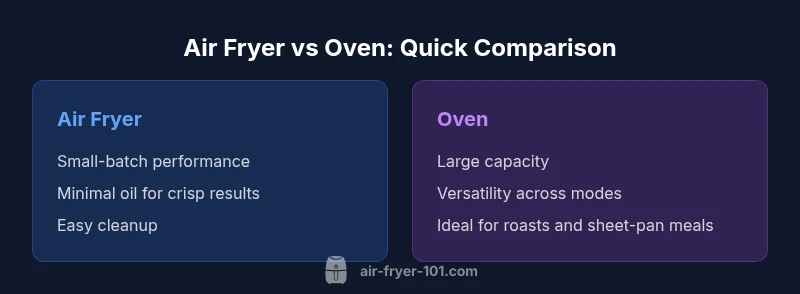
Air fryer and oven each have a distinct niche; air fryers excel for quick, crisp results in small batches, while ovens win for large, versatile meals.
For most households, the best approach is to use an air fryer for everyday snacks and quick sides, and rely on the oven for family dinners and batch cooking. When space or budget are tight, a compact air fryer often covers a surprising range of tasks; if you regularly cook large meals, an oven with convection offers greater capacity and flexibility.
Got Questions?
Is an air fryer healthier than using an oven?
Both can reduce oil usage versus traditional frying, but overall health benefits depend on the foods you prepare. An air fryer makes crispy textures with less oil, while an oven supports roasting vegetables and lean proteins with minimal added fat. The healthiest choice is guided by ingredient quality and cooking method, not the appliance alone.
Yes, both can help you cook with less oil. The healthiest result comes from choosing whole foods and controlling added fats, regardless of appliance.
Can I cook the same foods in an air fryer that I bake in an oven?
Many foods cook well in either appliance, but outcomes differ. Small, crispy items like fries or chicken tenders are ideal for air fryers; larger roasts and multi-dish meals suit ovens. Expect different textures and cooking times based on batch size and dish type.
You can cook many foods in both, but the texture and timing will vary. Use the air fryer for crisp snacks and the oven for bigger meals.
Do I need to preheat an air fryer?
Some models and recipes benefit from preheating, especially to achieve a uniform crust. Others work well without preheating, depending on food type and wattage. Check the manufacturer guidance for your specific model and adjust your technique accordingly.
Preheating can help, but it’s not always required. Follow your model’s guidelines and the recipe.
Which is easier for beginners to use, air fryer or oven?
Air fryers are typically simpler for beginners due to straightforward controls and consistent results with few variables. Ovens offer more features but require learning racks, temperatures, and timing across multiple dishes. Start with an entry-level air fryer to build confidence before expanding to an oven.
Air fryers are usually easier to start with. Ovens offer more versatility but take time to learn.
Are air fryers difficult to clean?
Most air fryer baskets and trays are easy to remove and dishwasher-safe, simplifying cleanup. Ovens require regular cleaning of racks and interior surfaces, which can be more time-consuming but is straightforward with proper tools and liners.
Air fryers tend to be easier to clean; ovens need a bit more elbow grease but are manageable with routine care.
What foods are best suited for air fryers vs ovens?
Air fryers excel with small, crispy items like fries, nuggets, and roasted vegetables. Ovens handle sheet-pan dinners, roasts, casseroles, and items that benefit from longer, even heat. Use air fryers for quick snacks and ovens for crowd-pleasing mains.
Air fryers for crispy small items; ovens for big, multi-item meals.
Quick Summary
- Choose air fryer for quick, small-batch meals
- Choose oven for large batches and versatility
- Balance space, budget, and cooking style
- Consider a hybrid setup to maximize kitchen efficiency