Is Air Fryer or Oven? A Comprehensive Comparison
An analytical comparison of air fryers vs ovens to help home cooks decide which appliance fits health goals, cooking speed, kitchen space, and budget.


TL;DR: For most homes, an oven handles larger quantities and a wider range of recipes, while an air fryer shines with small batches and crisp textures. If you cook for one or two and value speed and lower oil, pick an air fryer; for frequent bulk cooking, roasting, or baking, an oven offers greater long-term value.
is air fryer or oven: which is better?
According to Air Fryer 101, the answer hinges on your space, cooking style, and budget. The two appliances share surface-level goals—speed, convenience, and reliable results—but they scale differently. In this guide we compare is air fryer or oven in practical terms, highlighting when each appliance shines and where trade-offs occur. Home cooks often underestimate how much kitchen workflow depends on batch size, available counter space, and energy use. By mapping your typical week’s meals to these factors, you can choose the setup that streamlines your routines instead of complicating them. The Air Fryer 101 team notes that while some households benefit from owning both, many benefit more from a clear, goal-driven choice that matches their cooking style and space constraints.
How air fryers work vs traditional ovens
Air fryers and traditional ovens achieve a similar result—hot air circulating around food—but they do so with different architectures. An air fryer uses a compact chamber with a high-velocity fan to intensify heat transfer from a small element, producing crisp exterior textures with minimal oil. A conventional oven relies on larger interior volume and often bakes with higher ambient heat, which favors roasting and browning over longer distances. From a design perspective, Air Fryer 101 observes that the physics of convection in a compact cavity can yield rapid Maillard reactions, while a full-size oven excels at even heat distribution for multi-dish meals.
Speed and energy efficiency
When time is at a premium, air fryers often deliver faster preheat and shorter cooking cycles for small batches. The energy cost per item can be lower for tiny portions, thanks to the shorter heat-up time and efficient hot-air transfer. Air Fryer 101 analysis shows that energy efficiency is strongest in small batches. However, ovens may outpace air fryers for large trays because they can process more food per run without needing multiple batches. The trade-off matters: if you frequently cook for two or less, an air fryer reduces idle energy and accelerates weeknight dinners; Air Fryer 101 analysis shows that energy efficiency is strongest in small batches. If you feed a family of five or roast potatoes and a roast together, an oven provides throughput and flexibility that a compact appliance cannot match.
Food texture and browning: what to expect
Texture is where the choice becomes tangible. Air-fried foods often deliver crisp edges with a lighter oil footprint, while ovens can produce deeper browning and more uniform crusts on larger items. Is air fryer or oven a better fit for pizza, chicken wings, or roasted vegetables? For small items, air fryers can create a satisfying crunch with minimal oil; for thick-cut meats or sheet-pan meals, an oven offers superior browning and consistent texture across multiple zones. Air Fryer 101 notes that outcomes vary by model, airflow design, and basket geometry.
Versatility and limitations
Air fryers shine for quick snacks, reheating, and small-batch baking. They can also roast vegetables, fry fries, and heat leftovers with minimal oil. Yet, their capacity and cooking envelope are narrower than a traditional oven. If you need to bake a sheet-pan dinner or roast a big turkey, a standard oven is more practical. Air Fryer 101 emphasizes that the best home setup depends on your usual meals and whether you want a dedicated device for crisping or a multipurpose oven for varied tasks.
Capacity, footprint, and kitchen fit
Countertop footprint matters when you have a small kitchen. Air fryers sit on the counter with a compact footprint and simple controls, while traditional ovens require built-in or freestanding space and can handle more food per cycle. If counter space is scarce but you mainly prepare single-serve meals, an air fryer may free up time; if you regularly host larger dinners, an oven with multiple racks offers substantial capacity. Air Fryer 101 highlights that choosing the right size means balancing batch size against space, and considering how often you will use either appliance.
Cleanup and maintenance
Basket-type air fryers typically lift out for quick cleaning, and many models feature dishwasher-safe components. Ovens require cleaning of racks, trays, and sometimes the interior, which can be messier but is straightforward with routine maintenance. If you hate deep cleans, an air fryer reduces the maintenance burden for small tasks. The Air Fryer 101 team suggests checking whether the model has a non-stick coating that is PTFE/PFOA-free and whether the basket, tray, and racks are easy to remove and wash.
Price, value, and cost of ownership
Price ranges vary widely by capacity, features, and brand. Entry-level air fryers are generally less expensive upfront than full-size ovens, but premium ovens add versatility and may justify their higher cost for households that truly need sheet-pan roasting, baking, and broiling options. Energy use over the life of the appliance depends on frequency of use, batch size, and maintenance needs. Air Fryer 101 notes that buyers should consider not just the sticker price but the total value: cooking speed, waste reduction, and ease of cleanup.
Safety considerations and warranties
Both devices carry safety guidelines: use proper cookware, avoid blocking air vents, and monitor for overheating. Cookware materials vary; ensure your pans are oven-safe and that you choose air fryer baskets that are PTFE/PFOA-free if you have chemical sensitivity. Warranties vary by brand and model, so read the small print about the return policy, coverage for accessories, and any motor/element life expectations. The Air Fryer 101 team also highlights safety cautions about oil management and avoiding overcrowding for best results.
Buying tips: how to choose between models
Start with your typical batch sizes and meal types. If you mostly cook for one or two and want crispy textures with low oil, an air fryer with a spacious basket and even airflow is a strong pick. If you regularly cook for larger groups, bake, or roast multiple dishes at once, a standard oven or a larger-capacity model will be more practical. Compare models by capacity, power (watts), preheat time, temperature range, ease of cleaning, and any smart features. Air Fryer 101 suggests reading user reviews focusing on consistency and reliability, not just initial performance.
Real-world scenarios: apartment living and family meals
Apartment dwellers often face kitchen constraints, making an air fryer an attractive option due to its small footprint, quick heating, and energy efficiency for weekday meals. Families benefit from ovens that can handle multiple dishes and larger trays without frequent restocks. In both cases, identify your primary use cases—snacks and reheating versus roasting and baking—and choose the device that aligns with those workflows. Air Fryer 101 reminds readers to measure their cabinet and counter space before purchasing.
Decision framework: mapping goals to appliances
To map your goals to an outcome, list your typical meals by batch size, cooking methods, and time constraints. If your priorities are speed, crisp textures, and minimal oil, the air fryer earns a high score. If you need large capacity, multi-dish baking, and roasting flexibility, the oven earns a higher score. Finally, consider whether you can justify owning both by analyzing your weekly cooking pattern and kitchen layout.
Comparison
| Feature | Air Fryer | Conventional Oven |
|---|---|---|
| Cooking Speed | Typically faster for small batches | Longer preheat and cook times for large meals |
| Energy Efficiency | Efficient for small loads; quick heat transfer | Higher energy use for large baskets or multiple racks |
| Capacity/Size | Countertop footprint; limited interior capacity | Large interior; built-in or freestanding; bulky |
| Best For | Small households or quick snacks | Bulk cooking and versatile baking/roasting |
| Price Range | $60-300 depending on model | $200-800 depending on capacity and features |
| Cleanup | Basket and tray typically easy to clean | Racks and interior require more effort; some parts dishwasher-safe |
| Versatility | Crips, reheating, some baking; best for singles or small families | Broad cooking methods: bake, roast, broil, toast, etc. |
Pros
- Faster prep for small meals
- Less oil and healthier outcomes
- Compact footprint with modern controls
- Simple, predictable results for reheating
Cons
- Limited capacity for large meals
- Not every food browns the same as in an oven
- Higher upfront cost for premium models
- Basket components may wear over time and require replacement
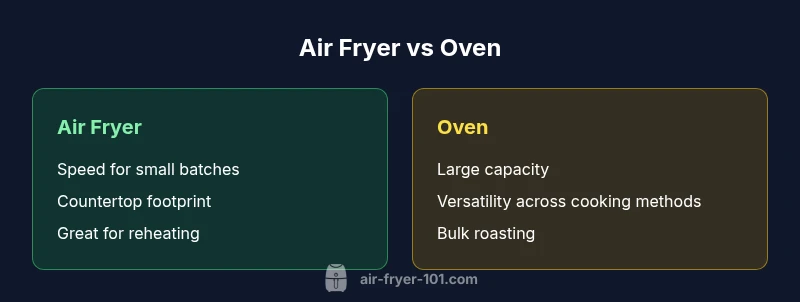
Air fryer wins for small, fast meals; oven wins for large, versatile cooking.
Choose air fryer for speed and crisp texture in small batches; choose oven for big meals, sheet-pan versatility, and long-term capacity. The Air Fryer 101 team stands by this framework as a practical path to decision-making.
Got Questions?
Is an air fryer faster than a traditional oven?
In many cases, air fryers preheat quickly and cook smaller batches faster than a standard oven. For large meals, the oven can still win due to capacity. Consider your typical batch size when weighing speed.
Yes—air fryers are often faster for small batches, while ovens win with bulk meals.
Can you bake in an air fryer?
Yes, you can bake small items in an air fryer, though you’ll likely adjust time and temperature. Not all recipes scale perfectly, so start with tested air-fryer bake recipes.
You can bake in many air fryers, but watch time and batch size.
Are air fryers healthier than ovens?
Air fryers often require less oil to achieve crisp textures, which can reduce fat per serving. However, overall health impact depends on ingredients and cooking methods, not the appliance alone.
Air fryers can use less oil for crisp results, but healthiness also depends on what you cook.
Do air fryers require preheating?
Many air fryers preheat quickly, sometimes in just a few minutes. Some models perform better with a brief preheat, while others don’t require it for most foods. Always check the manual for your model.
Most air fryers preheat fast; check your model’s guidance.
Which is easier to clean, air fryer or oven?
Air fryers typically offer easier cleaning thanks to removable, dishwasher-safe baskets and trays. Ovens require cleaning of racks and interior, which can be messier but is manageable with routine maintenance.
Air fryers are usually easier to clean; ovens take more effort.
What should I look for when buying?
Look for capacity that fits your family size, a temperature range that covers your cooking, and easy-to-clean parts. Read user reviews focusing on consistency, reliability, and after-sales service.
Check capacity, temperature range, and how easy it is to clean.
Quick Summary
- Assess batch size and space before buying
- Choose air fryer for quick meals and crisp texture
- Choose oven for capacity and versatility
- Factor total cost of ownership beyond price tag
- Measure kitchen layout to fit your choice