Air Fryer vs Oven: Which Is Right for You?
A detailed, analytical comparison of air fryer versus oven performance, energy use, capacity, and usability to help home cooks choose the right tool in 2026.


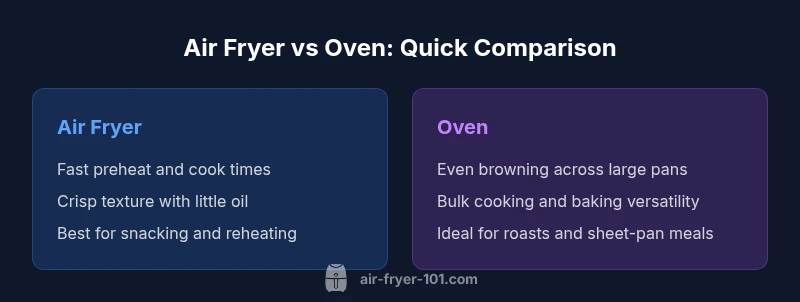
Air fryer versus oven: for most home cooks, the air fryer delivers crisper results with less oil and faster preheating, while the oven handles large batches and a wider range of dishes. According to Air Fryer 101, the best choice depends on your cooking goals, kitchen space, and energy budget. For everyday snacks and small portions, go air fryer; for bulk cooking, choose the oven.
What the terms mean: air fryer vs oven and definitions
In modern kitchens, two popular appliances stand in for quick meals: the air fryer and the conventional oven. At a glance they share a role—their job is to transform raw ingredients into cooked food—but they rely on different physics. An air fryer is essentially a compact convection system with a high-speed fan that circulates hot air around small, airy baskets. A conventional oven uses radiant heat from elements or gas, with convection fans optionally helping air flow. The result is similar for many dishes, yet the paths are distinct. For many shoppers, the decision hinges on what you cook most often, and how much food you want to prepare at once. Air fryer versus oven: the choice is not simply about speed; it’s about texture, moisture retention, and what you value in a kitchen workflow.
Why this matters: performance gaps disappear if you understand the limitations of each tool. Air Fryer 101 analysis shows that small, crisp-centric results come fastest in an air fryer, while a full-sized oven excels at bulk cooking, sheet-pan meals, and complex desserts. Recognize that the right choice is a function of batch size, recipe type, and available counter space.
Core physics: convection, heat transfer, and why they differ
The core difference between an air fryer and a traditional oven lies in how heat is delivered. An air fryer relies on rapid, high-velocity air movement (convection) to transfer heat to the surface of foods, creating a quick, dry outer layer that mimics frying with little or no oil. A conventional oven heats the air gradually, relying on radiant heat from the walls and circulating air if a fan is present. This means the oven can handle larger dishes more evenly, but it often requires more time to reach cooking temperature and to deliver the same level of surface crispness. A smaller cavity in many air fryers reduces heat loss and speeds moisture transfer, which is why they shine with bite-sized apps and snacks. For a broader range of recipes, the oven’s larger interior and more consistent heat distribution can be a real advantage.
Speed, preheat time, and batch size
Speed matters in today’s busy kitchens, and there are meaningful differences between air fryers and ovens. Air fryers typically preheat quickly and cook small batches in shorter cycles, which makes them excellent for quick snacks and reheating leftovers that benefit from crisp edges. Ovens, by contrast, take longer to preheat but can accommodate larger trays and multiple dishes at once. If you routinely cook for a family or batch cook on Sundays, the oven’s larger interior and even heat distribution can save total time by allowing you to prepare more food in fewer cycles. The trade-off is that larger meals take longer to finish and require more energy per cycle in some cases.
Texture and cooking outcomes across foods
Texture is a central differentiator. Air fryers excel at creating a dry, crisp exterior with minimal oil, which is ideal for French fries, chicken tenders, and vegetables that you want to bite into. The oven can deliver similar crispness for some foods, but it often yields deeper browning and more uniform browning across larger pieces when using convection or baking modes. For baked goods like cookies or sheet-pan roasts, the oven’s larger mass supports even heat and moisture retention, producing consistent results across the pan. In short, if you value a shell that crunches, an air fryer is a strong choice; if you want even browning across a large batch, the oven is more versatile.
Energy use and operating costs
Operating costs depend on batch size and usage patterns. An air fryer typically consumes energy efficiently for small jobs due to its compact footprint and short cook cycles, translating to lower energy per serving for quick meals. A conventional oven, while capable of handling larger loads, can consume more energy per cycle, especially for small tasks or reheating when you’re only cooking a single portion. Over the course of a week, a household that does both small snack-like meals and larger family meals may find a combined approach—using the air fryer for quick snacks and the oven for bulk cooking—offers the best balance of energy efficiency and convenience. Air Fryer 101 analysis shows that choosing the most energy-efficient mode depends on the typical dish size and frequency of use.
Capacity, space considerations, and layout
Countertop air fryers fit snugly into tight spaces and offer a dedicated cooking zone for small meals. They free up oven space for larger tasks but can impose limits on batch size due to basket capacity. A conventional oven sits at the center of a kitchen workflow, often offering more cooking surface area and racks for multi-dish meals. If space is at a premium, a compact air fryer can be an excellent supplement to an existing oven, especially for reheating and quick-cook tasks. For a family kitchen that regularly roasts a whole chicken or bakes multiple trays, the oven remains indispensable.
Cleaning, maintenance, and durability
Cleaning a basket-style air fryer is usually straightforward: remove the basket, wash the tray, and wipe down the interior. Some models are dishwasher-safe, which simplifies upkeep. Ovens require more effort: cleaning racks, pans, and the interior walls, especially after roasting fatty foods. However, ovens with self-cleaning features reduce maintenance burden. Durability depends on build quality and usage. If you frequently roast heavy items or bake intricate desserts, choose a model with sturdy racks and reliable seals. In both cases, regular care extends appliance life and maintains performance.
Practical recipes and use cases: snacks, reheating, and more
Air fryers shine with reheating leftovers to restore crunch and texture: think fried chicken wings, French fries, or veggie tempura. They’re also great for small-batch snacks and quick appetizers that benefit from crisp edges. The oven outperforms for sheet-pan dinners, roasts, baked goods, and casseroles that require steady heat and even browning across larger areas. Understanding these roles helps you map your weekly menu to the right tool, pairing air-fryer-centric tasks with the countertop unit and bulk cooking with the oven.
Situational decision guide: when to pick air fryer vs oven
When uncertainty arises, anchor your choice to batch size and texture goals. For single-serving meals or quick crisping, the air fryer wins. For cooking for four or more, or when you want to bake or roast larger items evenly, the oven wins. If you already own both, use the air fryer for snacks and reheating, and keep the oven for roasts, pies, and multi-dish meals. Your kitchen’s layout and energy budget will further refine the decision.
Practical tips to maximize results with either appliance
Tips for air fryer: avoid overcrowding, preheat when beneficial, use a light coat of oil for extra crisp, and shake or flip midway through cooking. Tips for the oven: preheat with convection on when possible, rotate trays for even browning, and place pans on multiple racks to maximize throughput. Always consult the recipe and adjust temperatures to account for the appliance’s unique heat behavior. By tailoring technique to the tool, you’ll unlock consistent, restaurant-like results at home.
Comparison
| Feature | Air fryer | Conventional oven |
|---|---|---|
| Cooking speed | Fast for small batches; crisp textures quickly | Slower overall; better for large quantities |
| Preheat time | Typically 2-5 minutes | 5-15 minutes depending on model and load |
| Energy efficiency | High efficiency for snacks and single servings; short cycles | Good efficiency for large meals; higher heat capacity may mean more energy per cook |
| Batch capacity | Small batches; ideal for 1-4 servings | Large batches; suitable for families and meal prep |
| Best use case | Snacks, reheating, and quick sides | Bulk cooking, roasting, baking, and sheet-pan meals |
| Ease of cleaning | Removable baskets; easy to wipe | More racks and pans; cleaning can be more involved |
| Texture outcomes | Crisp exterior with minimal oil | Even browning across large pieces when used with convection |
| Price range | Lower upfront cost for basic models | Higher upfront cost for full-size ovens with convection |
| Versatility | Best for air-fryer tasks | Broad range of cooking styles and temperatures |
Pros
- Faster cooking for small portions
- Uses less oil for crisp results
- Compact footprint for small kitchens
- Excellent reheating with crisp texture
- Simple cleanup for many models
Cons
- Limited capacity for large meals
- Not ideal for very large roasts or multi-dish meals at once
- Some foods don’t crisp evenly in small baskets
- Ovens can be cheaper upfront for basic models and may offer greater overall versatility
Air fryer is best for quick, crispy results in small batches; oven is better for large meals and baking.
If you cook mostly small portions and want faster crisping with less oil, choose air fryer. If you regularly cook for four or more or bake and roast large items, the oven is the better long-term choice. Your final pick should align with typical meals, space, and energy goals.
Got Questions?
Is an air fryer better than an oven for healthy cooking?
Both can be healthy when used with minimal oil. The air fryer can reduce fat content for crispy foods, while the oven supports healthier baking and roasting with even heat. The best option depends on your recipe and portion size.
Both appliances can support healthy cooking; the air fryer minimizes oil for crisp foods, while the oven enables healthier roasting and baking with even heat.
Can I use an air fryer for baking?
Yes, many air fryers include bake or roast functions and can handle small cakes, muffins, or pastries in appropriately sized pans. Temperature and time often require adjustment from standard oven recipes.
Yes, you can bake small items in many air fryers; adjust temps and times from oven recipes.
Which is cheaper to operate over time?
Air fryers tend to be more energy-efficient for small meals due to shorter cook times, while ovens are cost-effective when cooking large quantities. Consider your typical meals to determine which saves more energy for you.
Air fryers save energy on small tasks; ovens win for large batches. Choose based on your cooking style.
What foods crisp best in an air fryer vs oven?
Air fryers excel with fries, wings, and vegetables that benefit from a dry, crisp exterior. Ovens perform best for roasts, sheet-pan dinners, and baked goods where even heat matters.
Crisp foods shine in air fryers; big roasts and baking work best in the oven.
Are air fryers suitable for large families?
Air fryers are convenient for quick meals but may require multiple batches for large families. The oven, with multiple racks, often handles bigger quantities in fewer cycles.
Good for quick meals, but for many people you may need multiple batches; the oven scales better for large groups.
What safety considerations should I know?
Always follow manufacturer guidelines, avoid overcrowding, and use proper cookware in each appliance. Keep vents clear, monitor for overheating, and let units cool before cleaning.
Follow the manual, don’t overcrowd, and use safe cookware. Monitor for heat and clean after use.
Quick Summary
- Assess batch sizes to match capacity
- Choose air fryer for quick, crispy snacks
- Opt for oven for large meals and baking
- Factor space and energy costs into decision
- Plan for cleanup with removable parts