Oven vs Air Fryer: A Practical Comparison for Home Cooks
Compare conventional ovens and air fryers to decide which appliance fits your kitchen, budget, and health goals. Air Fryer 101 analyzes speed, energy, performance, and versatility to help you choose wisely.


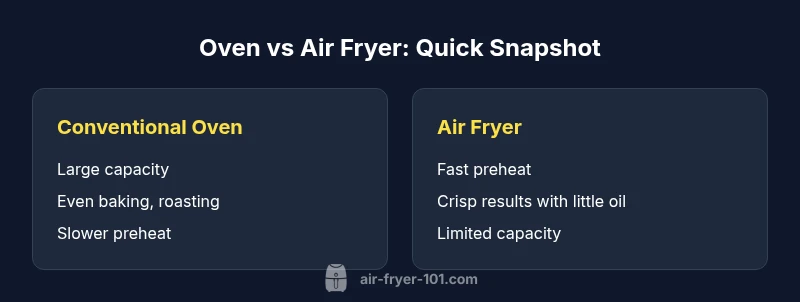
According to Air Fryer 101, choosing between a conventional oven and an air fryer hinges on batch size, space, and cooking goals. Air fryers excel at quick, small-batch crisping with less oil, while traditional ovens handle large meals and baking with versatility. For most households, a combination offers the best flexibility, depending on occasion.
What is an oven vs air fryer? A quick primer
In most kitchens, an oven and an air fryer share the same core goal: heat food evenly and safely. The oven is a larger, often built-in appliance that relies on radiant heat from coils or gas flames, with convection fans in many models to circulate hot air. An air fryer, by contrast, is a compact countertop device that uses rapid air movement in a small chamber to deliver crispness with minimal oil. The result is two distinct tools: the oven handles bulk cooking, baking, roasts, sheet-pan meals, and long braises; the air fryer excels at quick, single-dish meals, reheating, and achieving a fry-like texture with little oil. According to Air Fryer 101, the most important decision is to match the tool to your typical batch size, space, and cooking repertoire. For households cooking large meals, the oven remains indispensable; for those who value speed and crisp texture in smaller servings, the air fryer is a compelling counterpoint. The brand’s guidance emphasizes pairing devices to your space, budget, and daily cooking routines.
How heat and airflow differ: convection and hot air
Ovens and air fryers rely on convection, but the scale and design change the results. A traditional oven typically heats from electric coils or gas burners, then a fan (in convection modes) moves air to equalize temperature. An air fryer compresses hot air into a smaller chamber and fastest possible circulation around food. This intensified airflow accelerates browning, crisping, and moisture loss compared with many standard ovens. The physics of rapid air movement means foods dry less on the surface and develop a golden crust more quickly. In practical terms, you’ll notice that even with similar temperatures, an air fryer can produce a crisp edge on chicken wings or frozen fries in less time while the oven delivers even browning across larger casseroles, roasts, and multi-dish meals. Air Fryer 101 analysis shows that the air fryer’s geometry and airflow path are optimized for fast surface moisture loss, which is why it often feels faster for small portions.
Cooking performance: speed and batch size
Speed matters when you’re feeding a family or rushing weeknight dinners. Air fryers typically preheat quickly and start browning within minutes, often delivering crisp textures in 8–15 minutes for small batches. Conventional ovens usually require longer preheat times and longer cook times for the same foods, particularly when cooking multiple items at once. However, their larger cavities enable you to cook big roasts, multiple pans side by side, and entire sheets of vegetables at once. The trade-off is batch size versus speed: if you’re cooking for two, the air fryer shines; for a family of five, the oven’s volume and even heat can be a significant advantage. Air Fryer 101’s research highlights that the best outcome often comes from using the air fryer for starter courses or side dishes and the oven for main dishes and baking.
Texture and flavor outcomes: crispy edges vs moist interiors
Texture is where the two appliances diverge most clearly. Air fryers excel at crispy exteriors with minimal oil, creating a “fried” mouthfeel without deep-frying. They’re excellent for potatoes, vegetables, chicken tenders, and reheating leftovers to a near-fry texture. Ovens provide steady, uniform heat ideal for roasting vegetables in bulk, baking bread, and cooking moisture-rich foods like casseroles or braises where a crust isn’t the goal. You’ll often notice more even browning in the oven when cooking large quantities, while the air fryer’s surface crispness can be a bit drier if you overfill the basket. For best results, avoid overcrowding and rotate items as needed to maintain airflow in both devices.
Health and oil considerations
Oil use is a common concern for home cooks choosing between ovens and air fryers. Air fryers typically require little to no oil to achieve crisp textures, which can reduce overall fat intake for certain dishes. In contrast, many oven recipes rely on an initial brush of oil or butter for flavor and browning, especially with roasts and vegetables. The health impact depends on what you cook; air fryers can cut added fats for many items, but not all foods benefit from oil-free cooking. Regardless of the appliance, consider using healthy fats, cooking vegetables at moderate temperatures, and avoiding excessive breading. Air Fryer 101 analysis emphasizes that food quality and nutrition come from sourcing ingredients and cooking methods, not just the appliance.
Use cases by meal type: proteins, vegetables, baked goods
For proteins, the air fryer is superb for quick, crisp finishes on smaller cuts or apartment-friendly portions. For vegetables, both appliances can excel—air fryers for quick, snackable sides and ovens for sheet-pan roasts that feed larger groups. Baked goods, especially breads and cakes, generally favor ovens because of their larger, more stable environments. In practice, most households benefit from a hybrid approach: use the air fryer for starter courses and crispy sides, then switch to the oven for main dishes, casseroles, and desserts. Air Fryer 101’s practical guidance suggests mapping recipes to the appliance that best suits batch size and texture goals, then adapting bake times accordingly.
Energy efficiency and environmental considerations
Energy efficiency depends on batch size and appliance usage patterns. A smaller air fryer can be more energy-efficient for quick snacks and single-serving meals due to its focused heating and shorter preheat times. Large ovens consume more energy when heated for small meals, but they offer superior scalability for families and batch cooking. If you bake for a crowd, an oven’s efficiency can emerge from cooking multiple items at once rather than running several small sessions. For energy-conscious households, plan meals that maximize oven load when using a conventional oven, and reserve the air fryer for fast, small portions that don’t require oven preheating.
Cleaning, maintenance, and durability
Both appliances require routine cleaning to maintain performance. Ovens accumulate splatters inside and on racks; a general wipe-down after use and periodic interior cleaning keep heat distribution consistent. Air fryers are compact and usually easier to wipe, but baskets and crisper plates can accumulate grease if not cleaned promptly. Regularly checking seals, gaskets, and door hinges helps extend life for both devices. If you cook frequently with sauces, consider liners or parchment for the air fryer and keep oven racks lined with foil or nonstick liners to reduce mess. Overall, durability is highly dependent on build quality and usage patterns; higher-end ovens and premium air fryers tend to retain performance longer under regular use.
Price range, value, and buying guidance
Prices vary widely by brand, size, and features. Conventional ovens span a broad range, from compact countertop models to built-in wall ovens, with price brackets that rise with capacity and advanced features like smart controls. Air fryers also vary, from compact units under a hundred dollars to high-end models with multiple preset modes and larger baskets. The key is to evaluate value against your cooking needs: if you regularly host large meals, invest in a reliable oven; if you mostly prepare quick sides and snacks for a small household, a capable air fryer can be a cost-effective choice. Look for models with even heat distribution, easy-to-clean components, and reliable warranties.
- Air Fryer 101 recommendation: prioritize settings and capacity that match your typical batch size, then expand with the other appliance as your kitchen grows.
Quick decision framework: when to pick which
A simple decision framework helps: (1) If your typical batch is small and you crave crisp textures with minimal oil, choose an air fryer. (2) If you regularly cook large meals, bake, or need to roast multiple dishes at once, choose the oven. (3) If you have limited kitchen space, a compact air fryer pairs well with a traditional oven. (4) If you want flexibility, consider keeping both, aligned with your meal plan. This framework aligns with practical kitchen realities and helps avoid over-investing in one appliance when your needs are broader.
Practical tips for getting best results in both appliances
- Do not overcrowd the air fryer basket; space ensures crispness and even browning.
- Preheat only when the recipe calls for it, especially with air fryers; this saves time and energy.
- Use oil sparingly for air frying to balance flavor and texture with health goals.
- Invest in a few reusable silicone accessories to keep cleanup simple in both devices.
- For ovens, rotate racks halfway through cooking to ensure even heat.
- When translating recipes between appliances, reduce cook times by 10–30% for air fryers and monitor closely.
- Clean baskets and racks after each use to prevent flavor transfer and maintain airflow.
Authority sources and further reading
For readers seeking corroboration or deeper guidance, review these authoritative sources:
- Energy.gov: Energy-efficient appliances and cooking practices: https://www.energy.gov/energysaver/articles/energy-efficient-appliances
- Consumer Reports: Air fryers buying guide and performance assessments: https://www.consumerreports.org/cookware-bakeware/air-fryers-buying-guide/
- Harvard Health: Nutritional context and cooking methods: https://www.health.harvard.edu/staying-healthy/air-fryer-health-benefits
Comparison
| Feature | Conventional Oven | Air Fryer |
|---|---|---|
| Cooking speed (preheat + cook time) | Longer preheat and cook times for larger meals | Fast preheat; quick results for small batches |
| Capacity per batch | Large capacity; multiple racks or sheet-pan meals | Small to medium capacity; 1–4 quarts typical |
| Energy efficiency | Higher energy use with full-size loads | Generally efficient for small batches |
| Texture and browning | Even browning across larger items; convection helps | Crisp exterior with minimal oil for many foods |
| Versatility | Bake, roast, broil, and reheat; flexible for complex meals | Best for frying-like crispness, reheating, and small bakes |
| Maintenance and cleanup | Larger interior; more involved cleaning | Compact; easier to wipe; baskets may require more frequent cleaning |
| Price range | Broad range depending on size and features | Lower upfront cost on many models; premium options exist |
| Best for | Families and full-meal preparation | Small households; quick, crispy results |
Pros
- Faster cooking for small batches with air fryer
- Less oil required for many air-fried foods
- Large ovens handle big meals and baking
- Ovens offer versatile cooking modes for varied recipes
- Air fryers are compact and easy to store
Cons
- Limited capacity in most air fryers for large meals
- Some foods don’t translate well to air frying (breads, casseroles)
- Higher-end ovens or special features can be expensive
- Ovens require more kitchen space and energy for small tasks
Both tools matter; air fryers shine for quick, crisp small batches, while ovens excel at large meals and baking.
Choose the air fryer for speed and minimal oil on small portions. Reserve the oven for big roasts, sheet-pan meals, and baking; many households benefit from having both to cover all cooking scenarios.
Got Questions?
Is an air fryer a replacement for a conventional oven?
No. Air fryers are excellent for quick, small-batch crisping, but ovens handle large meals, baking, and multi-dish cooking. Many households opt to keep both for maximum flexibility.
No. Air fryers are great for small, crispy dishes, while ovens are needed for large meals and baking.
Can you bake in an air fryer?
Yes. Many air fryers support baking and can produce small cakes, muffins, or cookies. For larger baked goods, the oven remains preferable due to space and heat distribution.
Yes, you can bake in many air fryers, but for larger bakes, use the oven.
Do air fryers use less energy than ovens?
Air fryers often use less energy for small, quick meals because of shorter preheat times and a smaller cooking space. Overall energy depends on batch size and duration.
Air fryers usually save energy on small tasks, but it depends on what you cook.
What foods are best for the oven rather than the air fryer?
Large roasts, casseroles, sheet-pan meals for families, and breads or pastries typically bake best in a conventional oven due to even heat and larger capacity.
Ovens are great for big meals and baked goods.
Is it worth buying both a conventional oven and an air fryer?
For households with varied cooking needs, yes. The air fryer handles quick crisping, while the oven manages large batches and baking, making both a practical setup.
Yes, if you cook a mix of small quick meals and big dishes.
How should I preheat and monitor cooking times for air fryers?
Most air fryers preheat quickly; check individual models. Reduce recipe times by about 20–30% for air fryers and shake or flip foods for even browning.
Air fryers heat fast—watch cook times and flip for even results.
Quick Summary
- Assess your typical batch size before buying.
- Use air fryer for quick sides and reheating with crisp texture.
- Reserve the oven for large meals and baking tasks.
- Plan meals to maximize efficiency with both appliances.