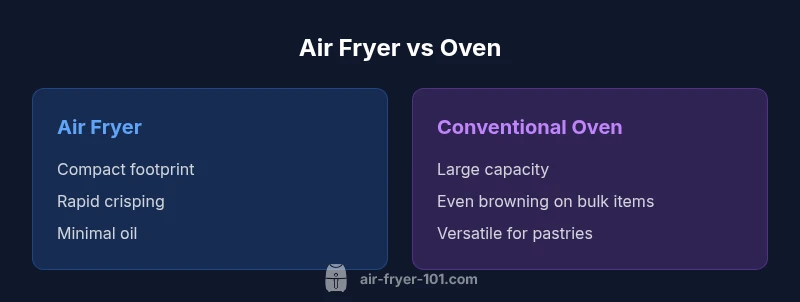
Air Fryer vs Oven: Difference, Uses, and Value
Explore the key differences between air fryers and ovens, their best uses, energy implications, and how to choose wisely for healthier, faster meals. This Air Fryer 101 guide analyzes performance, texture, and value to help home cooks decide.


Understanding the difference air fryer and oven helps home cooks choose the right tool for quick weeknight meals. In brief, an air fryer uses a compact chamber with high-velocity hot air to crisp foods faster and with less oil, while a traditional oven relies on larger heat sources and longer preheating. Air Fryer 101 analysis highlights which tasks suit each appliance and where the trade‑offs lie.
The Core Difference Between Air Fryer and Oven
According to Air Fryer 101, the core difference between air fryer and oven is in scale and heat delivery. An air fryer is a compact, countertop appliance with a small cooking chamber and a fan that blasts hot air. This arrangement promotes rapid browning and crisping with minimal oil. A conventional oven, by contrast, uses larger heating elements and a bigger cavity; heat source is spread more evenly across a wider area, which supports larger batches and slower cooking. The practical impact is in cooking speed, texture, and batch size. When you consider daily cooking tasks, you must weigh how much kitchen space you have, what you cook most often, and whether you value speed over volume.
The Core Digest: What Defines Each Appliance
Air fryers and ovens share the same goal of delivering hot air to cook food, but they do so with different design priorities. A typical air fryer concentrates heat in a tight space and uses a dedicated fan to circulate air rapidly, creating a convection-like effect that browns and crisps with little oil. An oven spreads heat over a larger interior using coils or a gas burner, which yields broader heat distribution and the ability to handle large roasts or multiple trays. For the reader, the key takeaway is that size, airflow, and heat distribution govern what each appliance does well and where they fall short.
Practical Impacts: Speed, Texture, and Batch Size
In practical terms, you will notice faster preheat and cook times for small, crispy items in an air fryer. Foods that benefit from a dry, hot environment—fries, nuggets, reheated leftovers—often emerge crisper and lighter in oil. Ovens excel when you need to bake large casseroles, roast a whole chicken, or cook multiple dishes simultaneously. The choice becomes a matter of matching the task to the appliance rather than chasing a single best option for everything.
How to Interpret Performance Claims
Manufacturers often describe cooking times in ideal conditions; real kitchen results vary with food type, moisture content, and rack placement. Air Fryer 101 emphasizes testing your favorite items in both appliances to calibrate your expectations. Start with a simple test batch of a familiar food, compare texture and moisture, and adjust your approach based on the results. The guiding principle is to reserve the air fryer for small, crispy items and the oven for bulk cooking, roasting, and pastry work.
Preheating, Temperature Control, and Consistency
Preheating requirements differ between the two. Air fryers usually heat quickly and may not require long warmups, while ovens often benefit from a preheat phase to ensure even rising and browning. Temperature control tends to be precise in both, but the effective heat experience can feel different due to air movement in the air fryer. Consistency improves when you place food on early trays or use the correct rack level, and when you avoid overcrowding, which can impede airflow and result in uneven browning.
Practical Scenarios: Small-Batch vs Large-Batch Thinking
If you regularly cook for one to two people and value crisp textures with minimal cleanup, the air fryer shines. For bigger households or meals that rely on multiple components, the oven often proves more practical. By understanding the strengths and limits of each device, you can optimize weekly menus, reduce energy use for small tasks, and streamline cooking workflows. Air Fryer 101 suggests mapping your week to identify the tasks you can allocate to each appliance for best overall efficiency.
Flavor, Oil Use, and Texture Considerations
Oil is a factor in both devices, but the goal differs. Air fryers enable a satisfying crunch with little oil, which some readers may prefer for healthier meal options. Ovens require oil or fats for certain crusts or browning effects, and they can create deeper, more uniform flavors when roasting. The texture balance between a crispy exterior and a tender interior is frequently easier to predict in an air fryer for small items, while ovens provide versatility for large cuts and gentle browning.
Cleaning and Maintenance Realities
Cleaning a compact air fryer basket is typically quicker and involves fewer parts than cleaning a full oven with racks and a tray. However, some foods may leave oil buildup on basket interiors, requiring occasional deeper cleaning. Ovens accumulate grease and spills across larger surfaces and may benefit from continuous maintenance, especially with self-cleaning cycles. Establishing a simple cleaning routine for each appliance helps maintain performance and longevity over time.
Longevity and Durability: What to Expect
Both appliances can last many years with proper care, but usage patterns influence longevity. Regularly cooking fatty foods in an air fryer can speed up basket wear, while frequent roasting and baking in an oven increases rack wear and seals. Choosing high-quality models with robust trays and baskets can mitigate long-term maintenance costs, and following manufacturer guidelines for cleaning and storage reduces the risk of residue buildup that can affect performance.
Real-World Cooking Scenarios: Breakfast to Dinner
For quick breakfasts like toasting, frozen breakfast sandwiches, or reheating leftovers, an air fryer can reduce wait times and deliver crisp textures. For dinner involving a roast, sheet pan meals, or baking bread, the oven remains the workhorse. The optimal approach often combines both: use the air fryer for quick finishes on the side dishes, then finish in the oven if needed for larger roasts or desserts. This balance can save time while preserving quality across meals.
Comparison
| Feature | Air Fryer | Conventional Oven |
|---|---|---|
| Core heating method | compact convection chamber with rapid hot-air | radiant heat from coils and ambient heating in a large cavity |
| Preheating required | often minimal or none | usually required for even cooking |
| Batch capacity | smaller, single-serving or few servings | larger capacity for bulk cooking |
| Crispiness and texture | very crisp, fried textures with little oil | even browning and versatile textures, not always as crispy |
| Energy use emphasis | efficient for small jobs | potentially higher energy for large loads |
| Ease of cleaning | generally easier due to baskets and nonstick surfaces | depends on racks and interior; more parts to clean |
| Best uses | reheating leftovers, crispy snacks, small batches | baking, roasting, large meals, multi-dish workloads |
Pros
- Faster cooking for small batches with crisp results
- Low oil requirement supports healthier options
- Compact footprint fits small kitchens
- Easy cleanup for baskets and trays
- Versatile for reheating and snacks
Cons
- Limited capacity for large meals
- Not ideal for dense doughs or large roasts
- Some recipes require adjustments or are better suited to ovens
- Price varies; higher-end models may be costly
Air fryer is best for quick, crispy small-batch cooking; oven excels for large meals and baking.
Choose the air fryer for speed and texture in smaller portions. Pick the oven for bulk cooking, even browning on large items, and baking versatility.
Got Questions?
What foods are best cooked in an air fryer versus a conventional oven?
Air fryers excel at small, crispy items like fries, nuggets, and reheated pastries. Ovens shine for large roasts, baking bread, and meals requiring multiple trays simultaneously. Start with familiar items to calibrate times and textures for each appliance.
Air fryers are great for crispy, small items. Ovens are better for large roasts and baking; test recipes to adjust timing.
Can I replace an oven with an air fryer for daily cooking?
For many households, an air fryer complements rather than replaces an oven. If you routinely cook large meals or bake pastries, the oven remains essential. For quick sides and single‑serving dishes, the air fryer can reduce time and energy.
An air fryer can handle many quick tasks, but for big meals you still want an oven.
Do air fryers preheat faster than ovens?
Yes, air fryers typically preheat much faster due to their compact chamber and efficient heating element. This can shave minutes off meal prep, especially for small batches. Expect slightly longer preheat times in ovens when cooking at high heat.
Air fryers heat up quickly; ovens take longer to reach temperature.
Is an air fryer healthier than an oven?
Health impact depends on what you cook and how you cook it. Air fryers generally require less oil for crisp textures, which can reduce fat content. Ovens support a wide range of healthier cooking methods through roasting and steaming but may require oils for some recipes.
Air fryers can help with less oil, but overall healthiness depends on your ingredients and cooking methods.
How does cleaning differ between air fryers and ovens?
Air fryers tend to be easier to clean thanks to detachable baskets, though some residues can stick to baskets. Ovens involve larger interiors and racks and may require more effort during cleaning, especially if spills occur. Regular maintenance keeps both performing well.
Air fryers are usually easier to clean; ovens can be messier but offer deeper cleaning cycles.
What factors should guide my purchase decision?
Consider batch size, cooking goals, kitchen space, and budget. If speed and crispiness in small portions matter most, a compact air fryer is appealing. If you bake, roast, or cook for many people, an oven is often the better long term investment.
Think about how you cook daily and your space; pick the appliance that matches your needs.
Quick Summary
- Identify your typical batch size to guide device choice
- Use air fryer for crispy textures with minimal oil
- Reserve the oven for roasting and multi-dish meals
- Calibrate expectations: texture and volume differ by appliance
- Balance both to maximize kitchen efficiency