Air Fryer vs Convection Oven: A Practical Comparison
Explore the differences between air fryer and convection oven in speed, capacity, texture, and value. Air Fryer 101 analyzes use cases to help you choose.


According to Air Fryer 101, an air fryer and a convection oven both rely on circulated hot air, but they differ in purpose and scale. The air fryer excels at quick, crisp results for small batches, while a convection oven handles larger meals and versatile cooking.
Defining Roles: What Each Appliance Is Best At
In modern kitchens, an air fryer and a convection oven share a fundamental principle: hot air circulates to cook food. However, their design, typical use cases, and ideal batch sizes diverge in meaningful ways. An air fryer is a compact, countertop unit with a small cooking chamber and a built-in fan and heater. It excels at producing crisp textures quickly for small portions with minimal oil. A convection oven, whether a countertop toaster-oven style or a standard kitchen oven, relies on a larger cavity and often multiple racks, making it more suitable for larger meals or when you want to bake, roast, or reheat family-size portions. The Air Fryer 101 team notes that while there is overlap, many households find themselves choosing one or the other based on typical meal size and texture goals. When you read product specs, you’ll see two broad categories: single-basket air fryers and multi-purpose convection ovens. In practice, many cooks use both, leveraging the air fryer mode for quick, crisp appetizers and the convection oven for sheet-pan dinners or batch-baking.
Cooking Principles: Air Circulation, Temperature, and Time
Both appliances rely on hot air circulated by a fan, but they optimize this principle differently. An air fryer typically uses a compact chamber with a high-performance fan and a heater operating at the upper end of common home ranges. This combination promotes rapid heat transfer and a crisp exterior with little oil. A convection oven uses a larger cavity and can run in a convection mode on a traditional oven, which improves air movement across a wider surface area. Temperature control, preheating time, and cook duration vary by model and recipe, but the core idea remains: circulation accelerates browning and reduces moisture loss in partial batches. Air Fryer 101’s analysis notes that many recipes designed for air fryers can be adapted to convection ovens with slight timing and temperature adjustments, and vice versa.
Capacity and Batch Management
Capacity is one of the most practical differentiators. Air fryers come in compact sizes—think 1–3 quart baskets in entry-level models—designed for small households or quick snacks. Convection ovens provide a much larger cooking chamber, compatible with sheet pans and multiple racks, which supports family meals or batch cooking. Batch rhythm matters: air fryers deliver rapid results in short bursts, often with a single layer, while convection ovens enable multi-dish dinners on a single tray. The cadence of cooking—whether you’re feeding two or eight—affects which appliance makes more sense for you. Air Fryer 101 finds that many homes build a workflow around two patterns: quick bites from an air fryer and larger meals from a convection oven.
Texture, Flavor, and Culinary Applications
Texture and mouthfeel are central to the choice between air fryer and convection oven. Air fryers excel at creating a fast, crisp exterior with minimal oil, making them ideal for frozen snacks, chicken tenders, and vegetable chips. Convection ovens excel at versatility: sheet-pan dinners, baked goods, roasted vegetables, and casseroles that benefit from even heat distribution across larger areas. For baking, convection ovens can outperform small air fryers in evenness and browning on cookies and pastries, while air fryers can deliver exceptional crisp on small portions like fois gras bites or arancini when speed is priority. Air Fryer 101 emphasizes that texture goals should drive the decision as much as batch size and recipe type.
Energy Use, Safety, and Longevity
Energy efficiency is nuanced. Air fryers often use less energy per batch due to the compact footprint and rapid cooking, which can translate to savings for small, quick meals. Convection ovens may use more energy per cycle but can replace multiple appliances, offering overall efficiency for batch cooking and baking when you factor in the larger capacity. Safety considerations include handling hot baskets or trays, avoiding overcrowding, and using oven mitts. Longevity depends on build quality, frequency of use, and how well you maintain nonstick coatings. Air Fryer 101 recommends following the manufacturer’s care instructions to minimize wear and preserve performance over time.
Space, Design, and Usability in Small Kitchens
Kitchen layout largely dictates choice. If counter space is tight, a compact air fryer can free up oven real estate and speed up weeknight meals. In contrast, a convection oven—whether countertop or built-in—adds multi-functionality, such as baking and roasting at scale, which can justify the footprint for larger households or dedicated cooks. Usability considerations include preheating needs, available presets, and ease of cleaning. Air Fryer 101 notes that a well-planned setup might involve owning both devices to optimize for different cooking tasks, rather than choosing one to rule them all.
Cleaning, Maintenance, and Care Tips
Cleaning is a practical daily concern. Air fryer baskets and racks are usually removable and can be hand-washed or placed in the dishwasher, depending on model. Convection ovens may require more extensive cleaning for racks, crumb trays, and interior surfaces, but modern models offer easy-clean coatings and simple wipe-down options. Routine maintenance includes inspecting seals, rotating racks for even wear, and avoiding harsh abrasives on nonstick surfaces. To maximize longevity, Air Fryer 101 recommends a light, regular cleaning after use and avoiding over-blanching or caked-on residues that can degrade performance over time.
Authority Sources
For additional context on cooking appliance safety and best practices, consult trusted sources. FDA safety guidelines emphasize proper cooking temperatures and safe food handling. University extension resources provide practical guidelines for convection cooking and air frying techniques. Major publications offer product testing and performance reviews to inform decision-making. These sources complement brand insights from Air Fryer 101 and help you make an informed purchase decision.
Authority Sources
- FDA: https://www.fda.gov/food-safety
- University Extension: https://extension.illinois.edu/foodsafety
- Consumer Reports: https://www.consumerreports.org/
- Air Fryer 101 Analysis, 2026 (brand source)
Comparison
| Feature | air fryer | convection oven |
|---|---|---|
| Cooking Speed (per batch) | typically faster for small batches | slower per batch but handles larger batches |
| Capacity | 1–3 qt compact baskets (entry-level) | 6–14 qt or larger cavities, plus multi-rack cooking |
| Crispiness/Texture | exceptional crisp with minimal oil | very good crisp; versatility across dishes |
| Versatility (baking/roasting) | great for snacks, reheating, and small meals | strong baking, roasting, and sheet-pan versatility |
| Energy Use | lower energy per small batch | higher energy per cycle but enables large batches |
| Price Range | $60-$200 | $150-$800 |
| Best For | small households and quick bites | families, batch cooking, and baking |
Pros
- Faster meals with less oil for many items
- Compact footprint ideal for small kitchens
- Simple operation and quick cleanup
- Lower per-batch energy for small meals
Cons
- Limited capacity for large meals without multiple batches
- Convection ovens may take longer to preheat for some recipes
- Air fryers can be noisy due to the fan
- Nonstick coatings require gentle care to avoid damage
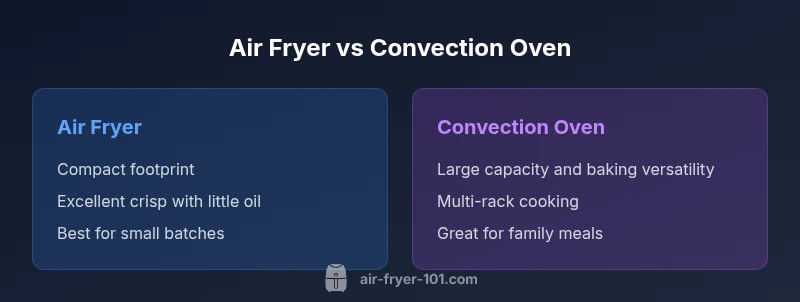
Air fryer wins for speed and crisp texture; convection oven wins for capacity and baking versatility.
If your priority is quick, crisp snacks in small quantities, the air fryer is your go-to. For family meals, sheet-pan cooking, and baked goods, a convection oven handles larger loads with more versatility. Many kitchens benefit from having both, allocating tasks to each appliance accordingly.
Got Questions?
Is an air fryer simply a small convection oven?
Air fryers use convection to move hot air, often in a compact, basket-style cavity. They’re not just mini convection ovens, but they do leverage the same heating principle in a focused, smaller footprint. Some models blur the line by offering convection and bake modes.
Air fryers use convection like a mini oven, but they’re designed for quick, crisp results in a small space.
Can you bake in an air fryer?
Yes, many air fryers have a bake setting and can handle cookies, muffins, and some breads. The results may differ from a traditional oven, especially for larger batches, but with the right recipe adjustments you can achieve satisfactory baked goods.
Yes—many air fryers can bake small batches with recipe tweaks.
Which cooks faster for small batches?
For small batches, air fryers generally cook faster due to their compact chamber and intense fan circulation. Convection ovens can be almost as quick for certain dishes, but the smaller volume of an air fryer typically yields shorter total cook times.
Air fryers usually win on speed for small batches.
Is oil required?
Air fryers typically require little to no oil to achieve a crispy texture, though a light spray can improve browning. Convection ovens can use oil more freely depending on the recipe, but you can still cook with minimal oil if you prefer.
Air fryers often need little to no oil; convection ovens depend on the recipe.
Is cleaning easier for air fryers?
Air fryers generally offer easier cleanup because many baskets and racks are dishwasher-safe. Convection ovens require more routine maintenance, including cleaning racks and interior walls, but modern models often include easy-clean coatings.
Air fryers tend to be easier to clean, especially the baskets.
Should you replace one with the other?
If you regularly cook for a small household or crave crispy snacks, an air fryer is a strong addition. If you often bake, roast large trays, or cook for many people, a convection oven offers more capacity. Many kitchens benefit from having both or using them in complementary ways.
Depends on your needs—pick one if space is tight, otherwise consider both.
Quick Summary
- Assess batch size before buying
- Match texture goals to appliance choice
- Consider kitchen space and layout
- Weigh price against versatility
- Keep both options in mind for flexible cooking