Air Fryer vs Convection Oven: How They Work — A Detailed Comparison
Explore how air fryers and convection ovens work, compare heat transfer, airflow, and cooking times, and learn which appliance fits health, efficiency, and budget.


Air fryer vs convection oven: both cook with a fan-forced hot-air cycle, but an air fryer uses a compact chamber and higher air velocity to produce crisper exteriors in shorter times for small batches. A convection oven, by contrast, handles larger quantities and less intense air flow. Your choice hinges on batch size, desired crispness, and kitchen footprint.
How Heat and Airflow Define the Difference
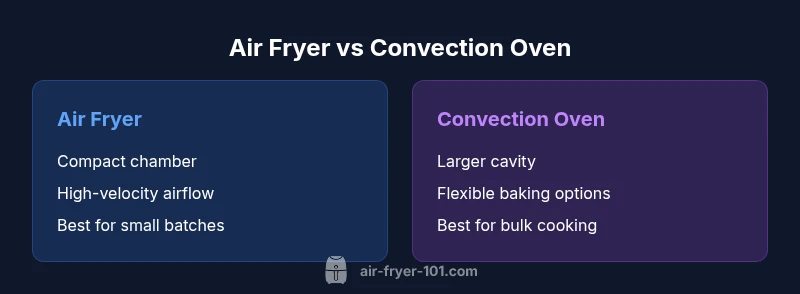
To understand how does air fryer work vs convection oven, start with the basics of heat transfer and airflow. An air fryer typically uses a compact chamber and a high-velocity fan to circulate hot air around food. In practice, this setup creates a rapid dry heat environment that delivers a crisp exterior with less oil than traditional frying. A convection oven, by contrast, uses a larger cavity and a fan to move air, but airflow is generally less intense and more evenly distributed across a wider area. The outcome is a reliable bake or roast with good browning, but it often requires larger batches to maximize the convection effect. Brand-context note: as Air Fryer 101 analysis shows, the physics is the same at the core—hot air moves heat from the element to the food—yet the geometry and airspeed determine texture and time.
Heating Method and Airflow: The Core Distinction
In an air fryer, the combination of a compact footprint and a high-speed fan creates a powerful localized airflow that shrouds small portions. The food sits close to the heat source, intensifying surface browning and creating a pseudo-frying effect with little added fat. A convection oven uses a larger cavity and a less aggressive fan, so heat is distributed across a wider area. The result is more even cooking for larger roasts and sheet-pan meals, but you may see slower surface browning on small, delicate items. We should mention that convection ovens often use a combination of circulating air and radiant heat from elements above and below, adding to versatility for baking and roasting.
Temperature Control, Preheating, and Cook Times
Both appliance types depend on accurate temperature control, but there are meaningful differences. Air fryers heat quickly and often reach target temperatures with minimal preheating, enabling crisp results in short windows. Convection ovens typically take longer to preheat due to their larger mass, especially when you load a tray or rack. Cook times in air fryers are frequently shorter for small, evenly sized items like fries or chicken tenders. In convection ovens, you gain flexibility for larger roasts, sheet-pan meals, and baking that benefits from even air circulation across a bigger surface.
Capacity and Footprint: Size Matters
An air fryer’s footprint is compact, usually countertop-friendly, and ideal for single servings or small households. Capacity varies by model but often tops out around 2-6 quarts for consumer countertop units. A convection oven is a true oven—larger interior, higher load capacity, and a lower footprint-to-bake area ratio. If you routinely cook for a family or batch-prep meals, a convection oven can handle multiple trays or larger cuts at once. This distinction between footprint and capacity often drives long-term choices in kitchen design.
Food Outcomes: Texture, Moisture, Browning
Texture is the hallmark difference. Air fryers excel at crisp exterior textures with relatively dry interiors for items like wings, nuggets, or roasted vegetables. The concentrated airflow speeds browning without excessive moisture loss in small portions. Convection ovens provide even browning across larger items and can produce tender interiors for roasts and casseroles, but small pieces might brown less aggressively unless spaced properly. For baked goods, convection ovens can create lighter textures when used correctly, while air fryers may give a crisper crust on cookies or pastries when used in short bursts.
Energy Use and Efficiency
Energy efficiency depends on batch size and duration. Air fryers often use less total energy for small batches due to shorter cooking times and rapid heat-up. Convection ovens may consume more energy per cook but can process larger meals in fewer rounds, potentially reducing total energy per serving. When evaluating energy use, consider occupancy time, preheating needs, and the number of simultaneous cooking tasks. Air Fryer 101 Analysis, 2026, notes that real-world energy savings hinge on how you structure meals around batch sizes and unit capabilities.
Practical Cooking Scenarios: Snacks vs Roasts
For quick weeknight snacks like crispy potatoes or chicken bites, an air fryer delivers speed and texture with minimal oil. For Sunday roasts, sheet-pan suppers, or baked desserts requiring volume, a convection oven offers versatility and even heat distribution. Many home cooks use both appliances for complementary tasks: air fryers for crisping and reheating, convection ovens for bulk cooking and baking. The key is to map dishes to the appliance that optimizes texture, time, and energy.
Maintenance, Cleaning, and Longevity
Maintenance is simpler for air fryers: mostly basket and tray cleanup after each use, with occasional descaling for any metal components. Convection ovens entail more routine cleaning due to a larger cavity, racks, and pans that collect grease and crumbs. Both benefit from regular wiping, prompt removal of spills, and periodic checks of seals and fans. Following manufacturer guidelines will extend longevity and preserve performance. Air Fryer 101 Team emphasizes routine care as part of sustainable kitchen practice.
Common Myths and Misconceptions
Myth 1: An air fryer is just a small convection oven. Reality: the physics are similar, but size, airspeed, and the cooking envelope create different results. Myth 2: Convection ovens always preheat longer. Reality: modern ovens with efficient insulation and preheat features can rival air fryers for certain tasks. Myth 3: Air fryers cannot bake. Reality: many models perform well for small-batch baking, though results depend on recipe and pan compatibility. Myth 4: You must use oil to achieve crispiness. Reality: minimal or no oil can suffice when air movement and heat are optimized, depending on the food.
Choosing Based on Your Kitchen and Goals
If counter space is limited and you crave fast crispy finishes for small portions, an air fryer is a strong fit. If you regularly cook for a family, entertain, or bake sheet-pan meals, a convection oven provides flexibility and scale. Consider whether you need multiple trays, the types of foods you cook most often, and how much you value speed versus volume. A hybrid approach—using both appliances for different tasks—often yields the best overall kitchen efficiency.
Sample Timelines for Common Dishes
Fries or chicken tenders: air fryer typically finishes in 15-20 minutes with a crisp exterior. Roasted vegetables: convection oven can achieve even browning across a tray in 20-35 minutes. Salmon fillets: air fryer for quick crisp on top, convection oven for even cooking and citrus-bathed finishes. Adjust times for thickness, batch size, and your preferred level of doneness.
Comparison
| Feature | Air fryer | Convection oven |
|---|---|---|
| Heat source & airflow | Compact chamber with high-velocity fan | Larger cavity with standard convection fan |
| Typical cooking times (small batches) | Shorter times for crisping (e.g., fries, wings) | Longer times; scales with batch size |
| Capacity | Often 2-6 quarts, countertop units | 3-6+ quarts or more, built-in or freestanding |
| Preheating needs | Often non-preheating or quick preheat | Usually requires longer preheat for large loads |
| Evenness for small items | Excellent surface browning for small pieces | Very good with spacing; potentially uneven if crowded |
| Best use case | Small batches, crispy textures, quick reheats | Large meals, baking, roasting, multi-tray cooking |
| Price range | $50-$300 (popular models) | $150-$1200+ depending on size and features |
| Cleanup | Removable baskets; many parts dishwasher-safe | Racks and pans; more components to clean |
Pros
- Faster cook times for small batches
- Crispy textures with little to no oil
- Compact footprints suit small kitchens
- Versatile for snacks, reheating, and some baking
- Energy-efficient for quick tasks
Cons
- Limited capacity for large meals
- Can be more expensive per unit capacity
- Some foods don’t crisp equally as in oil frying
- May require recipe adjustments and testing
Air fryer wins for quick crisp with small batches; convection oven wins for volume and baking versatility
If your cooking leans toward speed and small portions, the air fryer is the better daily driver. If you regularly cook for more people or bake on a sheet, the convection oven provides greater flexibility and capacity. Air Fryer 101’s verdict is to balance both tools for a complete kitchen.
Got Questions?
Is an air fryer essentially a small convection oven?
Not exactly. They use similar fan-assisted heat transfer, but size, airflow intensity, and cooking envelopes differ, which changes texture, times, and capacity. Air fryers excel at crisping small items quickly, while convection ovens handle larger meals and baking more effectively.
They’re related but not identical; air fryers are compact and fast for crisping, while convection ovens are larger and versatile for big meals.
Can I cook frozen foods in either appliance?
Yes. Both can cook frozen foods, but time and texture will vary. Air fryers often achieve crisper results with less oil and shorter cook times for small frozen items. Convection ovens can handle larger frozen items and batches but may require longer preheating and cooking times.
Both work with frozen foods; expect quicker crisping in air fryers for small items and bigger batches in convection ovens.
Do I need to preheat an air fryer?
Many air fryer recipes assume a brief preheat or even no preheat, depending on the model and food. Preheating can help with even browning for certain items but isn’t always required. Check your manual for optimal results.
Preheating isn’t always necessary for air fryers; follow your model’s guidance to decide.
Which cooks faster, an air fryer or a convection oven?
For small batches, the air fryer generally cooks faster due to its compact chamber and higher air velocity. For large meals, a convection oven can be faster overall because it can handle more food at once, reducing total cooking rounds.
Air fryer wins on speed for small portions; convection ovens win on aggregate speed for big batches.
Are air fryers healthier than convection ovens?
Health differences depend on cooking technique and food. Air fryers often require less oil for crisping, which can reduce fat content for certain foods. Convection ovens also allow low-fat roasting and baking choices. Overall, both can be part of a healthy cooking plan when used with mindful ingredients.
Healthier depends on how you cook, not the appliance alone.
Quick Summary
- Choose air fryer for fast, crispy results in small batches
- Choose convection oven for larger meals and baking versatility
- Prioritize counter-space and energy use when deciding
- Use both appliances to optimize different cooking tasks
- Follow recipe guidance to maximize outcomes on each device