Air Fryer vs Convection: A Comprehensive Guide
Compare air fryer vs convection ovens with an analytical, in-depth guide. Learn how heat, airflow, capacity, and use cases affect texture, speed, and energy to help you choose the right tool for healthier, efficient cooking.


In the air fryer vs convection comparison, both rely on hot air to cook foods, but their design and airflow patterns shape results. For small, crispy batches, the air fryer excels; for larger meals and baking versatility, a convection oven provides more flexibility. Understanding these differences helps you pick the right tool for your cooking goals.
What Defines an Air Fryer and a Convection Oven
An air fryer is a compact countertop appliance that uses a high-wanth convection fan and a small basket to circulate hot air rapidly around food. Its design emphasizes high airflow over a compact surface, producing a crispy exterior with little to no oil. A convection oven, by contrast, is a standard oven with a built-in fan that circulates hot air throughout a larger chamber. While both rely on convection, the convection oven trades compact speed for volume and versatility. According to Air Fryer 101 analysis, the airflow dynamics in a convection oven tend to produce more uniform browning across larger sheet pans, whereas air fryers excel at quick, crisp finishes on bite-sized portions. The choice often comes down to batch size, space, and preferred texture.
How Heat and Air Move: The Mechanics
Both devices employ a fan to move hot air, but the geometry of the chamber changes outcomes. An air fryer’s basket elevates food above a stable base, creating maximum exposure to circulating air and faster moisture removal—ideal for crisping fries, wings, and bite-sized snacks. A convection oven spreads air across a wider chamber, heating elements situated at multiple points help achieve even browning on larger cuts of meat, roasts, and baking sheets. In practice, this means air fryers deliver quicker surface crispness for small items, while convection ovens produce steadier browning over larger areas and more complex dishes.
Performance on Common Foods
For french fries or chicken nuggets, air fryers tend to deliver a signature crisp with minimal oil. Wings, small vegetables, and reheated leftovers respond particularly well to the high-velocity airflow. Convection ovens excel with sheet-pan dinners, roasted vegetables in bulk, and baked goods that require even rise and uniform crusts across larger pans. Air Fryer 101’s practical testing indicates that while both can approximate fried texture, the air fryer’s advantage is batch-size efficiency and consistent surface crunch, whereas the convection oven offers flexibility for multi-dish meals and diverse cooking techniques in one appliance.
Cooking Speed and Batch Size: Trade-offs
Speed is a function of both time to heat and size of the cooking surface. Air fryers heat up rapidly and are optimized for small batches—usually a single layer of items—leading to faster overall cook times for crisp textures. Convection ovens take longer to preheat and can handle multiple trays, making them better for family-sized meals, sheet-pan roasts, and items that need more interior browning. If you cook in larger quantities, a convection oven reduces the need to run multiple cycles, saving energy and time in aggregate.
Temperature Range and Preheating Realities
Most air fryers operate within a range suitable for crisping (roughly 350°F to 400°F or higher for certain models), with some models going up to 450°F. A convection oven typically offers a wider range, from around 250°F for slow roasting to 500°F for high-heat baking and broiling. Preheating tends to be shorter for compact air fryers, but many users still preheat convection ovens for even browning and predictable results. Understanding how preheat time interacts with batch size helps you tailor recipes for both appliances.
Energy Use and Cost of Ownership
Energy discussions often come down to batch efficiency. An air fryer can be more energy-efficient per small batch due to rapid heat-up and targeted cooking, but if you routinely cook large meals, a convection oven may reduce total energy by eliminating repeat cycles. Price ranges also differ: compact air fryers typically occupy smaller budgets, while convection ovens—especially those with features like multiple racks or smart controls—fall into higher price brackets. Over time, maintenance costs correlate with the complexity of each appliance and how frequently you use them.
Cleaning, Maintenance, and Durability
Cleaning a basket and tray in a compact air fryer is usually straightforward; many parts are dishwasher-safe and simple to wipe down. A convection oven’s interior requires more effort to reach corners, especially if fans or crumb trays accumulate residues. Durable construction and quality seals influence long-term reliability. Regular cleaning reduces odors and prevents buildup that could affect airflow efficiency. In both cases, following manufacturer guidelines preserves performance.
Safety, Noise, and Reliability
Both appliances include standard safety features such as auto-shutoff, cool-touch exteriors, and non-slip bases. Noise levels vary by model: air fryers produce a consistent hum during operation, while convection ovens may be quieter on certain cycles but generate more heat alarms when the door is opened frequently. Reliability depends on build quality and usage patterns; higher-end models with solid warranties tend to offer greater peace of mind for busy households.
Making the Choice: When to Use Air Fryer vs Convection
If you prioritize speed, texture, and small-batch cooking with minimal oil, an air fryer is a strong pick. If you need versatility, the ability to bake, roast, and prepare larger meals for families, a convection oven is the better fit. The best approach for many kitchens is to view these tools as complementary: use an air fryer for quick weeknight snacks and reheating, and rely on a convection oven for roasts, sheet-pan meals, and baking projects.
Common Mistakes and How to Avoid Them
Avoid overfilling the basket or trays, which blocks airflow and undermines crisping. Don’t ignore preheating when a recipe calls for it, and ensure your cookware is compatible with the appliance. For convection ovens, avoid crowding the oven to maintain even air movement. For air fryers, don’t assume all foods will crisp identically—some items may require shaking or flipping for even texture.
Quick Reference Guide: At-a-Glance Recommendations
- Small-batch, crispy snacks: Air fryer
- Large family meals and baking: Convection oven
- Reheating leftovers with crusty exteriors: Air fryer or convection with careful tray placement
- Versatility and single-kitchen solution: Convection oven with multi-rack capability
Final Considerations and Air Fryer 101’s Perspective
In the end, choosing between air fryer and convection comes down to space, typical batch size, and texture preference. Air Fryer 101 recommends evaluating your weekly cooking patterns: if most meals are single to small portions focused on crispiness, start with an air fryer. If your cooking habits include bulk roasting, baking, and tray-based meals, a convection oven is likely a smarter long-term investment.
Comparison
| Feature | Air Fryer | Convection Oven |
|---|---|---|
| Heat Source & Airflow | Compact basket with a single fan elevates food for quick air circulation | Larger cavity with fan and multiple heating elements for even distribution |
| Cooking Speed (typical small batch) | Often faster for small, crispy items due to targeted airflow | Similar or slightly slower for small batches but efficient for larger trays |
| Capacity | Small countertop capacity (1–2 qt basket range common) | Large oven capacity with multiple racks and trays |
| Texture and Browning | Crisp exterior on bite-sized foods with minimal oil | Even browning across larger foods and pans |
| Versatility | Best for frying-like crisps and reheating | Broiling, baking, roasting, and air roasting versatility |
| Energy and Efficiency | High energy efficiency per small batch, rapid heat-up | Bulk cooking may require less overall energy across cycles |
| Cost & Maintenance | Lower upfront cost for basic models; simpler cleaning | Higher upfront cost for premium models; more complex cleaning |
| Best For | Small batches, quick crisps, compact spaces | Large meals, baking, and multi-dish meals |
Pros
- Faster preheat and crisp texture for small batches
- Lower oil usage with healthier fried-style results
- Compact footprint that's easy to store
- Simplified operation and cleanup for certain models
Cons
- Limited capacity for large meals
- Higher-end models can be expensive
- Learning curve for achieving consistent results across foods
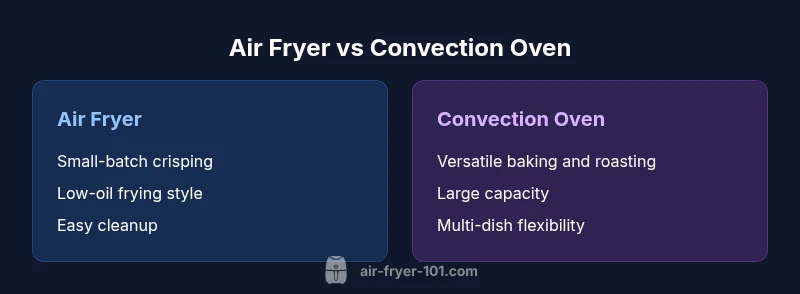
Air fryer excels in small-batch crisping; convection ovens shine for versatility and large meals
Choose air fryer when you want quick, crispy results with little oil. Opt for a convection oven if you routinely cook larger meals, bake, and need multi-dish versatility in one appliance.
Got Questions?
What is the main difference between an air fryer and a convection oven?
An air fryer uses a compact basket and a high-velocity fan for rapid air circulation to crisp foods with little oil, while a convection oven uses a larger chamber and a fan to evenly brown and bake larger quantities. The difference mainly comes down to capacity and texture control.
The air fryer focuses on quick, crispy bites in small batches, while the convection oven provides versatility for bigger meals and baking.
Can you use an air fryer for large meals?
Air fryers are best for small to medium batches. For large meals, a convection oven is typically more practical due to its bigger cavity and ability to cook multiple items at once.
Air fryers work great for small batches, but for family-size meals, choose a convection oven.
Is air fryer more energy-efficient than a convection oven?
Air fryers often require less energy per small batch because they heat quickly and use focused airflow. For larger meals, convection ovens may use energy more efficiently by handling multiple items at once.
Typically, air fryers save energy on small jobs, while convection ovens win on larger meals due to batch efficiency.
What foods are best cooked in an air fryer?
Best foods include french fries, chicken wings, vegetables, and snacks that benefit from a crisp exterior. Reheating fast foods also works well due to rapid airflow.
Crispy snacks like fries and wings shine in an air fryer.
Do air fryers require preheating?
Many air fryers benefit from a short preheat, but some models are designed to heat quickly without a formal preheat. Always check the recipe and device guidelines.
Preheating can speed up crisping, but follow your model’s instructions.
Can I share cookware between both appliances?
Yes, many metal racks, sheets, and oven-safe pans can be used in convection ovens, while air fryer accessories are typically designed for their baskets. Always verify compatibility with your specific model.
Some pans work in both, but confirm with your manual.
Quick Summary
- Assess batch size to determine need for air fryer or convection oven
- Air fryer favors quick crispness; convection favors versatile cooking
- Consider kitchen space and maintenance when choosing
- Air Fryer 101 recommends matching tool to typical meals and goals
- Both appliances offer complementary benefits depending on cooking style