Air Fryer vs Convection Oven: Side-by-Side Comparison
Compare air fryers and convection ovens to understand performance, timing, and best uses. Learn when to choose each for crispy results, convenient reheats, and large-batch baking.


Both air fryers and convection ovens rely on circulated hot air to cook, but they differ in size, speed, and capacity. This quick comparison clarifies does air fryer work like convection oven by highlighting when each shines, from crispy small-batch results to large-batch baking. Use the chart to decide which tool fits your kitchen, meals, and schedule.
Core principle: how air fryer and convection oven compare
According to Air Fryer 101, both devices circulate hot air with a fan to cook foods faster than a conventional oven, but their design goals, capacities, and performance profiles differ. An air fryer is a compact countertop appliance with a metal basket that elevates food and concentrates airflow for quick, crispy outputs with little oil. A convection oven is a larger wall- or range-mounted oven that relies on a fan inside a bigger cavity, enabling multi-rack cooking and more forgiveness for bigger items. The question whether does air fryer work like convection oven is not a simple yes or no; it depends on what you’re cooking, how much you’re cooking, and how you value texture, speed, and cleanup. Across a typical week, many households use both devices for different tasks: the air fryer for small batches and crisp finishes, the convection oven for roasts, sheet-pan meals, and baked desserts that need more space. Understanding the core mechanism helps set expectations and pick the right tool for the job.
Temperature ranges and heating elements: what changes from oven to air fryer
Air fryers tend to operate at higher effective air speeds in a compact chamber, and most models reach 180-230°C (350-450°F) quickly. The heating element is often top-and-front mounted to maximize direct heat onto the basket. Convection ovens offer similar temperature ranges, but the fan and larger cavity can spread heat differently, leading to subtle hot spots if not properly preheated or rotated. Because of the smaller footprint, air fryers heat faster and preheat times are typically shorter, which can shave minutes off cooking time for small batches. The trade-off is that the heat distribution is narrower, so outcomes depend on how evenly items are spread and whether you’re cooking a single layer or stacking. In practical terms, you’ll notice that some air fryer recipes call for higher temperatures or shorter times than their oven equivalents, while more delicate baking often favors the more forgiving convection oven layout. For planners and shoppers, this means you’ll want models with adjustable temperature ranges and reliable heat control.
Airflow dynamics and cooking speed: impact on results
Airflow is the defining factor behind the air fryer’s signature crispness. The fan pushes hot air at high velocity around food in a compact chamber, creating rapid moisture evaporation at the surface and a browned, crispy exterior. Convection ovens also use a fan, but the airflow is spread across a much larger interior, which moderates browning and can require longer cook times for the same dish. This means the air fryer can produce a more uniform crust on small, evenly sized pieces, while the convection oven handles larger or multi-layer loads with less risk of over-drying the surface. The difference in airflow translates into practical results: small batches of fries, chicken tenders, or reheated leftovers often come out better from a dedicated air fryer, whereas baking a full sheet of cookies or a substantial roast shines in a convection oven. When you’re optimizing a recipe, consider the airflow pattern and how the surface area of your food interacts with airflow.
Food texture, browning, and moisture: expectations
Texture goals drive your choice. A well-tuned air fryer can deliver a crisp exterior with juicy interiors on many proteins and starches, with less oil than traditional frying. The convection oven can replicate crispy edges and evenly browned surfaces across larger items, sometimes with greater moisture retention in thicker cuts due to the slower overall heat penetration. Yet neither device is magic; outcomes rely on prep, spacing, person-adjusted settings, and cookware. For delicate items like custards or light batters, the larger cavity of a convection oven and the patience of slower heat can yield more even results, while air fryers excel at quick, high-heat finishes. For best results, preheat where appropriate, avoid overcrowding, and use accessories that maximize airflow (baskets, racks, perforated sheets).
Practical use-cases: reheat, bake, roast, and more
Air fryers excel at reheating leftovers to restore crunch without sogginess; temperature and timing can be tuned for pizza, fried foods, and sandwiches. They’re also great for small-batch roasting or crisping vegetables and proteins. Convection ovens shine when you need to bake cookies in bulk, roast a whole chicken, or bake casseroles and sheet-pan meals that benefit from a larger interior and the ability to use multiple racks. If you’re limited by space, an air fryer can fill a niche role; if you regularly cook for many people, a convection oven remains the more versatile centerpiece. Both devices can overlap in function, but optimizing your approach depends on batch size, recipe type, and how much you value speed versus capacity.
Recipe conversion tips: translating oven temps and times to air fryer
Translating a traditional oven recipe to an air fryer requires adjusting for different heat delivery and airflow. Start by assessing the dish category—roasting, baking, or reheating—and align with the appliance’s strengths. If you’re adapting a single-rack bake, reduce the temperature slightly and check doneness earlier than the original time. For items that bake or roast on multiple racks in a convection oven, you may need to rework the layout to fit a single layer in the air fryer basket or use a rack insert. Always monitor early and use an instant-read thermometer for safety. A practical approach is to prepare the air fryer with a light coating of oil or a parchment liner, then shake or flip halfway through for even browning. This method minimizes guesswork and improves consistency across recipes.
Common myths debunked: does it actually replace oven?
Common myths linger about air fryers replacing convection ovens. The truth is not all tasks map directly. For dense breads or large roasts, a convection oven provides more space and heat distribution, while an air fryer offers speed and crispness in compact form. Another myth is that air fryers can always produce the same texture as a deep fry without any oil; while they often require less oil, some foods benefit from a light brushing or spray for moisture and browning. Finally, some people assume air fryers are only good for small portions; modern models with larger baskets or multiple racks can scale up, but you still balance capacity with desired texture. Understanding the strengths and limits helps you pick the right tool for the job.
Cleaning, maintenance, and longevity considerations
Regular cleaning is essential to preserve airflow and performance. In air fryers, remove the basket and rinse promptly to prevent residue buildup; most baskets and crisper plates are dishwasher-safe, but check the manufacturer guidelines. Convection ovens require periodic cleaning of racks and interiors to prevent grease accumulation and to maintain even heat; some features like self-clean modes exist but are not universal. For durability, avoid using metal utensils that could scratch non-stick surfaces, use low-oil cooking where possible, and ensure the interior is dry before cooking. Proper maintenance reduces the risk of odors and ensures consistent results over time. With careful care, both appliances remain reliable workhorses for healthful and convenient cooking.
Energy efficiency and cost context
From an energy perspective, air fryers can be efficient for small meals or quick snacks because they heat up fast and don’t require preheating large volumes of air. Convection ovens, while larger, may be more energy-efficient when they are used for multiple dishes at once or full-batch roasting. The best choice depends on how frequently you cook small batches versus large meals, the energy costs in your region, and how you define value: upfront cost, ongoing energy use, and versatility. Air Fryer 101’s analysis suggests that household patterns matter more than appliance class alone. When used appropriately, both devices offer efficient solutions for health-conscious cooks who want convenience without compromising flavor.
Safety considerations and durability
Always follow manufacturer instructions for power, placement, and heat settings. Do not overcrowd the basket in an air fryer; allow space for air to circulate. In convection ovens, ensure racks are correctly arranged and use oven mitts to handle hot pans. Look for models with automatic shutoff, cool-touch exteriors, and secure wiring. Regularly inspect cords and seals, especially for older units. From a health and safety perspective, both devices reduce the need for deep frying oil and enable precise cooking, but safe handling, clean surfaces, and proper operation protect you from burns and odors. Routine maintenance supports long-term reliability.
Quick-start checklist for trying it today
Before you start: define the dishes you cook most often and identify whether you typically feed one or several people. Clear a space on the counter, check the power supply, and review the manual for maximum rack placements. Gather tools: a rimmed baking tray for the oven alternative, a perforated air fryer basket, tongs, and a probe thermometer. Try a simple test: air-fry small potatoes or chicken tenders to gauge texture and browning; then test a sheet-pan roasted vegetable dish to compare batch size and flavor development. Take notes on time, temperature, and outcomes, and adjust future attempts accordingly. In practice, you’ll quickly develop a sense for which recipes map best to air fryer or convection oven and how to tweak them for your kitchen.
Comparison
| Feature | Air fryer | Convection oven |
|---|---|---|
| Heating principle | Compact, high-velocity air with a focused basket | Fan-assisted heat in a large cavity with multiple racks |
| Temperature range | Typically 180-230°C (350-450°F) | Broad range, 90-260°C (190-500°F) depending on model |
| Preheat time | Short preheat; ready in minutes | Longer preheat for the full cavity |
| Capacity / batch size | Small-batch, single-layer cooking | Large batches with multiple racks |
| Best for | Small meals, crisp finishes, quick reheats | Baking cookies, roasts, sheets, and bulk meals |
| Evenness of cooking | Often very even for small items | Can be even but requires rotation for large items |
| Cleaning | Easier cleanup; baskets and trays | More parts and interior surfaces to clean |
| Price range | Lower upfront cost for entry models | Higher upfront cost for full-size convection ovens |
Pros
- Faster preheats and smaller footprint
- Crispy textures with less oil
- Lower energy use for small batches
- Easy cleanup with non-stick baskets
- Versatile for reheat and quick meals
Cons
- Limited capacity for large meals
- Some recipes don’t map perfectly to air fryers
- Uneven results for thick or bulky items without rotation
- Higher cost per unit if you only need a basic oven
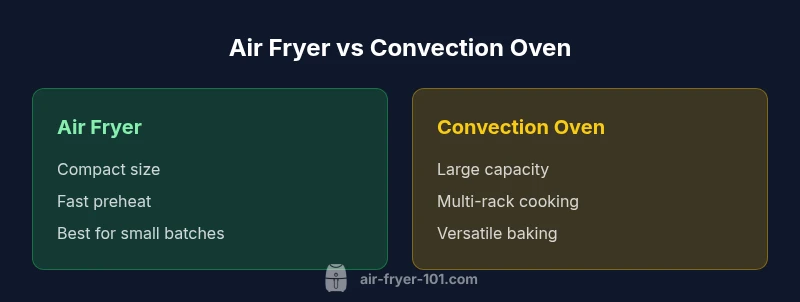
Air fryer is best for small batches and crisp textures; convection ovens excel for larger meals and baking versatility
Choose air fryer for quick, crisp results in limited space. Choose convection oven for bulk cooking and broader baking tasks; both complement a well-equipped kitchen.
Got Questions?
Is it the same as a convection oven?
Not exactly. Both use fan-assisted heat, but air fryers are smaller with focused airflow for crisping, while convection ovens are larger and better for bulk cooking and multi-rack baking. The best choice depends on batch size and texture goals.
Both use fan-assisted heat, but air fryers are smaller and crispier, while convection ovens handle larger batches and baking.
Can you bake cookies in an air fryer?
Yes, you can bake cookies in many air fryers, but you’ll likely need to use smaller cookies and monitor closely to avoid over-browning. Space them in a single layer and rotate the tray for even browning.
Yes, but bake small batches and watch closely for even browning.
Do I need to preheat an air fryer?
Preheating is often recommended for consistent results, especially for crispy textures. Some models reach temperature quickly, so preheat time can be short. Check your manual for specific guidance.
Preheating helps with crispiness; follow your model’s guidance.
What foods work best in an air fryer?
Foods with a high surface area and moisture that benefits from quick browning, such as fries, wings, nuggets, reheated leftovers, and small vegetables. Large roasts and multi-rack baking are often better suited to a convection oven.
Great for fries, wings, and small batches requiring crispness.
Can I replace a convection oven with an air fryer in a small kitchen?
An air fryer can cover many quick, crisp tasks, but it won’t fully replace an oven for large meals or multi-rack baking. Use the air fryer for small batches and rely on the convection oven for bigger cooking needs.
Nice for quick tasks, but not a complete oven replacement.
How do I convert oven recipes to air fryer?
Start with the dish category, adjust for airflow, and monitor doneness early. Reduce temperature slightly and shorten cooking time; check frequently and use a thermometer for accuracy.
Adapt by lowering temp, shortening time, and checking early.
Quick Summary
- Choose air fryer for fast, crispy results in small batches
- Use convection oven for large meals and baking versatility
- Adapt recipes with mindful temperature and time adjustments
- Maximize results by avoiding overcrowding and using airflow-friendly cookware