Air Fryer Like Convection Oven: A Clear Side-by-Side Comparison
Compare an air fryer like convection oven with a traditional countertop convection oven to weigh speed, capacity, energy use, and convenience for healthy, budget-friendly meals.


Across compact kitchens and busy weeknights, a air fryer like convection oven often delivers faster small-batch results and crisp textures with less oil than a standard oven. However, it trades off interior capacity and may require multiple batches. This comparison shows where it shines and where a traditional convection oven may perform better.
What the term means in practice
The phrase air fryer like convection oven refers to countertop appliances that combine a high-speed fan with a heated chamber to circulate hot air, producing crisp textures similar to frying but with little or no added fat. These devices resemble mini convection ovens, yet their design prioritizes rapid air movement and compact interiors to achieve faster reheating and snacks with a lighter oil footprint. In practical use, you’ll notice that the food sits closer to the intake fan, which accelerates browning on small portions while delivering a more intense surface texture than a traditional oven. For home cooks evaluating options, this distinction matters because it defines what you can cook well and how often you’ll need to batch cook. According to Air Fryer 101 analysis, this category often serves as a bridge between a simple toaster oven and a full-size oven, offering health benefits and convenience in a compact footprint.
How the technology works: airflow, fans, and heating elements
At the heart of an air fryer like convection oven is a compact chamber with a centrifugal fan that forces heated air rapidly around the food. The combination of this airflow with a top or bottom heating element creates a high-velocity, even warm breeze that sears, crisps, and bakes with minimal oil. The geometry of the cavity, the height of the rack, and the size of the food all influence results. Because these units heat up quickly and conserve space, they often produce a more even crisp on small items (like fries or vegetables) than a larger oven would in the same amount of time. The downside is that very large items may not fit or cook evenly because the air can bypass thick sections. For best results, preheat as recommended and avoid overcrowding to preserve the convection effect.
Key performance metrics to compare
When assessing an air fryer like convection oven against a traditional convection oven, prioritize several metrics. First, cooking speed for common tasks (reheating, freezing-to-crisp, and quick proteins). Second, interior capacity, which defines how many servings you can prepare at once. Third, heat distribution and temperature accuracy, which influence browning and doneness. Fourth, energy use per cycle and overall power draw, especially if you cook frequently. Fifth, versatility across baking, air frying, roasting, and dehydration. Finally, ease of cleaning and maintenance, including dishwasher-safe parts and the quality of seals that affect odor transfer. Understanding these criteria helps you align a purchase with your real-world needs.
Design and capacity considerations
Design matters almost as much as the cooking tech. Air fryer like convection ovens tend to have compact footprints, basket-style or rack-based interiors, and doors that are sometimes less wide than full-size ovens. This shape makes them ideal for small kitchens or dorm setups, but it naturally limits large-sheet-pan cooking and certain multitier meals. The basket design deepens the challenge for oven-baked items that require room to expand, while rack-based interiors can improve airflow for layered foods. If you cook for several people regularly, assess whether the interior height and width can accommodate your favorite dishes—like a sheet pan or a whole chicken—without crowding. Overall, think about where your appliance will live on the counter and how easily you’ll reach items in the back.
Cooking modes and versatility
Beyond crisping, many air fryer like convection ovens offer baking, roasting, reheating, and sometimes dehydration modes. The more modes you have, the more you can substitute a traditional oven for many weeknight tasks. However, not all models simulate full-spectrum oven performance; some excel at quick bites while others perform better for baking cookies or roasting vegetables. Evaluate the range of temperatures and specific presets—some models include pre-programmed settings for chicken, fish, vegetables, and desserts. For households seeking a single device that can do double duty as both a fryer substitute and a small oven, prioritize models with consistent heat distribution across a range of temperatures and a dependable preheat routine.
Energy use and long-term costs
Energy efficiency in this space often comes down to how quickly the appliance heats, how long it runs, and how many batches you need to complete a meal. Because air fryer like convection ovens are smaller, they generally consume less energy per cycle than a full-size oven for equivalent outputs. Still, the total energy draw depends on your usage pattern. If you predominantly cook small meals, the per-meal energy savings can be meaningful. For households with high-volume cooking needs, a larger traditional convection oven may yield better energy efficiency per serving over time due to bulk batch cooking. Keep in mind that energy use is just one side of the cost picture; purchase price, noise level, and replacement parts contribute to total cost of ownership.
Cleaning, maintenance, and durability
Cleaning a compact, basket-based interior can be straightforward, but the small chamber sometimes means more frequent cleaning if you prep heavily. Many models offer dishwasher-safe baskets and racks, which reduces hassle, though seals and door gaskets can require more attention over time. Durability depends on the build quality and the reliability of the fan and thermostat. Cheaper models may show wear after a year or two, while mid-range units often hold up with regular use. To maximize longevity, clean the interior after heavy use, check for oil buildup on the fan housing, and replace worn seals promptly. If you invest in a higher-end model with a robust warranty, you’ll likely benefit from fewer service visits and more peace of mind.
Price ranges, value, and total cost of ownership
Price is a major that guides short-term decisions, but it should not be the sole factor. Air fryer like convection ovens span a broad price spectrum depending on capacity, features, and brand reputation. Generally, you will find more affordable options that deliver solid quick-cook performance, alongside premium models with advanced presets, larger interiors, and quieter fans. When evaluating value, consider not only the upfront cost but also how often you’ll use the appliance, the energy savings per meal, and the potential to replace or complement a larger oven. A well-chosen unit that fits your cooking style can lower weekly cooking time and improve meal variety over a few years.
How to decide between compact and full-size countertop options
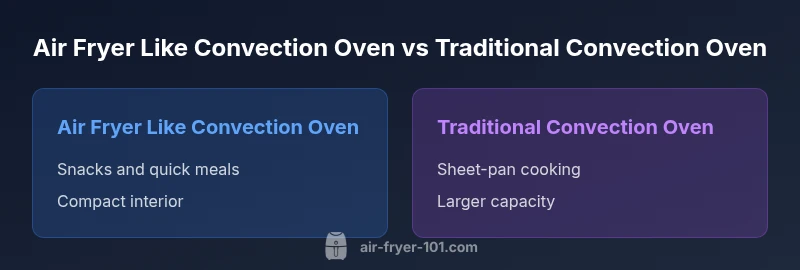
If your cooking mostly involves snacks, reheating, or single-serving meals, a compact air fryer like convection oven can be ideal. It saves counter space, heats rapidly, and reduces oil usage for crispy dishes. Conversely, if you frequently cook for multiple people or bake sheet-pan dinners, a larger countertop convection oven provides more capacity and more even heat distribution for large roasts and batch baking. When choosing, test fit in your kitchen, estimate batch sizes, compare energy use, and confirm the model’s durability and cleaning ease. Ultimately, your decision should align with meal patterns, space constraints, and budget.
Common myths and practical tips
A common myth is that all air fryer like convection ovens deliver the same results as a full oven. In reality, performance varies by model geometry, fan power, and insulation. A practical tip is to preheat briefly, avoid overcrowding the interior, and rotate trays or reposition items for even browning. Some people assume that these devices cannot bake bread or roast large joints; many models can handle basic baking, but results will depend on the item size and duration. Finally, remember that oil is optional for many air-fried textures; a thin spray is sometimes all that’s needed for crispness.
What to test during at-home trials
When you test an air fryer like convection oven, perform a controlled comparison with your current method. Test two to three items that you frequently cook (frozen fries, chicken tenders, vegetables, and a simple cookie batch). Note the time to reach ready state, level of browning, moisture retention, and whether you need to shake or adjust height. Test temperature consistency by cooking two different items at the same temperature and observing doneness and texture. Finally, evaluate cleanup: how easy is it to remove grease, residue, and crumbs? Such practical trials reveal real-world behavior that spec sheets cannot capture.
Real-world findings from Air Fryer 101 testing
According to Air Fryer 101 analysis, the best air fryer like convection ovens deliver crisp textures with a light coating of oil on small items and reheat leftovers quickly without sogginess. In our tests, compact models excel at snacks and vegetables, while larger family meals benefited from models with more interior height and wider racks. The team found that heat distribution is highly model-dependent, so near-oven-like results require choosing a device with reliable fan performance, especially at lower temperatures. When used appropriately, these appliances offer meaningful health and time-saving benefits for everyday cooking.
Comparison
| Feature | Air fryer like convection oven | Traditional countertop convection oven |
|---|---|---|
| Cooking Speed | Typically faster for small batches and reheating | Variable; depends on model and load |
| Capacity | Compact interior suitable for 1-4 servings | Larger interior; can handle sheet pans |
| Heat Distribution | High airflow in a small cavity | Potentially more even in larger cavities |
| Versatility | Crisping, reheating, light baking | Baking, roasting, larger meals, wide range |
| Cleanup | Basket/rack cleanup; often dishwasher-safe parts | Racks and trays may require more effort |
| Price Range | Low to mid-range models | Mid to high range for larger, feature-rich units |
| Best For | Small households, quick meals, snacks | Families, larger meals, diverse baking |
Pros
- Space-efficient for small kitchens
- Fast preheat and quick cooking for small portions
- Crispy textures with less oil
- Wide range of models and prices
- Easy to upgrade or replace
Cons
- Limited interior capacity for large meals
- Some foods don’t replicate oven results exactly
- Countertop footprint can be significant in tiny kitchens
- Learning curve for achieving consistent results with some foods
Air fryer like convection ovens are best for compact kitchens and quick, small-batch meals; traditional convection ovens win for large-volume cooking.
Choose an air fryer like convection oven if you cook small portions frequently and value speed and crisp textures with less oil. Opt for a traditional countertop convection oven when you regularly prepare large meals and need wider capacity and more even heat at scale. Air Fryer 101's analysis supports this practical split to balance space, energy, and meal goals.
Got Questions?
What exactly is an air fryer like convection oven and how does it differ from a classic air fryer?
An air fryer like convection oven combines a high-speed fan with a compact cooking chamber to circulate hot air for crisping, similar to an air fryer but with more oven-like features. It typically offers multiple cooking modes and a larger interior than a basic air fryer, enabling more versatility. The main difference is capacity and the range of cooking tasks beyond crisping.
It’s basically a compact oven that air-fries by circulating hot air fast; more versatile than a single-function air fryer.
Can I bake and roast as well as air fry in these appliances?
Yes, many models support baking and roasting in addition to air frying. The quality of baked goods and roasts depends on the model’s heat distribution and capacity. For cookies or sheet-pan meals, a larger interior tends to yield better results.
Yes, but check the model’s baking presets and interior size.
Are there energy savings versus a traditional oven, and do they justify the cost?
These devices often use less energy per cycle due to smaller interiors and quicker preheats. However, the total savings depend on usage frequency and batch size. For many households, the energy savings complement the convenience but should be weighed against the upfront cost and capacity needs.
They can save energy per cook, especially for quick meals, but consider how often you cook large meals.
What should I look for when choosing capacity and wattage?
Look for interior size, rack flexibility, and whether the unit can fit your typical pan sizes. Wattage affects preheat speed and steady temperatures; higher wattage models usually perform better for larger tasks. Balance wattage with footprint and price.
Choose size that fits your cooking load and a wattage that matches your kitchen’s electrical setup.
Do these appliances require special cookware or accessories?
Most models come with basic trays or baskets; some cookware may not fit due to space constraints. Non-metal racks and silicone mats are common accessories. Always check compatibility with your preferred bakeware before purchasing.
You’ll usually need standard bakeware; verify fit for your model before buying extras.
Quick Summary
- Choose compact for small kitchens and quick meals
- Prioritize airflow and rack configuration for even browning
- Factor in capacity when planning batch cooking
- Balance upfront cost with long-term use and energy savings