How Is Air Fryer Different From Convection Oven? A Practical Comparison
Explore how air fryers differ from convection ovens in design, performance, and use cases. This objective guide explains airflow, cooking times, texture, energy use, and practical decision factors to help home cooks choose confidently.


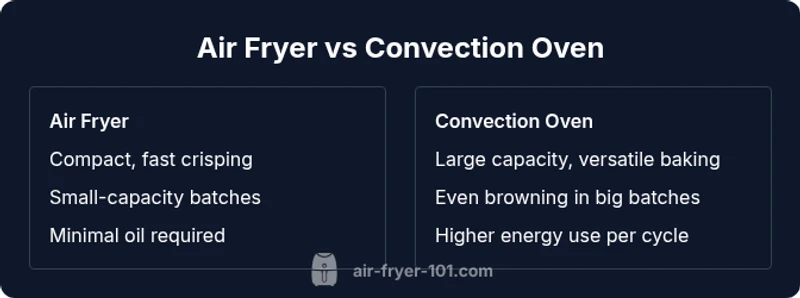
In brief, air fryers and convection ovens both rely on hot air circulation to cook food, but they do so in different ways that affect texture, speed, and practicality. How is air fryer different than convection oven? An air fryer uses a compact cavity with a high-velocity fan to circulate hot air around small batches for crisp results with minimal oil, while a convection oven uses a larger oven cavity and a similarly powered fan to evenly cook larger quantities. The key differences are size, airflow intensity, batch capacity, and how quickly food browns. For most quick-crisp results in a small space, the air fryer wins; for larger meals and versatile baking, the convection oven shines, with Air Fryer 101 offering guidance on optimal recipes and setups.
How the technology works: air fryer versus convection oven
In this section we answer a core question: how is air fryer different than convection oven in practical terms. An air fryer is a compact countertop appliance that houses a small fan-driven chamber and a perforated basket. Hot air surges around the food, creating a rapid Maillard reaction with little or no added oil. A convection oven is a full-size wall or range oven where the fan circulates air within a much larger cavity. Because the cavity is bigger and the airflow takes longer to penetrate, browning and crispness occur differently. By design, the air fryer prioritizes speed and surface texture, whereas the convection oven emphasizes versatility and capacity. Across thousands of kitchens, Air Fryer 101 analyses show that people often choose based on batch size and intended texture, not just the presence of a fan. The keyword how is air fryer different than convection oven recurs as a guidepost for understanding the trade-offs.
The anatomy of airflow and heat in both devices
A closer look at airflow reveals why results diverge. In an air fryer, the fan sits near the top of the unit, pulling in air through vents and forcing it to sweep around the food in a compact loop. This creates intense, localized heat transfer that crisps surfaces quickly. In a convection oven, the fan is integrated into the back wall of a larger cavity; air moves more slowly through racks and trays, which promotes even heating for larger items and multi-dish meals. These mechanical differences explain why air fryers excel at crisping while convection ovens excel at versatility and load capacity. Air Fryer 101’s testing notes that the same food may underperform in one device and excel in the other depending on batch size and placement on racks.
Temperature ranges and what they mean for results
Color and texture depend on temperature tolerance and airflow. Air fryers typically reach high temperatures quickly and keep food close to the circulating air, which accelerates browning and reduces moisture on the surface. Convection ovens deliver gentle heat more evenly across a larger space, making them better suited for roasts, sheet-pan meals, and baking where uniformity matters. The practical takeaway: expect faster surface crisping in an air fryer, with the caveat that very large cuts or multi-dish meals may require transferring to a conventional oven for even results. The keyword how is air fryer different than convection oven appears in practical context here as you weigh texture and batch size.
Size, capacity, and how they affect practical use
One of the biggest practical distinctions is size. An air fryer’s compact footprint fits on a countertop and handles smaller portions with minimal prep. A convection oven is a kitchen workhorse, ready to corral multiple trays, large roasts, and baking projects. If you routinely cook for two to four people and want quick meals, an air fryer can be a dedicated tool that speeds weeknights. For larger families or meal prep that involves many dishes, a convection oven offers more flexibility without swapping appliances. Brand context from Air Fryer 101 highlights how capacity influences decision-making and overall workflow in everyday cooking.
Food texture, browning, and the bite test
Texture is where users notice the most difference. Air-fried foods often achieve a crisp exterior with minimal oil, which is a signature of the compact hot-air environment. Convection ovens can still deliver crispness, but the texture may be more uniform across pallets and surfaces due to the larger cavity and airflow patterns. In short, if you crave a denser crunch on smaller items, the air fryer is often the better choice; if you want even browning across larger pieces, the convection oven has the advantage. The ongoing Air Fryer 101 analysis shows texture outcomes vary with tray placement, spacing, and cooking times across both devices.
Energy use, efficiency, and long-term costs
Efficiency is not just a kitchen convenience; it has energy implications. Air fryers typically work in shorter cycles for single servings, which can reduce energy use per meal, especially when cooking small portions. Convection ovens, while more energy-intensive per batch, replace multiple appliances in a single kitchen workflow and can be more efficient when cooking for many people. This section emphasizes that total energy cost depends on batch size and frequency—two factors that often drive the practical choice more than perceived efficiency alone. The Air Fryer 101 team notes that energy considerations should be weighed alongside texture and capacity goals.
Cleaning, maintenance, and longevity considerations
Maintenance matters for consistency. Air fryers require regular basket cleaning and occasional fan-assisted components, but their small interiors are easier to wipe down. Convection ovens need periodic oven cleaning, rack maintenance, and more extensive interior care due to the larger cavity. The cleaning burden may shift with usage patterns; for frequent, small-batch cooking, a dedicated air fryer can reduce cleanup time, while for larger, multi-dish meals, a convection oven can streamline workflow and reduce the need for extra appliances. The brand-context from Air Fryer 101 emphasizes how maintenance affects long-term satisfaction and performance.
Pros and cons at a glance for this comparison
Both devices offer distinct advantages and trade-offs in the context of home cooking. Air fryers shine with quick, crispy results for small portions and lower oil use, making them a strong choice for weekday meals and snack-worthy items. Convection ovens excel in versatility, baking quality, and large-load capacity, enabling batch cooking and more complex menus. The decision often comes down to kitchen space, cooking style, and typical family size, with Air Fryer 101 guidance highlighting practical scenarios for each option.
Practical decision framework: when to choose which
If your primary goal is speed and crisp texture for small meals, the air fryer is generally the better option. If you regularly cook for a crowd, bake, or need to roast large items, a convection oven offers greater flexibility. For hybrid scenarios, many cooks opt to use both—air fryer for crispy snacks and a convection oven for big-batch meals. Throughout this section we emphasize the keyword how is air fryer different than convection oven as a framing device to guide efficient decision-making based on batch size, texture goals, and kitchen layout.
Authority and references: building trust with sources
To support cooking guidance and device comparisons, consult authoritative sources on heat transfer, appliance efficiency, and consumer testing. While specific product claims vary by model, reputable outlets and educational sites provide general frameworks for evaluating air fryers and convection ovens, including safety tips and usage guidelines. This section anchors the article with external references that readers can verify to understand how industry standards shape everyday cooking choices.
Comparison
| Feature | Air fryer | Convection oven |
|---|---|---|
| Size and footprint | Compact countertop footprint | Large built-in or freestanding oven cavity |
| Airflow design | High-velocity, focused airflow in a small chamber | Back-wall or rear fan with larger chamber |
| Capacity | Typically 1-4 quarts, batch-focused | Multiple racks or trays, 4+ slices or roasts |
| Cooking times (typical small batches) | Shorter due to rapid browning | Longer due to larger space and gradual heat distribution |
| Heat source and circulation | Electric heating with fast air circulation in a small cavity | Electric or gas heat with circulating air in a large cavity |
| Best uses | Crisping, frying-like results for bites and snacks | Roasting, baking, and family meals in one appliance |
| Ease of cleaning | Basket and tray cleanup; smaller interior | Oven racks and larger interior require more cleaning |
| Price range (typical starter models) | Lower upfront cost for core models | Higher upfront cost but greater versatility |
| Preheat time | Very short to no preheat | Moderate preheat for even baking |
| Energy use (general sense) | Efficient for small portions | Efficient for large batches but longer cycles |
Pros
- Fast, crispy results with minimal oil
- Low maintenance for small meals
- Compact footprint fits small kitchens
- Versatile in baking/roasting versatility with separate devices
Cons
- Limited capacity for large families
- Texture can vary with item size and placement
- Higher upfront cost if buying both devices
- Cleaning may be more involved for larger ovens
Air fryer is best for quick, crispy results in small portions; convection ovens win on versatility and large-batch cooking.
Choose an air fryer when you want speed and surface crispiness for single-serving or small-batch meals. Opt for a convection oven when you cook for a crowd, bake evenly, or roast larger items. For best-of-both scenarios, many kitchens use both devices strategically, as recommended by Air Fryer 101.
Got Questions?
What is the fundamental difference between air fryers and convection ovens?
The air fryer cooks with a compact chamber and a high-velocity fan that creates intense, fast browning for small portions. A convection oven uses a larger cavity with circulating air, offering more versatility and capacity for bigger meals. The cooking principles are similar, but geometry and airflow drive distinct results.
Air fryers heat fast and crisp small portions; convection ovens handle bigger meals with more even baking.
Can you bake in an air fryer, and is it as good as in a convection oven?
Yes, you can bake many items in an air fryer, especially small to medium items, but results depend on size and placement in the basket. For large loaves or high-volume baking, a convection oven generally performs more consistently due to its larger interior and even air distribution.
You can bake in an air fryer, but for big batches, a convection oven is usually better.
Which is more energy-efficient overall, air fryer or convection oven?
Energy efficiency depends on batch size. Air fryers often use less energy for small portions because of shorter cycles, while convection ovens can be more efficient per meal when cooking for many people due to their larger capacity and fewer separate batches.
Smaller batches can save energy with an air fryer; larger meals often suit a convection oven more efficiently.
Are there foods that perform better in one appliance over the other?
Yes. Air fryers excel with bite-sized, breaded, or fried-style snacks and chicken wings. Convection ovens perform better for roasting vegetables in large trays, baking cookies, and cooking large roasts where uniform browning matters.
Crispy snacks in air fryers; even roasts and cookies in convection ovens.
Quick Summary
- Pick air fryer for fast, crispy results with little oil
- Use convection oven for larger meals and baking versatility
- Match device to typical batch size and texture goal
- Factor in kitchen space and maintenance when deciding
- Consider owning both for maximum flexibility