Air Fryer vs Conventional Oven: Which Is Right for Your Kitchen?
Compare air fryer vs conventional oven to decide which appliance fits your kitchen. Examine speed, capacity, energy use, texture, versatility, and maintenance to make healthier, faster cooking decisions for small meals or family-sized dishes.


Air fryers excel at quick, small-batch meals with a crisp finish and minimal oil; conventional ovens handle larger quantities and baking with even browning. For most households, an air fryer is ideal for snacking and weeknight sides, while the oven remains the workhorse for family meals and baking. Choose both if space allows.
What the comparison means for home cooks
In the broad debate of air fryer vs conventional oven, the decision hinges on batch size, space, and the range of foods you cook regularly. An air fryer is a compact appliance that circulates hot air rapidly around food in a small basket, delivering a crisp exterior with little to no oil. A conventional oven is a larger cavity that relies on a heating element and fan (in many models) to achieve even browning across larger items. Understanding the core differences helps you align cooking goals with appliance capabilities. When you size up your kitchen and your weekly menu, you’ll see that the air fryer vs conventional oven question is less about a single winner and more about the right tool for the right job within your space.
This article uses the phrase air fryer vs conventional oven to emphasize the practical tradeoffs between speed, texture, capacity, and energy use, so you can pick the best tool for each cooking task.
Speed, preheating, and batch efficiency
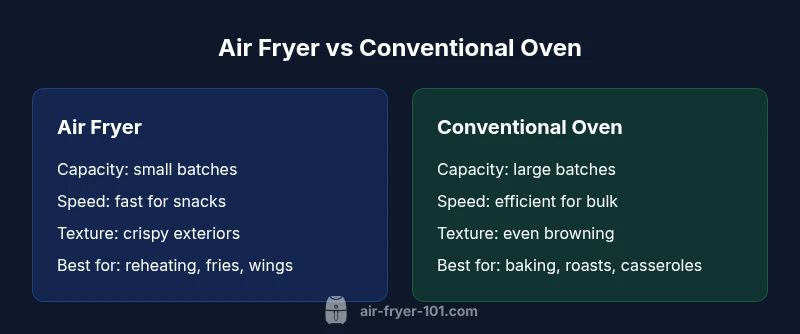
Speed is often the first factor home cooks notice in the air fryer vs conventional oven debate. Air fryers excel for quick, single-serving or small-batch items like fries, wings, vegetables, and reheated leftovers. Because air fryers are compact, preheating times are typically shorter, and they can reach target temperatures quickly, which translates to shorter overall cook times for small portions. In contrast, conventional ovens are slower to preheat but can handle larger volumes in a single batch, making them more efficient for family dinners or batch cooking. The key distinction is not just speed but batch efficiency: air fryers win on speed for small outputs; ovens win on capacity for larger meals and multi-dish meals.
Capacity, footprint, and kitchen layout
Capacity and footprint are critical in the air fryer vs conventional oven decision. Air fryers come in compact footprints that fit neatly on most countertops, ideal for studios, apartments, or kitchens with limited space. However, their capacity is inherently smaller, which means more batches for larger meals. Conventional ovens, whether built-in or freestanding, offer substantial cooking volume and can handle multiple racks for roasting, baking, and broiling at once. The layout trade-off is clear: air fryers save space but limit batch size; ovens consume more space but unlock greater versatility and quantity.
Texture, browning, and moisture management
Texture is a defining factor in the air fryer vs conventional oven comparison. Air fryers create a crisp, fried-like exterior with a relatively moist interior when foods are cooked properly, often with minimal oil. They excel at evenly crisp exteriors for items like chicken tenders and vegetables. Conventional ovens deliver even browning across larger surfaces and are superior for delicate bakes, casseroles, and roasted meats where uniform temperature distribution matters. For breaded items, the air fryer’s rapid air can yield crisp coatings, while the oven can produce deeper browning on larger roasts.
Baking, roasting, reheating, and versatility
The air fryer shines for reheating and quick bakes, but its versatility ends up narrower than a full oven. You can bake cookies, muffins, and small cakes in some air fryers, but results vary by model and capacity. The conventional oven, meanwhile, remains the flagship for baking bread, pies, sheet-pan meals, and large roasts. If you frequently bake or cook for a crowd, the oven generally offers a more forgiving and scalable workflow. In the air fryer vs conventional oven debate, your menu will largely guide your choice: crisp-snack reliance versus all-day baking and roasting.
Energy use, operating costs, and heat in the kitchen
Energy use is a practical concern in the air fryer vs conventional oven discussion. Air fryers typically consume less energy per batch due to smaller size and shorter cook times for small items, translating into energy savings for quick meals. Ovens, while efficient for large quantities, often pull more power and emit more ambient heat, which can impact kitchen comfort and cooling costs, especially in warm climates. If you’re balancing energy costs with cooking needs, consider how often you cook small meals versus family-sized dinners and how much kitchen heat you’re willing to tolerate during hot months.
Maintenance, cleanup, and durability
Cleanup is another practical factor in the air fryer vs conventional oven discussion. Air fryer baskets are usually removable and dishwasher-safe, making quick weekly cleanup straightforward. Ovens require interior cleaning when spills occur and can benefit from self-clean cycles or professional maintenance, depending on model. Durability varies by build quality and usage: high-end ovens may outlast compact air fryers in heavy use, but a well-made air fryer can be a reliable daily helper for quick meals and snacks.
Price, value, and long-term considerations
Price often drives initial decisions in the air fryer vs conventional oven debate. Air fryers span a wide range, typically from the low hundreds to a few hundred dollars for more capable models. Conventional ovens vary even more, with standalone units, built-ins, and ranges depending on features and capacity. When weighing value, consider not only upfront cost but energy use, maintenance, and how often you will use each appliance. If your cooking style favors quick, crisp results for small portions, an air fryer offers strong value; if you frequently bake and roast for several people, the oven provides broader flexibility and capacity.
Comparison
| Feature | Air fryer | Conventional oven |
|---|---|---|
| Capacity | Small batches (1-4 servings) | Large batches (6-24 servings) |
| Cooking speed | Faster for small items and snacks | Slower for small batches; efficient for many items when batch-cooking |
| Preheating | Often minimal or no preheat | Preheat often required (longer) |
| Texture and browning | Crisp, fried-like exterior | Even browning across larger surfaces |
| Versatility | Best for roasting, reheating, snacks | All-around: baking, roasting, broiling, and more |
| Capacity footprint | Countertop-sized, compact | Built-in/standalone, large footprint |
| Maintenance | Removable baskets; easy cleanup | Ovens require rack cleaning and interior wipe-downs |
| Price range | $60-$250 | $300-$2000 |
| Best for | Small households, quick meals | Large families, baking, and batch cooking |
Pros
- Fast, crisp results with little oil for small batches
- Compact footprint fits small kitchens and apartments
- Versatile for reheating, roasting, and some baking
- Lower upfront cost for basic models
- Energy-efficient for short, high-velocity cooking
Cons
- Limited capacity requires multiple batches for large meals
- More countertop clutter if you own multiple appliances
- Not all foods translate perfectly to air fryer results
- Larger ovens offer greater capacity and baking versatility
- Some foods don’t fit well in air fryer baskets
Air fryer is ideal for quick, small-batch cooking; the conventional oven remains the go-to for large meals and baking.
Choose the air fryer for speed, crisp results, and minimal oil with small portions. Opt for the conventional oven when you routinely cook for many people, bake, or need extensive versatility. In many kitchens, both appliances together deliver the best overall performance.
Got Questions?
Is an air fryer healthier than a conventional oven?
Air fryers can reduce oil use for many foods, which may lower overall fat intake. However, health impact depends on the ingredients and how you cook them. A conventional oven can be just as healthy when cooking with little oil and focusing on lean ingredients.
Air fryers can cut oil, but healthy cooking depends on ingredients and methods; ovens can be equally healthy with mindful choices.
Can you bake in an air fryer?
Many air fryers offer baking modes or sufficient space for small cakes, muffins, and cookies. Results vary by model, but you can achieve delicious baked treats on a smaller scale. For larger baking projects, a traditional oven is generally more practical.
Yes, you can bake small treats in some air fryers; results depend on the model and batch size.
Do air fryers cook faster than ovens?
Air fryers typically cook faster for small items due to rapid hot-air circulation. For larger dishes, ovens can be faster on a per-dish basis when cooking multiple items at once. Overall, expect faster turnaround on small, crisp foods with an air fryer.
Usually faster for small items; ovens may win on bulk cooking.
Is preheating necessary for air fryers?
Many air fryers heat quickly with little or no preheating; others perform better after a brief preheat. Check your model’s guide to optimize results for each recipe.
Preheating varies by model; some don’t require it, others benefit from a short preheat.
What foods are best in air fryer vs oven?
Air fryers excel with small, crispy items like fries, wings, and vegetables. Ovens shine with large roasts, casseroles, sheet-pan meals, and baked goods that require even heat over a bigger area.
Air fryers for crispy bites; ovens for big roasts and baking.
How should I decide when space is limited?
In tight spaces, an air fryer saves countertop room and reduces kitchen heat. If you bake often or cook for many people, keep a conventional oven because of its capacity and versatility.
In small spaces, air fryers save space; ovens are better for large families.
Quick Summary
- Prioritize batch size to decide: small batches favor air fryers; large meals favor ovens
- Use air fryer for crisp snacks and reheating; reserve oven for baking and multi-dish meals
- Consider kitchen space: countertop air fryers save room but limit capacity
- Factor energy and heat: air fryers often use less energy per batch; ovens heat larger spaces