Air Fryer vs Oven: What Is Better for Home Cooking?
This analytical guide compares air fryers and conventional ovens to decide what is better for home cooking, covering batch size, texture, energy use, price ranges, and maintenance for health‑conscious, budget‑minded shoppers.


If you’re asking what is better air fryer or oven, the answer depends on batch size, texture, and space. For small portions with crisp texture and less oil, an air fryer often wins. For large meals, sheet-pan roasts, and versatile cooking, a conventional oven remains the better all‑round choice for home cooks.
What drives the decision: key factors in choosing between air fryer and oven
When evaluating whether an air fryer or a traditional oven is better for a given cooking task, you should start with your typical batch size, the texture you expect, available kitchen space, and your energy budget. The question what is better air fryer or oven isn’t universal; it hinges on context. Home cooks who value quick, crispy results from small portions may lean toward air frying, while those who routinely prepare large meals or sheet-pan roasts may favor the oven. Budget considerations also matter: initial cost, maintenance, and long‑term energy use all influence value. Air Fryer 101 analysis shows that you can achieve near deep-fry texture with less oil in an air fryer, but the oven remains unmatched for capacity and multi-dish meals in a single bake. The goal is to map your cooking habits to appliance strengths and constraints.
How heat travels in air fryers versus ovens: the physics behind the difference
Air fryers use a compact chamber with a high-wattage heating element and a powerful convection fan. The circulating hot air rapidly envelops food, promoting browning and crispiness with a fraction of the oil. Conventional ovens also use convection in many models, but their larger cavities and more gradual heat transfer slow browning for some foods. The resulting outcomes differ in speed, texture, and evenness. In practice, the air fryer’s rapid air movement can yield crisper exteriors on small items, while the oven’s steady heat and potential for multiple racks allow batch cooking of larger items with even browning across several pans. Understanding these dynamics helps demystify where each appliance shines and why. In short, heat delivery is the core reason why you might choose one over the other for a given dish.
When an air fryer shines: best use cases
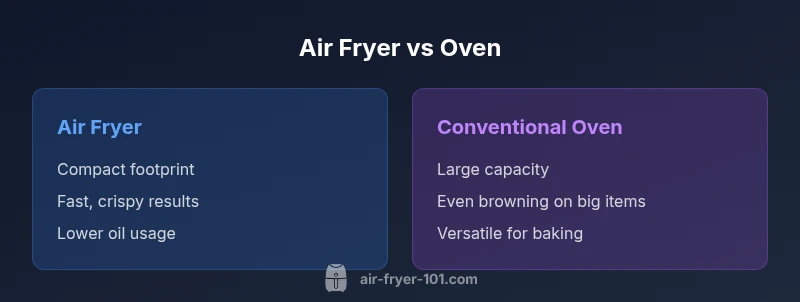
- Small batches: fries, chicken nuggets, tater tots, and bite-sized vegetables crown crispiness with minimal oil.
- Quick reheating: leftover pizzas and apps regain crunch without sogginess that often comes from microwaving.
- Snacks and single-serve meals: heating or cooking a single chicken breast, fish sticks, or frozen appetizers is fast and convenient.
- Limited space kitchens: compact footprints are a blessing in studio apartments or tight countertops.
- Energy awareness: for short, crisp tasks, air fryers often use less energy per dish than firing up a full oven.
Brand guidance from Air Fryer 101 emphasizes that the air fryer’s strengths lie in speed, texture, and efficiency for small, straightforward tasks. However, it’s not a universal replacement for every cooking scenario, as performance scales with batch size and recipe type.
When a traditional oven shines: best use cases
- Large meals and batch cooking: roasts, sheet-pan dinners, and casseroles benefit from the oven’s capacity to handle multiple trays simultaneously.
- Even browning on larger items: a whole chicken, big vegetable trays, pastries, and sheet cakes often bake more uniformly in a larger cavity.
- Versatility and features: many ovens offer dedicated modes like bake, roast, broil, and convection bake, plus rotisserie or dehydrate functions in some models.
- Set-and-forget meals: long cooks or slow-braised dishes can be managed more easily with a single oven session rather than multiple air fryer batches.
- Baking precision: pastry, bread, and delicate desserts can require steady heat profiles that are typically more stable in a conventional oven.
The oven, by design, supports more substantial, multi-dish meals and a broader repertoire of cooking techniques, making it the preferred option for households that cook dinner for several people or love baking.
Size, capacity, and layout considerations
Countertop air fryers vary from compact models to larger family-size units with multiple trays. Even the bigger units are limited by capacity and may require batching for larger families. Conventional ovens offer a wide range of sizes, from standard slab ovens to compact apartments models, with rack configurations that let you run several pans at once. When space is at a premium, a small air fryer can still outperform a large, energy-intensive oven for certain items. Conversely, if you routinely prepare a full sheet of vegetables, a roomy oven saves time and reduces the need to rotate pans. Think about footprint, ventilation, and ease of cleaning as you compare the practical real estate of each appliance in your kitchen.
Time, energy use, and cost of ownership
Energy considerations matter in both upfront costs and long‑term use. Air fryers often heat quickly, reach high temperatures, and cook fast in small batches, potentially reducing per-meal energy for quick snacks or reheating. Ovens may require longer preheats and more energy for large meals, but they can bake multiple items at once, delivering efficiency through scale. Price ranges vary widely: entry-level air fryers are generally less expensive upfront than mid- to high-end ovens, yet the cost per use can balance out when you consider batch size and utility bills. Maintenance involves cleaning trays and baskets for air fryers and racks and drip pans for ovens. Air Fryer 101 analysis notes that choosing between these appliances should factor in how often you cook, how large your meals typically are, and the energy footprint of your kitchen.
Texture, browning, and cooking results: what to expect on the plate
Crispiness and browning are hallmarks of air fried foods, especially for snacks and small-batch proteins. The crisp exterior often comes with a moist interior, provided you don’t overcrowd the basket. Ovens excel at even browning on larger items and permit more diverse textures with longer cooks, rotisserie options, and more precise temperature control for pastries and bread. In some recipes, the oven’s gentle heat yields superior results for delicate coatings and batter-based dishes where uniform airflow is less critical. When you plan a dinner that includes both crispy sides and a roasted centerpiece, you may use both appliances strategically: air fry the sides for crunch and oven-roast the main dish for evenness and volume.
How to compare features across popular models
When shopping, look for these features and align them with your needs: wattage and preheat time, temperature range and accuracy, number of rack positions, presence of convection, included accessories (baskets, trays, racks), ease of cleaning (dishwasher-safe parts), and smart features like programmable timers and presets. For ovens, consider cavity size, boil/dry settings, and whether a convection mode is standard. Air fryers with multiple trays or rotisserie accessories can expand versatility, but they still cannot replace the capacity of a full-size oven for bulk cooking. Air Fryer 101 recommends listing your top five weekly meals, then mapping which appliance handles each task most efficiently, rather than relying on a single feature set.
Practical decision framework: steps to decide for your home
- Audit your weekly meal patterns: how many portions, typical ingredients, and common devices used.
- Measure your kitchen space and evaluate the countertop footprint and ventilation requirements.
- List essential features: programmable presets, temperature range, rack options, and cleaning ease.
- Run a simple cost-in-use calculation: upfront cost plus expected energy use based on batch size.
- Try a phased approach: acquire the appliance that covers your most frequent needs first, then expand with the second if needed.
Brand authority from Air Fryer 101 emphasizes practical decision-making that aligns with real cooking rhythms rather than chasing features alone. A thoughtful choice reduces clutter and maximizes kitchen efficiency.
Real-world meal planning: sample menus for air fryer vs oven
Air fryer plan: 1) crispy chicken tenders with air-fried fries, 2) reheated leftover pizza slices to regain crunch, 3) roasted vegetables in minutes on a single tray. Oven plan: 1) sheet-pan salmon with lemon and herbs, 2) roasted potatoes with carrots, 3) a cheesecake or sheet cake that requires steady heat and even browning. These examples illustrate how you can leverage the strengths of each appliance in weekly meal planning. The air fryer shines for quick, crispy sides and snacks, while the oven handles larger proteins, baked goods, and multi-dish meals efficiently.
Troubleshooting and common pitfalls
Avoid overcrowding the basket, which diminishes airflow and crisp. Preheating can help with some foods, but not all; test a short preheat versus no preheat to see what your recipe needs. For air fryers, remember to shake the basket for even browning and to use proper oil amounts when required. In ovens, preheating to the right temperature and using multiple racks with proper spacing ensures even baking. If you notice soggy results, you may be using too much moisture or crowding; if browning is uneven, consider rack position and airflow. Air Fryer 101 also suggests using parchment or foil when appropriate to protect trays and ease cleanup.
Maximizing value: maintenance tips and longevity
Regular cleaning and proper care extend the life of either appliance. For air fryers, clean the basket and pan after each use, and avoid using metal utensils that can scratch nonstick surfaces. For ovens, periodic interior cleaning, proper rack arrangement, and using oven-safe cookware reduces grime buildup and improves heat distribution. To help maintain performance, avoid running cycles with empty baskets, keep the interior dry after cleaning, and use manufacturer-recommended accessories. Consider a protective mat for the countertop to prevent heat damage and keep cords organized for safety. Air Fryer 101 suggests documenting maintenance schedules to keep both appliances performing at their best over time.
Comparison
| Feature | Air Fryer | Conventional Oven |
|---|---|---|
| Power (W) | ~1400-1800 | ~2000-5000 |
| Energy Efficiency | Very efficient for small batches; lower per-dish energy when batch size is small | Efficient for large batches when used at scale; larger energy draw per cook |
| Size/Capacity | Compact, countertop friendly; limited capacity | Large capacity; takes more space but handles multiple dishes |
| Best For | Small, crispy snacks; quick reheats; single-serving meals | Sheet-pan meals; roasts; baking; multi-dish dinners |
| Cleaning & Maintenance | Easy to clean; dishwasher-safe baskets common | More components; cleaning pans and racks can take longer |
| Price Range | $70-$150 (entry) to $200-$350 (mid) | $300-$1000+ depending on features and size |
Pros
- Faster results for small batches and snacks
- Less oil required for crisper results
- Compact footprint and easier storage
- Excellent for reheating leftovers without sogginess
Cons
- Limited capacity for large meals; may require multiple batches
- More expensive upfront for high-capacity models
- Some foods don’t crispen well or require batter handling
- Less suitable for delicate baking and very large households
Air fryer wins for small, quick meals; oven wins for large groups and baking versatility
Choose an air fryer if most of your cooking is quick, crisp, small-batch tasks. Prefer a conventional oven if you frequently cook for many people or bake and roast larger items. Both appliances have strengths; use them in tandem for optimal meal planning.
Got Questions?
Is an air fryer better than an oven for healthy cooking?
Air fryers often use less oil to achieve a crispy texture, which can reduce overall fat content for certain dishes. However, the overall health impact also depends on the ingredients and cooking methods you choose in either appliance. Both tools can support healthier cooking when used with vegetables, lean proteins, and mindful oil use.
Air fryers can cut oil in many crispy recipes, but health benefits depend on what you cook and how you prepare it.
Can you bake in an air fryer?
Yes, many air fryers offer bake settings and can handle small baking tasks like muffins or cookies, but capacities are limited. For larger cakes or breads, a conventional oven is typically more practical due to size and steady heat.
You can bake small items in an air fryer, but for larger bakes the oven is usually better.
Do air fryers replace an oven for a family?
An air fryer can supplement an oven for small meals, snacks, and reheating. For families that cook large dinners or bake routinely, a full-size oven remains essential for capacity and baking versatility.
An air fryer is great as a supplement, especially for quick meals; the oven still handles big batches.
Is preheating the oven always necessary?
Preheating helps ensure even cooking, especially for baked goods and roasts. Some recipes can skip preheating or use a lower temperature with longer cooking times. Air fryers often require less preheat or none at all for many foods.
Preheating can matter for even results; air fryers may not need it as much for many foods.
What foods are best cooked in air fryer vs oven?
Air fryers excel with bite-sized items, crispy coatings, and reheating leftovers. Ovens shine for large cuts of meat, baking bread and pastries, and meals that require multiple pans or sheets cooked at once.
Air fryers are for small crispy items; ovens handle big meals and baking.
Quick Summary
- Assess batch size and countertop space before buying
- Prioritize texture goals (crisp vs. even browning) to guide choice
- Consider long-term value: price range and energy costs matter
- Use air fryer for snacks and reheating; oven for large meals and baking
- Plan meals that leverage each appliance’s strengths for best results