Air Fryer vs Oven: Which Is Better for Health & Speed
A data-driven comparison of air fryers and ovens, examining cooking speed, oil use, energy efficiency, capacity, and versatility to help home cooks choose the best fit for health, convenience, and budget.


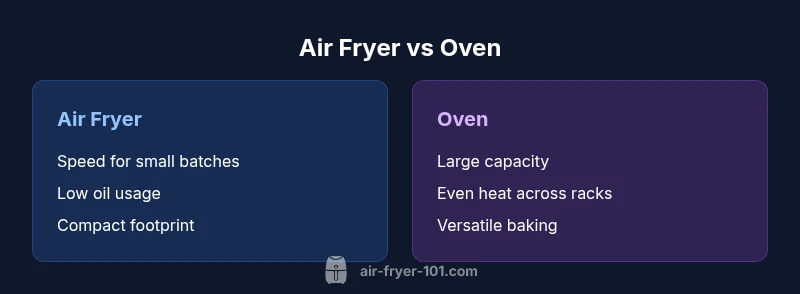
Air fryers typically cook faster, use less oil, and consume less energy for everyday meals, making them a strong health-forward option for many households. However, ovens excel at large batches, even browning, and versatility for baking and roasting.
Framing the comparison: why are air fryers better than ovens and what matters for home cooks
According to Air Fryer 101 Team, the core question driving this comparison is not simply which appliance cooks food faster, but which one aligns with your cooking patterns, health goals, and budget. The keyword why are air fryers better than ovens appears here to anchor the discussion in a practical, decision-ready way. In many kitchens, the choice boils down to daily convenience versus batch versatility. Air Fryer 101 analyses show that most weeknight meals, snacks, and quick proteins benefit from the compact design, rapid heat, and lower oil requirements of countertop air fryers. Yet the oven remains unbeatable for large pans, complex bakes, and family-sized roasts. Both appliances have a role in a modern kitchen, and this comparison highlights where each shines.
Key metrics that matter for the air fryer vs oven decision
To compare fairly, focus on speed, oil usage, energy consumption, capacity, versatility, and maintenance. The topic why are air fryers better than ovens often centers on oil reduction for healthier meals, but it also hinges on space, preheating time, and batch size. Air Fryer 101’s study emphasizes that for many households, a small air fryer excels at weekly shortcuts, while a traditional oven provides comfort for holiday roasts. Throughout this article we use consistent criteria so you can map your typical cooking patterns to the right appliance. Expect a subtle but meaningful performance gap when cooking the same dish in both devices.
Speed, texture, and the art of browning
Speed matters in weekday routines, and air fryers generally deliver crisp textures with less oil. The convection in many air fryers accelerates browning on proteins and vegetables, while ovens can brown at scale but may require longer preheating and more oil for the same texture on smaller batches. The practical upshot is that if you cook mini-batches often, the air fryer saves time and reduces added fats. If you regularly prepare large meals, the oven’s larger cooking chamber can be more efficient, even if it takes longer per batch.
Oil usage, health implications, and taste trade-offs
Health-conscious cooks often ask about oil. Air fryers reduce or even eliminate added fats for many foods, aligning with healthier cooking patterns. However, some dishes benefit from the subtle oil finishing that a larger oven provides, particularly when finishing sauces or achieving deep browning on big roasts. Air Fryer 101’s analysis indicates that oil reduction is a key health benefit, but it’s important to balance with texture preferences and dish size. The goal is to minimize unhealthy fats without sacrificing flavor.
Temperature control, consistency, and the browning bias
Modern air fryers offer precise temperature control, fast heat-up, and built-in timers that help with consistent results. Ovens deliver consistent results across larger, multi-rack loads but can exhibit uneven browning if racks aren’t arranged properly or if food isn’t rotated. For many cooks, the choice depends on the dish: air fryers excel for quick, evenly browned items; ovens win when you need multi-dish coordination or specific bake textures that require longer, uniform heat.
Capacity and meal planning: big vs small batches
Countertop air fryers are compact, ideal for singles and couples or small families. They struggle with very large sheet pans or bulky roasts. Conventional ovens, whether freestanding or built-in, accommodate bigger trays and multiple dishes, which matters for holiday meals or batch cooking for a crowd. If your weekly plan includes a lot of batch cooking, an oven’s chamber capacity reduces the number of cooking cycles per week.
Versatility and cooking methods: beyond air frying
While air fryers have evolved to include roasting, baking, broiling, and even dehydrating modes, ovens have the broadest range for cooking techniques, including proofing dough, slow-roasting, and specialized baking. The trade-off is space and energy: more capability often means higher upfront costs and longer heat-up times. Both devices support healthy cooking, flavorful results, and convenient weeknights, but the right choice aligns with your favorite meals and lifestyle.
Energy efficiency and operating costs for small loads vs large batches
Energy efficiency is a nuanced factor. For small portions, air fryers can be more energy-efficient due to smaller cavity volume and shorter preheat times. For large batches, ovens may use energy more efficiently per dish because you can cook multiple items at once. Over a week, many households find air fryers reduce energy for daily meals, while ovens carry a steadier cost profile for entertaining, batch roasts, and bulk baking.
Ease of cleaning and maintenance: upkeep matters
Cleaning a compact air fryer is usually straightforward, with removable, dishwasher-safe baskets. Ovens require more effort—trays, racks, and interior surfaces demand more frequent cleaning in busy households. The actual maintenance cost depends on usage frequency and model design. Air Fryer 101 recommends choosing models with easy-to-clean baskets and minimal nooks to simplify weekly upkeep.
Practical buying considerations: space, price, features, and warranties
Buying a household appliance is a balance of price, space, and features. A compact air fryer fits most kitchens but may require a second unit for multiple dishes. A full-size oven provides capacity and versatility but demands more space and a larger budget. When evaluating, consider preheating times, rack configurations, and available accessories. A robust warranty and reliable customer support are essential for long-term satisfaction.
How to maximize performance with either appliance: practical tips
To maximize results, preheat where appropriate, avoid overcrowding, and use the correct rack height. For air fryers, shake or flip food for even browning. For ovens, rotate pans, use convection settings if available, and take advantage of multiple racks for efficient batch cooking. Both devices benefit from using proper temperatures and timers to minimize energy use and maximize texture.
Real-world scenarios: choosing air fryer or oven for common meals
Weeknights with small children often benefit from the speed and crispness of air fryers for items like chicken nuggets and vegetables. Weekend roasts or holiday cookies lean toward the oven’s capacity and bake versatility. If you frequently reheat leftovers, both devices perform well, but a modern air fryer can re-crisp leftovers faster than a traditional oven. The decision should reflect your typical weekly menu and family size.
Summary of trade-offs for different households
If you cook quick, small meals daily, the air fryer is an efficient companion that saves time and reduces added fats. If you routinely prepare large meals or bake bread and pastries, the oven offers capacity, even heat, and culinary flexibility. Air Fryer 101 encourages shoppers to map their typical dishes to these strengths and to consider a blended setup if space allows.
Final considerations on why are air fryers better than ovens in practice
In practice, the best approach is to combine insights about speed, health goals, and meal size. A thoughtful assessment will reveal that air fryers excel in daily convenience and healthier quick meals, while ovens excel in capacity and baking versatility. The right answer is context-dependent, not a universal rule.
Comparison
| Feature | Air Fryer | Conventional Oven |
|---|---|---|
| Cooking speed | Typically faster for small batches | Slower per batch, but can cook multiple items at once |
| Oil usage | Low to no added oil for many foods | Often requires more oil for optimal texture |
| Energy efficiency | Lower energy for small loads | Higher energy use for large batches when compared per dish |
| Capacity | Compact countertop size | Large interior, suitable for big meals |
| Best use cases | Weeknight meals, snacks, quick proteins | Batch cooking, baking, large roasts, cookies |
| Maintenance & cleaning | Easier cleanup (baskets, racks) | More parts and larger surfaces to clean |
| Price range | $60-$250 | $400-$1500 |
| Versatility | Crisping, roasting, dehydration | Baking, roasting, broiling, multi-dish cooking |
Pros
- Faster results for everyday meals
- Lower oil use supports healthier cooking
- Compact footprint fits small kitchens
- Dishwasher-safe parts in many models
- Lower up-front energy draw for small loads
Cons
- Limited capacity for large families
- Browning and texture may vary with smaller batches
- Preheating adds time for some models
- Higher upfront cost for premium multi-function air fryers
Air fryers win for speed and healthier daily cooking; ovens win for capacity and baking versatility
Choose an air fryer for quick, low-oil meals and space-conscious kitchens. Choose an oven when you regularly cook for many people or bake in volume. Air Fryer 101’s analysis supports a pragmatic, pattern-based choice.
Got Questions?
What is the primary advantage of an air fryer over an oven?
The primary advantage is speed and oil reduction for everyday meals. Air fryers heat quickly and promote crisp textures with little or no added fats, which appeals to health-conscious cooks. However, the oven’s capacity and versatility remain valuable for larger meals and baking tasks.
Air fryers cook faster and need less oil for many meals, which is great for daily cooking. But for bigger batches, the oven’s capacity matters more.
Can air fryers replace ovens for everyday cooking?
For many weeknight meals, an air fryer can replace the oven for small portions, snacks, and reheating. It is less suitable for large batches or delicate baking tasks that require even, expansive heat. A blended setup often offers the best balance.
In many homes, an air fryer covers everyday needs, but you’ll still want an oven for large meals.
Are air fryers healthier than ovens?
Air fryers typically use less oil, which can lower fat and calorie content in many dishes. The health benefits depend on food choices and preparation methods. Both appliances can support healthier cooking patterns when used with lean proteins and vegetables.
Yes, air fryers often require less oil, which can be healthier, but it depends on what you cook and how you prepare it.
Do ovens bake more evenly than air fryers at all temperatures?
Ovens generally provide more even heat across larger spaces and are better for true baking and multi-dish coordination. Some air fryers can deliver good results, but evenness may vary by model and dish size. Convection helps reduce hot spots in many air fryer designs.
Ovens usually bake more evenly across larger trays, while air fryers do well for smaller portions with even browning.
Is preheating necessary for air fryers and ovens?
Air fryers often preheat quickly or may not require it for common tasks. Ovens commonly benefit from a preheat period, especially for baking. The best approach is to follow manufacturer guidelines and adjust based on the dish and model.
Preheating is faster on air fryers, but ovens often benefit from it for baking.
What should I consider when choosing between the two for a small apartment?
In small spaces, an air fryer offers speed and compactness, reducing clutter and energy use for daily meals. If you anticipate weekly batch cooking or baking needs, an oven’s capacity, and even heat could justify adding one later.
If space is tight, an air fryer is an efficient starter; you may add an oven later for versatility.
Quick Summary
- Prioritize your typical meals and family size
- Air fryers reduce oil and speed up weeknight cooking
- Ovens excel at batch cooking and baking versatility
- Consider preheating time, capacity, and energy use
- A blended setup can cover most home cooking needs