Air Fryer vs Oven: What Sets Them Apart
Explore how air fryers differ from ovens in cooking speed, texture, capacity, energy use, and versatility. Learn when each shines and how to choose for health, convenience, and budget.


Air fryers and ovens serve the same broad purpose of cooking, but they operate on different principles and shine in different scenarios. For quick guidance, an air fryer is typically best for fast, small-batch frying-like results with less oil, while a conventional oven excels at large meals and diverse cooking tasks. Your choice depends on batch size, space, and the foods you cook most often.
Defining the difference: how is air fryer different from oven
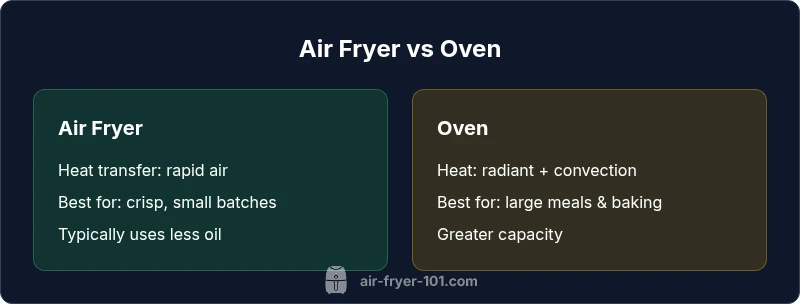
To answer the question how is air fryer different from oven, we start with the core physics. An air fryer uses a compact chamber with a powerful heating element and a high-speed fan to circulate hot air rapidly around food. This creates a crisp exterior similar to frying but with far less oil. An oven, by contrast, relies on radiant heat from elements or a gas flame along with convection fans in many modern models. It heats a larger cavity, treats air more slowly, and promotes even browning across larger items. Across both devices, temperature control is precise, but the mechanism of heat transfer and air movement shapes results in texture, moisture retention, and even cooking behavior. According to Air Fryer 101, the contrast in heat transfer is the central differentiator: rapid air movement versus slower, more uniform radiant heat. This difference influences how foods crisp, how fats render, and how predictable the interior doneness will be at a given setting.
format
Comparison
| Feature | Air Fryer | Oven |
|---|---|---|
| Heat transfer method | Rapid hot air circulation with a compact chamber | Radiant heat with convection in many ovens |
| Preheating | Often minimal or no preheat required for many snacks and small meals | Usually preheating recommended for baking and roasting |
| Batch size | Small to medium portions per cycle (2-4 servings typical) | Large batches possible; fits more food per load |
| Texture and browning | Excellent crisping with little oil; browning is rapid | Even browning across larger items, slight oil may be needed for crusts |
| Energy use | Often lower energy for single-serve or small meals | Can consume more energy per cook when baking large items |
| Versatility | Primarily fry/roast/reheat; some models bake | Very versatile: baking, roasting, broiling, and more |
| Price range | Typically $50-$200 for popular consumer models | Wide range from hundreds to thousands depending on size and features |
| Best for | Quick crisps, small batches, apartment kitchens | Large meals, baking, and diverse recipes |
Pros
- Faster turnaround for small, crisp-friendly dishes
- Requires less oil for many fried-style results
- Compact footprint and quick setup for small kitchens
- Simple, straightforward operation for everyday cooking
Cons
- Limited capacity for large meals or whole roasts
- Some foods don’t crisp the same as deep frying or roasting in a full oven
- Higher upfront cost per unit for quality models
- Specialized use-case limitations in very busy households
Air fryer is ideal for quick, small-batch crisps; oven dominates large, diverse cooking tasks
Choose an air fryer for speed and crisp texture in small portions. Choose an oven when you regularly cook large meals or require baking versatility.
Got Questions?
What is the main difference between an air fryer and an oven?
The main difference lies in heat transfer: air fryers use rapid hot air to crisp foods with little oil, while ovens rely on radiant heat and longer cook times for larger, more varied dishes. Both can bake, roast, and reheat, but the textures and efficiency differ markedly.
The air fryer crisps foods with hot air and little oil, while an oven uses radiant heat for larger batches and broader cooking tasks.
Can I replace an oven with an air fryer for most recipes?
Not for all recipes. Air fryers are excellent for quick, small portions and crispy results, but ovens are better for large quantities, baking breads and pastries, and cooking certain sheet-pan meals. Expect some adjustments to time and temperature when substituting.
Air fryers work well for small, crispy meals, but ovens are better for large batches and baking. Adjust timing and temperature if replacing.
Are air fryers healthier than ovens?
Air fryers can reduce oil usage for many fried-like foods, which lowers fat content per serving. However, overall health impact depends on ingredients and cooking methods, not the appliance alone. Both appliances can support healthier cooking with appropriate ingredients and portion sizes.
Yes, air fryers often use less oil, but overall health depends on what you cook, not just the appliance.
Which is more energy-efficient overall?
For small, quick tasks, air fryers typically use less energy due to shorter cook times and smaller spaces. For large meals or long baking sessions, ovens may provide efficient results at scale, though energy use can be higher due to size and longer preheat times.
Air fryers usually save energy on small tasks; ovens win on large meals but can use more energy overall.
What foods are best suited for air fryers vs ovens?
Air fryers shine with chicken wings, french fries, crisp vegetables, and reheated leftovers that you want extra crunch on. Ovens excel for cookies, sheet-pan meals, casseroles, roasts, and foods that benefit from even, longer, more forgiving cooking.
Air fryers for crispy bites; ovens for baking and large meals.
Quick Summary
- Assess batch size before choosing appliance type
- Air fryers excel at crisp texture with little oil
- Ovens handle large, diverse meals and baking tasks
- Consider kitchen space and energy usage when deciding
- Plan for future needs: upgrade path may involve both devices