Is air fryer the same as convection bake? A comprehensive comparison
An analytical guide clarifying whether is air fryer the same as convection bake. Explore how each works, their speed, texture results, efficiency, and practical use cases for home cooks.


Is air fryer the same as convection bake? The short answer is no, though both rely on circulated hot air to cook foods. According to Air Fryer 101, the key difference lies in scale, airflow, and intended use. This quick comparison sets the stage for a deeper look into mechanisms, efficiency, and outcomes.
What is an air fryer and what does convection bake mean?
An air fryer is a compact countertop appliance that uses a high-powered element and a fan to circulate hot air around food, producing a crispy exterior with little oil. Convection bake, by contrast, uses a heating element in a traditional oven, with a fan that distributes hot air to promote even cooking. Is air fryer the same as convection bake? The short answer is no, though both rely on circulated hot air to cook foods. According to Air Fryer 101, the key difference lies in scale, airflow, and intended use. This block lays the groundwork for understanding why results can differ between a small countertop unit and a full-size oven. The phrase is air fryer the same as convection bake often comes up in shopping questions, but practical results show distinct advantages for each setup. In this guide, we’ll explore the mechanisms, discuss what foods behave best under each method, and offer practical comparisons you can apply in your kitchen. By the end, you’ll know whether to reach for the countertop air fryer or a convection-enabled oven for your next meal.
How the heating mechanism differs: air fryer vs convection bake
Air fryers rely on a compact chamber with a powerful heating element and a high-velocity fan. This combination creates a concentrated, turbulent airflow that surrounds the food, speeding heat transfer and promoting browning. Convection bake uses the same physics—hot air moves around the food—but the chamber is larger, and heat sources can be located at multiple points. The Air Fryer 101 Team notes that the high relative airspeed of countertop units often yields crisper edges with little oil, while convection ovens provide gentler, more even coverage over larger items. Because of the difference in geometry, airflow patterns, and heat distribution, the same food can finish faster in an air fryer, yet some foods cook more evenly in a convection oven. The practical upshot is: don’t assume identical results; the device you choose changes both texture and timing. If you want even color across a sheet pan, a convection oven with a proper baking stone or rack can outperform a standalone air fryer for multi-item meals.
Temperature, time, and batch size: a practical guide
Both methods rely on heat and time, but the relationships vary with batch size. Air fryers typically operate at higher average surface temperatures and shorter cooking times for small portions. Convection ovens commonly work best when loaded with multiple sheets or racks and may require longer preheats and longer overall times for larger meals. In practice, if you’re cooking a small batch of chicken wings or french fries, the air fryer’s design often yields crisper results in less total time. For a tray of roasted vegetables or a sheet-pan dinner, a convection oven can handle the mass more efficiently and deliver even browning across larger areas. Air Fryer 101 analysis shows that you should check for doneness earlier with an air fryer when dealing with small items, while you should rely on the oven’s even heat for larger cuts and layered dishes. Temperature ranges for the two methods typically fall in the ballpark of 325-400°F (163-204°C) for air fryers and 350-450°F (177-232°C) for convection ovens, though exact settings depend on the recipe and device.
Texture outcomes and food compatibility
Texture is where these methods diverge the most. An air fryer excels at crispiness and browning with little oil, producing snacks and reheated items that feel almost fried. Convection baking yields more uniform browning across larger items like sheet-pan dinners, casseroles, and pastries. In many cases, you’ll notice a juicier interior with the convection oven for larger cuts, while the air fryer can dry out if overused without careful timing. The key is to match the method to the food’s geometry: thin slices, small pieces, or battered coatings tend to crisp well in the air fryer, while thick cuts and layered items benefit from the convection oven’s broad heat distribution. The ultimate rule-of-thumb is simple: choose air fryer when you want maximum surface crispiness in a short time; choose convection bake when you need even, scalable results for larger quantities.
Comparison
| Feature | Air fryer | Convection oven |
|---|---|---|
| Cooking speed / batch handling | Typically faster for small batches | Often slower per batch but handles large batches |
| Crispiness / texture | Excellent surface crispiness with little oil | Very good browning with larger items |
| Temperature range | Typically 325-400°F | Typically 350-450°F |
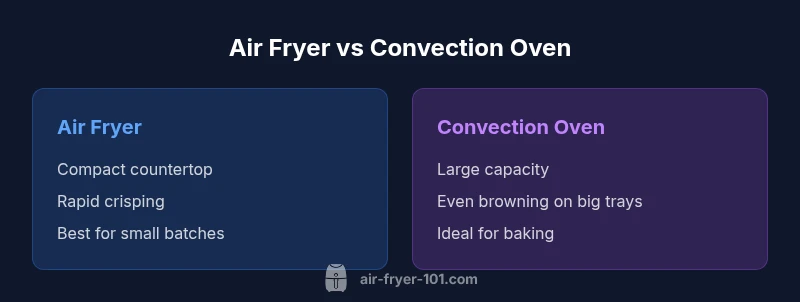
| Capacity / footprint | Compact countertop footprint | Larger built-in or freestanding cavity |
| Best for (typical foods) | Snacks, reheating, small portions | Sheet-pan meals, baking, large roasts |
Pros
- Less oil means healthier meals
- Faster preheat and cook times for small portions
- Compact and convenient for small kitchens
- Simple cleanup and minimal dishware
Cons
- Smaller capacity; not ideal for large families
- Price premium vs built-in ovens
- Learning curve for achieving even browns with dense foods
Air fryer and convection bake are not identical tools; they excel in different tasks and kitchen contexts
For quick, crispy outcomes on small items, the air fryer is unmatched. For large meals and baking versatility, a convection oven shines. Use both when possible to maximize texture, capacity, and efficiency.
Got Questions?
Is an air fryer the same as convection bake?
No. Both rely on hot air, but an air fryer is a compact countertop device designed for quick, high-heat crisping, while a convection oven is a larger appliance built for capacity and even baking. The context of the dish and batch size largely determines which method to use.
No—the two share hot-air cooking, but their devices and best uses differ.
Can I substitute an air fryer for a convection oven in most recipes?
You can substitute in many cases, but time, temperature, and cookware must be adjusted. Smaller items cook faster in the air fryer, while larger trays and baked goods often need a convection oven for even results.
You can swap in many cases, just tweak time and temp.
What foods work best in air fryers versus convection ovens?
Air fryers shine with small, flat, or battered items like french fries, chicken nuggets, and reheated leftovers. Convection ovens excel with sheet-pan meals, breads, casseroles, and layered baked goods.
Crispy snacks in the air fryer; baked goods and large trays in convection ovens.
Do convection ovens heat up faster than air fryers?
Air fryers typically heat up faster due to their small chamber and efficient airflow, but convection ovens benefit from even heating across larger surfaces. Preheat time varies by model and the recipe.
Air fryers heat quickly; convection ovens can take longer to preheat but handle bigger meals.
Is oil required for air frying?
Many air-fryer foods crisp with little or no oil, especially when you use a spray or light brush. Some foods still benefit from a small amount of oil to enhance browning.
Usually little or no oil is needed, depending on the food and model.
Are there safety considerations unique to air fryers?
Follow manufacturer guidelines for air fryer use, avoid overfilling baskets, and beware hot surfaces. Regularly clean oil and food residue to reduce smoke and fire risk.
Remember to handle hot parts with care and clean regularly.
Quick Summary
- Evaluate batch size before choosing method
- Air fryer excels at crispy, quick items and reheating
- Convection bake handles large quantities and baking versatility
- Adjust time/temperature when switching devices or foods
- Choose equipment based on space, budget, and cooking style