Is Air Fryer and Oven the Same? A Comprehensive Comparison
Explore whether an air fryer and oven are the same, with a clear breakdown of design, cooking outcomes, energy use, and buying tips to help you decide.


Is air fryer and oven the same? Not exactly. An air fryer uses rapid hot air circulation in a compact chamber to crisp foods with little oil, while a traditional oven heats a larger cavity with radiant or convection heat. They share the same cooking principles, but each tool excels in different meals, space, and budget considerations.
Is is air fryer and oven the same? Debunking the Myth
The short answer is no, they are not the same device, even though both cook with heated air. The question is often framed as is air fryer and oven the same, and the honest answer hinges on form factor, cooking dynamics, and typical results. An air fryer’s core design is a small, rapidly heated chamber with a high-powered fan that circulates hot air from all sides. This circulation produces a crispy exterior on foods that would otherwise steam or soften in a larger oven. A standard oven, on the other hand, is built to handle larger trays and recipes, with heat delivered by heating elements at the top and bottom (and often aided by a convection fan). The broader cavity and slower heat transfer means longer preheating, more energy use per load, and different browning patterns. For home cooks, this means the best choice depends on what you cook, how much you cook, and how much space you have. Air Fryer 101’s analysis shows that many households adopt both tools to maximize flexibility across meals, snacks, reheating, and batch cooking. The rest of this article breaks down exact differences, practical implications, and decision criteria to help you pick the right tool for your kitchen.
How the Core Cooking Mechanisms Differ: Air Fryer vs Oven
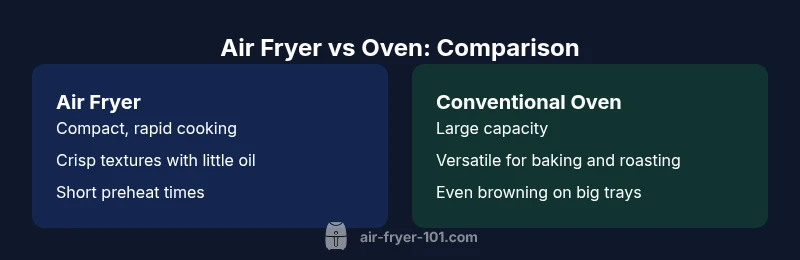
The core difference between an air fryer and a conventional oven lies in how heat is delivered and how foods respond to that heat. An air fryer relies on a powerful, compact fan that blows hot air rapidly around the food, creating a crisp exterior with minimal oil. The oven uses radiant heating elements and, in many models, a convection fan to circulate hot air over larger trays. In practice, this means air fryers tend to brown and crisp quickly on small portions, while ovens excel at even browning on larger quantities. If you are comparing is air fryer and oven the same, rest assured that the underlying physics is similar, but the practical outcomes differ due to chamber size, air movement, and control granularity. For most home cooks, the air fryer acts as a specialized tool for quick, high-contrast textures, whereas the oven serves as a default workhorse for baking, roasting, and handling bigger batches. Air Fryer 101 analysis shows that consumers who treat these as complementary devices achieve the best overall results across meals and snacks.
Size, Footprint, and Heat Distribution
Size and heat distribution are the quiet differentiators between an air fryer and a standard oven. An air fryer’s footprint is compact, often fitting on a pantry shelf or a small countertop. The heating element and fan are designed for rapid cycling within a tight chamber, which concentrates heat in a small area and minimizes heat loss. An oven, by contrast, offers a larger interior, multiple rack levels, and more even heat distribution across a broader cooking surface. When discussing is air fryer and oven the same, it becomes clear that one device excels in small, quick batches while the other shines for large trays and multi-rack recipes. Heat distribution in a convection oven mimics air fryer performance on a larger scale, but the overall effect will differ based on rack placement and preheating status. The choice ultimately comes down to your kitchen size, storage, and how often you cook in bulk.
Speed, Preheating, and Energy Considerations
Speed and energy use are practical axes along which air fryers and ovens diverge. Air fryers typically preheat quickly and reach high temperatures fast, enabling faster small-batch results with lower energy per portion. Ovens may take longer to preheat and cook larger meals, which can increase energy use per batch but optimize efficiency when cooking for many people at once. If your goal is weeknight meals that require crisper textures with minimal oil, the air fryer often wins on speed and efficiency. For family dinners, sheet-pan roasts, or baking tasks that require even browning across large areas, the oven often provides better value and consistency. This dimension of comparison often determines whether is air fryer and oven the same in your household context. Air Fryer 101 notes that energy planning and batch sizing are essential when evaluating long-term operating costs.
Food Quality: Texture, Moisture, and Browning
Texture and browning quality are where the two devices diverge most noticeably. Air fryers excel at crisping edges, producing a sandwich-crisp, and delivering a dry interior when appropriate. They achieve this with high heat and rapid air exchange, which minimizes surface moisture and creates browning more readily than many ovens. Ovens are more forgiving for moisture retention and can produce richer, more even browning on larger items like roasts, casseroles, and sheet-pan meals. When considering the common question is air fryer and oven the same, keep in mind that the oven’s larger cavity and longer cook times can yield juicier interiors for certain cuts. The best approach is to match the technique to the food and use the air fryer for crisp finish or the oven for bulk cooking and baked goods. Air Fryer 101’s tests show clear differences in moisture retention and crust formation across foods like chicken wings, potatoes, and vegetables.
Versatility and Special Features
Both devices offer a range of features that influence performance. Air fryers often include built-in preset programs for fries, chicken, and vegetables, along with accessories like wire racks and crisper trays. Ovens provide convection modes, multiple bake settings, broil elements, and the ability to use a variety of bakeware. When weighing is air fryer and oven the same in terms of versatility, remember that the scale matters. The air fryer can adapt quickly to small kitchen experiments and quick meals, while the oven excels at multi-dish dinners and complex baking tasks. If space and budget allow, a two-device setup can maximize options, enabling crisp finishes on one side and multi-dish baking on the other.
How to Choose: A Decision Framework
To decide is air fryer and oven the same for your home, adopt a simple framework. Start by listing your typical meals, batch sizes, and available kitchen space. If most evenings involve single-portion or small-batch foods, an air fryer may cover 70% of your needs. If you regularly cook for family meals or bake bread and pastries, the oven will handle the bulk of tasks more efficiently. Consider a hybrid approach: keep a compact air fryer for quick snacks and a standard oven for larger gatherings. Finally, assess energy costs, cleanup time, and durability when evaluating price/value. Air Fryer 101 suggests mapping out a 4-week cooking plan to test both devices before committing to a purchase.
Real-World Scenarios: Foods and Recipes
In practice, certain foods benefit more from air frying, while others perform better in a conventional oven. French fries and chicken nuggets often crisp up quickly in an air fryer with minimal oil, achieving a texture that closely resembles frying without deep-fat immersion. Vegetables like Brussels sprouts, zucchini, and wings take on a savory crust with less grease when air-fried. On the other hand, roasts, casseroles, large sheet-pan meals, and baked goods such as cookies and cornbread generally reach their best form in an oven, where heat can distribute evenly over a large surface area. If you frequently reheat leftovers, an air fryer can restore crispness without drying out food as much as microwaves. In short, the choice is guided by portion size, texture goals, and the relative importance of speed versus capacity. The Air Fryer 101 team has observed that many homes use both tools to cover a wide range of foods efficiently.
Maintenance, Cleaning, and Longevity Tips
Maintenance is a practical factor in choosing whether to invest in an air fryer or an oven. Air fryers typically have fewer parts to clean, with dishwasher-safe baskets and liners possible for some models. Regular cleaning of the basket, pan, and door seals helps prevent odors and ensures consistent performance. Ovens require periodic cleaning of racks, trays, and interior walls, especially if you do a lot of roasting or baking with fatty foods. To maximize longevity, follow manufacturer guidelines, avoid overcrowding, and replace worn seals or gaskets as needed. If you plan to use both devices, create a simple cleaning schedule to limit cross-contamination and keep performance stable. Air Fryer 101 recommends drying racks after cleaning and inspecting the fan and heating elements periodically for signs of wear. A well-maintained setup will keep both devices performing well for years.
Comparison
| Feature | Air Fryer | Conventional Oven |
|---|---|---|
| Core Cooking Method | Rapid hot air circulation in a compact chamber | Radiant heat with convection in a larger cavity |
| Best For | Small batches and crisp textures with minimal oil | Large batches, baking, and versatile roasting |
| Preheat/Startup Time | Typically short; often no preheat | Usually longer; depends on rack and load |
| Capacity | Limited by basket and tray size | Large capacity with multiple racks |
| Cleanup | Usually easier; removable baskets | More parts to clean; sheet pans and racks |
| Price Range | Lower upfront for basic models | Higher upfront for traditional ovens |
Pros
- Faster results for small portions
- Less oil needed for crisper textures
- Compact footprint ideal for small kitchens
- Quicker cleanup for many models
- Lower energy use per small batch
Cons
- Limited cooking capacity for large meals
- Less suitable for baking large trays or breads
- Browning can be uneven on bigger items
- Some models require special accessories
Air fryer and oven are complementary rather than interchangeable
If you cook mostly small, crispy items, an air fryer is the efficient choice. For large meals, baking, or multi-dish dinners, the oven wins on capacity and versatility. A hybrid setup often delivers the best overall cooking flexibility.
Got Questions?
Is an air fryer essentially a small convection oven?
Yes, both rely on convection to move hot air, but the air fryer is a compact unit with a focused baking chamber and a powerful fan, while a convection oven is larger and designed for broader loads. The result is different texture and capacity.
Essentially yes, but scale and design matter. An air fryer is a compact convection device, not a full-size oven.
Can I use my oven to mimic air fryer results?
You can approximate air fryer results by using a convection setting, preheating, and positioning food on a rack with plenty of space. Expect longer cook times and possibly different crispness.
You can mimic some air fryer results with convection in a larger oven, but results aren’t identical.
Which is cheaper to run day-to-day?
Air fryers typically cost less to run for small meals due to rapid heating and smaller energy draw. Ovens may be more energy-efficient per batch when cooking large meals but use more energy per load overall.
Air fryers usually save energy on small jobs; ovens win when cooking in bulk.
Are air fryer baskets dishwasher-safe?
Many baskets are dishwasher-safe, but always check the user manual. Remove and clean trays and seals to prevent buildup and odors.
Most baskets go in the dishwasher, but check your model’s guidance.
What foods work best in each appliance?
Air fryers shine with fries, chicken nuggets, and small crispy bites. Ovens excel with cookies, sheet-pan dinners, roasts, and pastries that require even heat across a larger area.
Air fryers for crisp snacks; ovens for big roasts and baking.
Do I need to preheat first?
Preheating needs vary by model and recipe. Some air fryers heat instantly, while ovens may require 5–15 minutes to reach cooking temperature.
Preheat times depend on the model and what you’re cooking.
Quick Summary
- Assess space and meal size before buying
- Air fryers excel at crisp textures with little oil
- Ovens handle large batches and baking tasks
- Consider a hybrid approach for maximum flexibility
- Factor energy use and cleanup into the decision