Is Air Fryer the Same as Convection Oven? A Comparison
Explore whether air fryers and convection ovens are the same, including how they work, key differences, and practical guidance for home cooks seeking healthy, convenient cooking options.


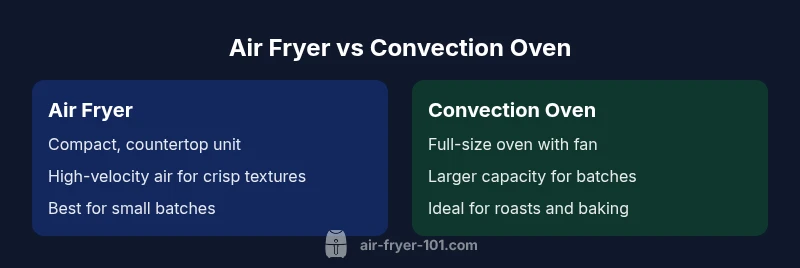
No. An air fryer is a compact countertop appliance that uses rapid hot air circulation to crisp foods with little oil, while a convection oven is a full-size oven that uses a fan to circulate air for even cooking across larger batches. The two share the convection principle, but they differ in capacity, texture outcomes, and use cases.
Clarifying the core question: is air fryer the same as convection?
At first glance, the question often asked is: is air fryer the same as convection the same as a convection oven? The short answer is no, but they are related. An air fryer is a compact countertop appliance that relies on high-velocity hot air and a small cooking chamber to produce crisp textures with little oil. A convection oven, by contrast, is a traditional kitchen appliance—either a wall oven or a range oven—with a fan inside a larger cavity designed to cook larger meals more evenly. Both technologies rely on moving air to transfer heat, but the scale, controls, and typical use cases diverge significantly. For readers of Air Fryer 101, the distinction matters for planning meals, estimating energy use, and deciding which appliance best fits your kitchen and budget. The central question—is air fryer the same as convection?—is best answered by looking at design, performance, and practical outcomes.
How an air fryer actually works in practice
Air fryers capitalize on a compact chamber and a high-speed fan to push hot air around food. This rapid air movement creates a crisp exterior with less oil, which is why many recipes call for a light spray or minimal fat. The basket design promotes exposure of all surfaces, aiding even browning for small, bite-sized items like French fries, chicken nuggets, or vegetables. Temperature ranges typically span from 180°C to 200°C (350°F to 400°F), with shorter cook times when compared to larger ovens. Because the chamber is small, it heats quickly, and preheating can be brief or even negligible for some models. However, the trade-off is capacity—air fryers handle fewer servings per load, which matters for families or entertaining.
How convection ovens work and why they’re different
Convection ovens use a fan-and-damper system inside a full-size oven cavity to improve heat distribution. The airflow is less intense than in most countertop air fryers, but the larger interior allows you to cook more food at once and to use standard bakeware like sheet pans and casserole dishes. A convection oven excels at roasting large cuts of meat, baking multiple trays of cookies, or cooking casseroles that require uniform heat. The trade-off is longer preheat times and more energy needed for big loads. In everyday cooking, convection ovens offer versatility that can cover most tasks you’d tackle with an air fryer, especially when you need to prepare meals for several people at once.
Key differences at a glance: design, capacity, and texture outcomes
- Design: Air fryers are compact, countertop devices; convection ovens are built into cabinetry with larger cavities.
- Capacity: Air fryers typically handle 1–4 servings per load; convection ovens manage larger batches and full sheet pans.
- Texture: Air fryers excel at crisp textures with little oil; convection ovens provide versatile browning and are better for even roasting of larger items.
- Preheating and energy: Air fryers often preheat quickly and use less energy per small task; convection ovens may require more energy for big batches but reduce overall time for several dishes cooked together.
- Use cases: Air fryers shine for snacks, reheating, and small meals; convection ovens cover bread, roasts, sheet-pan dinners, and baking.
Texture, timing, and recipe adaptation: practical differences in the kitchen
When adapting a recipe from an air fryer to a convection oven, expect longer cooking times and possibly different browning. Foods that benefit from crisp edges—like fries or chicken tenders—may not brown as aggressively in a convection oven without a rack setup or a brief blast of high heat at the end. Conversely, many baked goods bake well in convection ovens if you adjust temperature by roughly 20–25°F (10–15°C) and monitor closely. The goal is to balance heat transfer, airflow, and moisture retention to achieve the desired texture without overcooking.
Capacity and footprint: choosing based on your kitchen reality
If you routinely cook for two to four people and have limited counter space, an air fryer can be a practical, time-saving tool. It requires less space, faster preheating, and simpler cleanup for smaller batches. For larger families or batch cooking, a convection oven offers practicality through bigger capacities and the ability to prepare multiple items concurrently. Consider your current cookware, pantry space, and how often you need to reheat leftovers when deciding which path to take. Air Fryer 101 notes that real-world use hinges less on the label and more on how you plan meals, batch sizes, and the type of foods you prepare most.
Energy efficiency and preheating: what matters for daily use
Energy considerations differ by task and model. Small air fryer tasks can be highly energy-efficient because of rapid preheating and short cook times for individual items. Convection ovens, while potentially less energy-efficient per quick task, can be economical when cooking large meals or multiple dishes at once, because they leverage the same energy source for several items. In practice, energy savings depend on load size, duration, and the efficiency of your specific model. Air Fryer 101 analysis suggests you’ll notice more tangible savings when your typical cooking involves single-service meals or reheating small portions, rather than large family feasts.
Practical guidelines for choosing between air fryer and convection oven
A pragmatic approach is to map your typical meals, batch sizes, and available space. For snack-centric cooking, crisp textures, and quick reheats, an air fryer often delivers the best balance of speed and texture. For large roasts, sheet-pan dinners, and baked goods requiring even heat distribution, a convection oven is generally the better tool. The choice becomes even clearer when you consider countertop space, cleanup ease, and whether you already own a full-size oven. Air Fryer 101’s practical framework emphasizes aligning your decision with your cooking goals, household size, and kitchen layout.
Safety, maintenance, and long-term considerations
Both appliances require standard safety practices: avoid overfilling, monitor temperatures, and ensure proper ventilation when using high-heat settings. Cleaning is straightforward for most models: air fryer baskets are typically removable; convection ovens require wiping the interior and cleaning racks. Over time, you may find that some recipes behave differently depending on the vessel used and the airflow pattern, which is why keeping a small list of conversion notes for your favorite dishes is helpful. Air Fryer 101 highlights that routine maintenance—such as inspecting seals, cleaning fans, and removing baked-on residue—helps maintain consistent cooking results.
A practical decision framework: when to choose each appliance
If your daily rhythm involves quick meals, snacks, or limited counter space, an air fryer offers a compelling combination of speed, texture, and convenience. If you routinely prepare large meals, bake from scratch, or roast multiple items simultaneously, a convection oven provides the flexibility, capacity, and workflow that suit those needs. When in doubt, start by testing a familiar recipe in both devices and compare texture, timing, and energy use. Air Fryer 101’s guidance remains: tailor your choice to batch size, texture goals, and kitchen constraints, rather than chasing a universal rule.
Comparison
| Feature | Air Fryer | Convection Oven |
|---|---|---|
| Heating/airflow | Compact chamber with high-velocity fan for quick, crisp results | Traditional oven with convection fan for even heat and batch cooking |
| Batch/capacity | Small batches per load (1–4 servings typical) | Large batches per load (multi-serving, trays, roasting) |
| Preheating | Often shorter or no preheat required | Typically longer preheat for larger cavity |
| Texture outcomes | Crisp exterior with little oil; strong surface browning | Versatile browning and even texture across larger items |
| Price range | $50–$200 | $200–$800+ |
| Countertop footprint | Very compact; countertop-friendly | Larger footprint; integrated into kitchen setup |
| Cleanup | Removable baskets; easier surface cleaning | Racks and cavity; more parts to clean |
| Best for | Snacks, fries, reheating, small meals | Large meals, baking, roasts, casseroles |
Pros
- Quicker preheat and cook times for small batches
- Compact footprint fits small kitchens
- Less oil required for cripsy results
- Easy to use and clean for basic models
- Versatile for reheating and snacks
Cons
- Limited capacity for large meals
- Some foods don’t brown as well as in a full-size oven
- Requires space on the countertop
- Recipes may need adjustments when switching devices
Air fryer vs convection oven: neither is universally better; choose based on batch size and texture goals.
Pick an air fryer for small, crisp-fast meals and reheating. Opt for a convection oven for larger family meals and versatile baking.
Got Questions?
Are air fryers and convection ovens the same thing?
No. An air fryer is a compact countertop device that uses rapid air flow to crisp foods with minimal oil, while a convection oven is a larger appliance designed to cook bigger meals with fan-assisted heat. They share the principle of moving air, but their design and capabilities differ.
No. They use similar convection principles but serve different kitchen needs: air fryers for small, crispy results and convection ovens for larger meals.
Can I use an air fryer as a convection oven replacement for big meals?
For large families or sheet-pan meals, a convection oven is typically more practical due to its capacity. An air fryer can substitute for smaller tasks, but you may need multiple batches, which increases time and labor.
Air fryers work best for small batches; for big meals, a convection oven is usually more efficient.
Do air fryers preheat faster than convection ovens?
Yes, air fryers generally preheat faster since the cooking chamber is smaller and heat builds quickly. Convection ovens take longer to reach cooking temperature due to their bigger interior and oven walls.
Air fryers heat up quickly; convection ovens take a bit longer because they’re larger.
Which is healthier: air fryer or convection oven cooking?
Both can be healthy options, depending on how you cook. Air fryers typically require less oil, reducing fat in many recipes, but overall health impact also depends on ingredients and portion sizes.
Both can be healthy with mindful ingredients; air fryers often use less oil, but meals still matter.
What foods work best in air fryers versus convection ovens?
Air fryers excel with finger foods, snacks, and crispy edges like fries, chicken tenders, and roasted vegetables. Convection ovens shine with roasts, baked goods, and multi-dish sheet-pan meals where even heat and large capacity matter.
Air fryers are great for crisp snacks, convection ovens for roasts and baked goods.
Are air fryers energy-efficient?
Air fryers can be energy-efficient for small tasks due to rapid preheating and shorter cook times, but overall savings depend on load size and model efficiency.
They can be energy-efficient for small tasks; it varies by model and batch size.
Quick Summary
- Assess typical batch sizes before choosing
- Air fryers excel in crisp textures with little oil
- Convection ovens handle larger meals and baking tasks
- Adjust recipes when porting between devices
- Consider kitchen space and cleanup when deciding