Are Air Fryer and Convection Oven the Same? A Practical Comparison
Are air fryer and convection oven the same? This analytical comparison explains differences in design, performance, and use cases to help you choose the right appliance for your kitchen and budget.


Are air fryer and convection oven the same? Not exactly. Both rely on circulating hot air to cook, but they differ in capacity, speed, and typical uses. An air fryer is a compact, basket-based countertop appliance optimized for quick, small-batch frying-style results, while a convection oven is a larger oven (often with racks) that can handle bigger meals and a wider range of cooking tasks. The key distinction is scale, versatility, and how each device fits into your daily cooking routine.
Are they the same? Defining terms and context
The short answer is no: are air fryer and convection oven the same? Not exactly. Both rely on hot air circulating around food to promote browning and crisp textures, but they are built for different purposes and kitchen footprints. An air fryer is a compact countertop device with a small cooking chamber and a high-velocity fan, designed to mimic deep frying with little or no oil. A convection oven, whether built-in or countertop, uses a fan to circulate hot air inside a larger cavity and often accommodates multiple racks. The question people ask most often is whether they can substitute one for the other without trade-offs. In practice, view the air fryer as a specialized, rapid-class convection system ideal for small batches and crisp results, while the convection oven serves as a versatile workhorse for larger meals, baking, roasting, and more. According to Air Fryer 101, the core differences boil down to capacity, control, and intended cooking tasks. This section frames the exact phrase are air fryer and convection oven the same to anchor the discussion and set expectations for what follows.
How they work: airflow, heating elements, and design
Both devices rely on convection: hot air is circulated to transfer heat quickly and evenly. An air fryer achieves this inside a compact chamber with a perforated basket that places food close to the fan and heater. The result is rapid heat transfer and a tendency toward crisp exterior textures with minimal oil. A convection oven uses a larger cavity, often with multiple racks, and may rely on a single fan or multiple convection pathways. The air flow is powerful but spread over a bigger space, which influences cooking times and browning patterns. The upshot is: the air fryer excels at fast, small-batch crisping; the convection oven excels at large dinners and baking tasks. From a design perspective, the air fryer’s basket concentrates heat around the food, while the convection oven distributes heat more broadly through the chamber.
Size, capacity, and footprint implications
Size matters when choosing between an air fryer and a convection oven. Air fryers are compact, typically occupying a single countertop footprint and suited to small households or limited kitchen space. Their capacity suits snacks, single-portion meals, and small cuts of meat. Convection ovens are larger, either as a built-in option or a sizable countertop model, with more interior volume and the ability to accommodate sheet pans, roasters, and multiple racks. This difference affects not just what you can cook at once, but how comfortable you are moving trays, cleaning interior surfaces, and storing the appliance when not in use. If your kitchen routinely handles big family meals, a convection oven can ventilate and circulate heat more efficiently for larger batches. If you live in a small space and frequently cook for one or two, an air fryer can be a convenient, time-saving companion.
Cooking performance: speed, browning, and texture
When you are asking whether are air fryer and convection oven the same, cooking performance is the main differentiator. Air fryers heat quickly and deliver a crisp, fried-like exterior with relatively short cook times for small portions. They excel at reheating leftovers to regain crunch and preparing quick-fried items with notable texture. Convection ovens, while sometimes slower for tiny portions, shine with even browning across larger trays and excellent results for roasting vegetables, baking cookies, or meats that benefit from steady, uniform heat. Browning can be more uniform in a convection oven when you load multiple racks and monitor airflow, especially with larger roasts. The choice depends on batch size and the texture you want: the air fryer for quick crisp, the convection oven for even browning across higher volumes.
Versatility and typical use cases
Versatility is a central theme in any comparison between are air fryer and convection oven the same. Air fryers are superb for small, quick meals, crispy sides, and reheating. They are particularly well-suited for bite-sized snacks, wings, french fries, and small protein portions where a light, oil-conscious crisp is desired. Convection ovens offer broader capabilities: bake bread, roast a chicken on a rack, sheet-pan dinners, casseroles, and desserts. They can perform tasks that require larger cooking surfaces or longer cooking times without crowding issues. For bakers and meal planners who need flexibility, a convection oven often handles more variety. For singular, speed-focused cooking, the air fryer provides an efficient pathway to a crisp finish.
Energy use, efficiency, and cost of ownership
Energy use and cost of ownership influence long-term decisions. Air fryers typically consume less energy for small batches because of their compact size and shorter cook times. They heat rapidly and shut down quickly when the cycle ends, which can translate to modest energy savings for day-to-day quick meals. Convection ovens, due to their larger cavity and longer preheat and cook times for certain dishes, can consume more energy on large meals or continuous baking workflows. However, they justify that energy draw with greater capacity and the ability to execute a broader set of tasks. When considering total cost of ownership, think about how often you’ll use each appliance, the meals you frequently prepare, and whether you value speed and texture (air fryer) or volume and versatility (convection oven).
Cleaning, maintenance, and durability
Cleaning is a practical consideration that often shapes user satisfaction. Air fryers have removable baskets and trays that are generally straightforward to clean, with fewer interior nooks. The interior of a equipped air fryer tends to be easy to wipe down after cooking, although basket geometry can influence cleanup effort. Convection ovens require more maintenance: interior walls, racks, and door seals may collect grease and residues over time, and cleaning the oven cavity can be more involved. Durable construction matters for both, but lifetime expectations differ with usage patterns. Regularly cleaning fans and seals, and following manufacturer guidelines, helps maintain performance for years. Overall, the air fryer wins on ease of cleaning for quick weekday meals, while the convection oven offers durability and versatility for more ambitious cooking projects.
Safety, learning curve, and user experience
Safety and user experience play pivotal roles in the decision. Air fryers are typically simple to operate with straightforward presets, which shortens the learning curve for beginners. The risk of oil splatter is minimized due to reduced oil usage, but improper basket loading can lead to uneven results. Convection ovens require more familiarity with rack placement, pan selection, and airflow considerations to maximize results. The learning curve is steeper, but the payoff is precise, even baking and roasting. In all cases, following manufacturer guidelines and ensuring proper ventilation in the cooking area reduces risk. The consumer journey often hinges on how quickly you can achieve reliable results with minimal trial and error.
Price ranges and value: when to buy which
Price and value considerations help clarify the decision. Air fryers are generally lower in upfront cost and ideal for budget-conscious shoppers seeking quick, crispy outcomes without a larger appliance footprint. Convection ovens command a higher upfront cost but justify the investment with greater cooking capacity and broader functionality. If you anticipate frequent batch cooking, baking, and roasting in one appliance, the convection oven can deliver more long-term value. For those prioritizing space-saving and rapid crisping, an air fryer may offer the best balance of cost, convenience, and performance. Balance your expected meals, kitchen layout, and time constraints when evaluating price versus value.
How to decide: a practical framework
To determine which is the right fit, start with your typical meals, kitchen space, and daily rhythm. If you regularly prepare small, crisp snacks or reheat leftovers and want fast results, an air fryer is a strong fit. If you routinely cook larger meals, bake bread, or need a device that can replace several appliances, a convection oven offers more versatility. Consider whether you prefer countertop convenience or integrated home cooking capacity. Finally, assess energy use and long-term costs by comparing usage scenarios: do you often cook for two or do you regularly feed a family of four or more? The framework below helps: 1) Identify your most common dishes, 2) Evaluate batch size needs, 3) Assess space and storage, 4) Weigh upfront cost against long-term versatility, 5) Read user reviews for reliability and support.
Practical recipes and side-by-side recommendations
To illustrate practical use, we provide side-by-side guidance for common tasks. For air fryer: reheating pizza to restore crispiness, air-frying frozen wings, and making small crispy vegetables as a quick side. For convection oven: baking cookies that spread, roasting a chicken with vegetables on a sheet pan, and doing a lean roast with browning around the edges. The recommendations emphasize that both devices can achieve excellent results, but the approach differs: the air fryer for quick crisp and small portions; the convection oven for volume and baking versatility. A hybrid approach—using each appliance for its strengths—often yields the best overall outcomes.
Common mistakes and troubleshooting tips
Common mistakes include overfilling the basket in an air fryer, which blocks air circulation and leads to uneven cooking; in a convection oven, overcrowding trays or ignoring rack positioning can similarly compromise results. Preheating benefits many recipes, particularly in convection ovens, though some air fryer models perform well with no preheat. If results are uneven, rotate trays in a convection oven or shake the basket in an air fryer midway through cooking. For both devices, ensure airflow isn’t blocked by lids or liners that obscure the air paths. Regular cleaning of fans, vents, and seals helps prevent performance drops and extends device life.
Comparison
| Feature | Air Fryer | Convection Oven |
|---|---|---|
| Size & footprint | Compact countertop footprint | Larger cavity; more footprint or built-in options |
| Cooking speed for small batches | Very fast for small portions | Fast but sometimes slower for tiny portions due to larger chamber |
| Heat distribution | Focused heat around food via basket | Broad heat distribution with multiple rack options |
| Versatility | Best for crisping, reheating, small snacks | Excellent for baking, roasting, multi-dish meals |
| Temperature range | High-velocity air with strong surface browning | Wide temperature range with baking potential |
| Maintenance | Easier cleanup due to simple basket design | More components and interior surfaces to clean |
| Best for | Singles, small households, quick snacks | Families, meal prep, baking and roasting |
Pros
- Faster preheat and cook times for small batches
- Low oil cooking with crisp results
- Compact countertop convenience and energy efficiency for quick tasks
- Simple setup and beginner-friendly operation
- Good for reheating leftovers with texture
Cons
- Limited cooking capacity for large meals
- Less even browning on bulky dishes compared with a full-size oven
- Few models offer true oven-like multi-rack versatility
- Cleaning can be more difficult for certain basket designs in some brands
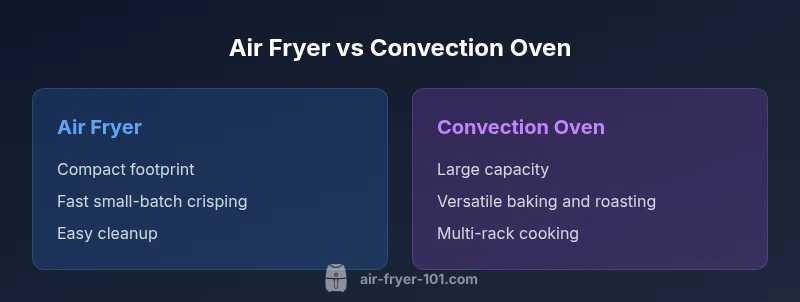
Choose based on meal size and versatility: air fryer for quick, crispy results; convection oven for larger meals and baking versatility
Air fryers excel in small-batch crisping and quick reheats, while convection ovens provide broader cooking versatility for bigger meals. If space and speed matter most, start with an air fryer; if you need baking and roasting capacity, opt for a convection oven.
Got Questions?
Are air fryers and convection ovens the same?
No. They share the concept of circulating hot air but differ in size, capacity, and typical usage. Air fryers are compact and ideal for small batches and crisp textures; convection ovens are larger and suited for baking, roasting, and larger meals.
No. They’re not the same; air fryers are small and great for quick crisping, while convection ovens are larger and better for baking and big meals.
Which is faster for small batches?
Air fryers generally cook faster for small portions due to their compact chamber and concentrated heat. Convection ovens can still be quick, but the overall speed advantage is usually with the air fryer for small tasks.
Air fryers are typically faster for small batches.
Can I replace a convection oven with an air fryer?
You can substitute some tasks, like crisping or reheating, with an air fryer, but for large meals, baking, and multi-dish roasts, a convection oven provides more capacity and flexibility.
You can replace some tasks, but not all, with an air fryer.
Is cleaning easier with an air fryer?
Generally yes for quick tasks, since baskets and trays are removable and easier to sanitize. Convection ovens can be more time-consuming to clean due to larger interior surfaces and racks.
Usually easier to clean an air fryer than a convection oven.
Do I need oil to use these appliances?
Air fryers often require little to no oil for crispiness, depending on the recipe. Convection ovens may use oil in some recipes but typically need less oil than traditional frying.
Oil is optional in many air fryer recipes and often reduced in convection ovens.
Which is more energy-efficient overall?
For average daily use, air fryers can be energy-efficient for small tasks due to quick preheats and short cook times, while convection ovens may consume more energy when cooking large meals. Efficiency depends on batch size and usage.
Energy use depends on batch size; air fryers are efficient for small tasks, convection ovens for larger meals.
Quick Summary
- Identify your typical meal size to pick the right appliance
- Use air fryer for crisp-on-the-outside, small portions
- Use convection oven for baking and large meals
- Consider space, energy use, and long-term value
- Maintenance and cleaning vary by design; plan accordingly