Air Fryer vs Convection Bake: What’s the Difference?
Explore the differences between air fryer and convection bake, including heating methods, browning behavior, cook times, and best-use scenarios for healthier, efficient cooking in small and large batches.


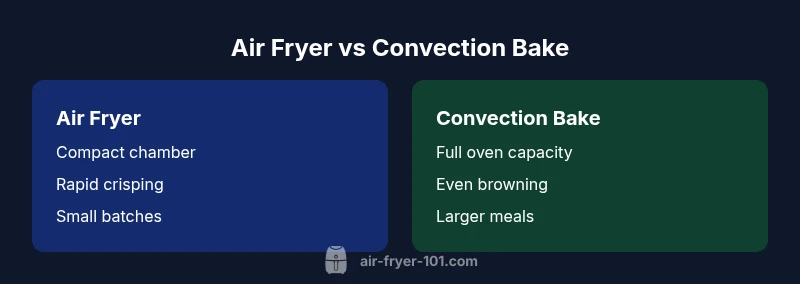
TL;DR: The air fryer and convection bake both move hot air to cook foods, but they differ in setup, size, and results. An air fryer uses a compact chamber with a high-velocity fan and a shallow basket to deliver rapid browning with less oil. Convection bake uses a full oven cavity, racks, and steady airflow for even cooking of larger batches.
Understanding the difference between air fryer and convection bake
The difference between air fryer and convection bake matters for real-world cooking, and understanding it helps you decide which tool fits your kitchen. According to Air Fryer 101, the core distinction rests on enclosure size, airflow dynamics, and intended use. An air fryer operates as a compact, high-heat chamber designed for quick, crisp results with minimal oil. Convection bake uses a standard oven with a dedicated fan and exhaust that circulate hot air around larger dishes. This page unpacks those distinctions with practical guidance and real-world scenarios to help you optimize both approaches.
How heat and airflow shape outcomes
In an air fryer, the heat source sits close to the food, and the tiny chamber forces rapid air movement around a small, shallow basket. This creates higher surface temperatures and faster dehydration of surface moisture, yielding crisp textures similar to frying but with less oil. In convection bake, air circulates through a larger space with multiple racks. The motion is gentler per inch of food, which favors even browning and Roast-like textures on bigger cuts or casseroles. Understanding this physics helps you predict results: bite-sized bites crisp quickly in the air fryer; larger pieces brown evenly over time in a convection oven.
Capacity, size, and kitchen layout considerations
The practical limit for most air fryers is counter-space and basket size. Small-batch cooking is convenient if you’re feeding one to two people or reheating snacks. Convection bake shines when you need to accommodate a sheet pan, a roast, or multiple dishes at once in a single oven cavity. If your kitchen has limited space, a compact air fryer can be paired with a standard oven to gain versatility. For apartments or small homes, consider how often you cook large meals and how much room you have for both devices.
Temperature ranges and cook-time patterns in practice
Air fryers typically run hotter at the food surface due to the proximity of the heating element and concentrated airflow, which speeds up crisping but canovercook delicate items if not watched. Convection bake relies on evenly distributed heat within the entire oven cavity, aiming for steady browning without drying out meat or vegetables. You may see shorter times for small items in an air fryer, while larger items or sheet-pan meals often require longer convection bake sessions. When adapting recipes, start with lower temperatures and monitor closely to avoid overshoot.
Texture and moisture management: crispy vs juicy
If your goal is a crispy exterior with minimal oil, the air fryer is typically the better choice for small portions like chicken wings, fries, and crispy appetizers. Convection bake tends to deliver more uniform moisture and browning across larger items, such as roasted vegetables, sheet-pan dinners, and baked goods, without as much surface dehydration. The texture outcome is a function of time, temperature, space, and airflow; curling, dryness, and uneven browning can be mitigated by spacing, rotation, and using appropriate racks.
Practical foods and best uses for each method
Air fryers excel at quick snacks and small-batch experiments: frozen items, crispy bites, reheating leftovers with a crisp edge, and small roasts. Convection bake is better for casseroles, sheet-pan meals, and baking where uniform heat is essential—think roasted chicken, vegetables on a tray, pastries, and delicate baked goods. For many cooks, the sweet spot lies in using the air fryer for small, crispy tasks and the convection oven for family-sized meals. This complementary approach maximizes efficiency and texture.
Energy efficiency and cost considerations
In general, air fryers consume less energy per minute for small tasks due to their compact size and rapid heat. Convection bake uses the full oven and often more energy overall, especially when preheating large spaces, but it saves time when cooking multiple items together. Over the long term, energy savings depend on batch size, frequency, and how often you preheat. If you frequently cook for several people, the convection oven may offer better throughput despite higher per-cycle energy use.
Cleaning and maintenance differences
Air fryers require regular basket and tray cleaning to prevent residue buildup, but the small parts are relatively easy to wash by hand or in the dishwasher where safe. Convection ovens have larger interior walls and racks that need more frequent cleaning to remove baked-on grease; liners, racks, and sheet pans simplify cleanup. The maintenance routine for each device aligns with its architecture: quick wipe-downs for the air fryer, thorough interior cleaning for the oven over time. Proper care extends lifespan and keeps performance consistent.
Setup tips: preheating, racks, and accessories
Preheating behavior varies: air fryers often preheat quickly or may not require a formal preheat for many snacks, while convection bake might benefit from 5–10 minutes preheat for even early browning. Accessories such as wire racks, perforated pans, and multi-tier inserts expand the versatility of convection ovens, enabling more efficient batch cooking. For air fryers, consider a perforated basket or a metal rack to improve air exposure and space planning within limited volumes.
Buying tips: what to look for in each option
When shopping, assess capacity relative to your household size, typical meals, and counter space. For air fryers, focus on wattage, basket size, and accessory compatibility; for convection ovens, consider rack configuration, oven cavity size, and energy efficiency features. Compare models with clear instructions for temperature accuracy and preheat performance. If you have to choose one, your decision should hinge on batch size, preferred textures, and how much space you can dedicate to a single appliance.
Comparison
| Feature | Air Fryer | Convection Bake |
|---|---|---|
| Heat source | compact chamber with near-food heating element and high-velocity fan | full-size oven with heating elements and a cavity fan |
| Airflow design | focused, high-speed airflow in a small cavity | cavity-wide airflow with multiple rack clearance |
| Best for | small batches, quick crisping, snacks | larger meals, even browning and roasting |
| Capacity | limited by basket size (1–2 qt typical) | full oven capacity with multiple racks |
| Cook times | often faster for small pieces; watch carefully to avoid over-dry | depends on dish; efficient for multi-item meals |
| Texture outcomes | crispy exterior, reduced moisture loss | even browning with balanced moisture retention |
| Energy use | lower energy per batch for small tasks | potentially higher energy overall but faster batch throughput |
| Ease of use | plug-in, simple controls, quick setup | integrated into kitchen workflow; more setup options |
| Maintenance | easy to clean baskets and trays | requires cleaning of interior walls and racks |
| Price range | lower upfront cost for a countertop unit | higher upfront cost for full-size oven; value depends on kitchen size |
Pros
- Delivers crispy texture with minimal oil in small batches
- Compact footprint; quick setup and fast preheat
- Ideal for reheating and snacks with minimal effort
- Versatile with a growing ecosystem of accessories
- Can often fit on countertops without major remodeling
Cons
- Limited capacity for large meals and batch cooking
- Requires more frequent accessory changes for different tasks
- Higher upfront cost if purchasing a new convection oven
- Some recipes need adaptation to air fryer timing
Air fryer is best for quick, crispy snacks and small meals; convection bake handles larger meals and even browning.
Choose air fryer for speed and crisp texture at small scales. Choose convection bake for family-sized meals and even browning; many kitchens benefit from having both for maximum flexibility.
Got Questions?
What is the main difference between air fryer and convection bake?
The air fryer uses a compact chamber with rapid air circulation to crisp foods with less oil, ideal for small batches. Convection bake uses a full-size oven with a fan that circulates air for even browning on larger dishes. The choice depends on batch size and texture goals.
Air fryers crisp up small portions quickly with little oil, while convection bake excels at evenly browning larger meals in a regular oven.
Can I use air fryer recipes in a convection oven?
Many air fryer recipes can be adapted for convection ovens by lowering the temperature by about 25°F to 50°F and adjusting cooking times. Monitor closely and use a thermometer for doneness. Expect slightly different textures due to air path and space.
You can adapt air fryer recipes for convection ovens by lowering heat and watching cooking times closely.
Do air fryers require preheating?
Many air fryers heat quickly and don’t require lengthy preheating for most items. Some recipes benefit from a short preheat to ensure even surface browning. Always follow the model’s guidance and check early for doneness.
Most air fryers heat fast, but some recipes benefit from a brief preheat.
Is convection bake better for large meals?
Convection bake is generally better for large meals or multiple items on different racks because it provides uniform heat and allows cooking multiple foods at once. It’s less ideal for very small batches that need quick crisping.
Yes, convection bake handles large meals more evenly and efficiently.
Are air fryers healthier for cooking?
Air fryers can reduce oil use compared to traditional frying, which can lower fat content in some recipes. Still, healthfulness depends on the ingredients and overall cooking method. Both methods can support healthier cooking when used wisely.
Air fryers can cut oil use, but overall healthiness depends on what you cook.
Do convection ovens save energy compared to air fryers?
Energy use depends on batch size and duration. Air fryers often use less energy per small task; convection ovens may consume more energy for large, time-saving batches but reduce total time for multiple items. Overall efficiency varies by recipe and habits.
Energy use varies; air fryers save per small task, convection ovens for large batches.
Quick Summary
- Choose air fryer for small batches and crisp textures.
- Opt for convection bake when cooking large meals or sheet-pan dinners.
- Balance texture goals with batch size and kitchen space.
- Preheat appropriately and use racks/accessories to optimize airflow.
- Clean and maintain each appliance to extend life and performance.