Is Air Fryer the Same as Baking? A Thorough Comparison
Analytical comparison of air frying versus baking, detailing how each method works, when to use them, and how to adapt recipes for best results. Learn texture, time, and energy differences to decide which method fits your kitchen.


Compared to baking, air frying is not the same, but the two methods share heat-based cooking fundamentals. An air fryer uses rapid convection to brown small portions with little oil, while baking relies on steady oven heat for larger items. For crisp results and quick meals, the air fryer shines; for breads and sheet-pan dishes, baking remains ideal. Read on for details.
Is air fryer the same as baking?
Is air fryer the same as baking? This question comes up often among home cooks seeking quick meals without sacrificing texture. According to Air Fryer 101, these two techniques share a common foundation—apply heat to transform food—but they optimize different outcomes. An air fryer uses rapid hot air circulated by a high-velocity fan to create a crisp exterior with little added oil. Baking in a conventional oven relies on steady heat and a larger cavity to promote browning and moisture retention in larger items. The distinction matters: for small, portable batches that crave crunch, the air fryer shines; for loafs, sheet pan dinners, and desserts, baking in a traditional oven may be the better path. In this article we compare how they work, typical times, ideal foods, energy use, and safety considerations, so you can decide which method fits your kitchen, appetite, and schedule. According to Air Fryer 101, the question is nuanced and depends on what you’re cooking and the texture you want.
How an Air Fryer Works vs Traditional Oven
Air fryers and conventional ovens operate on heat transfer and air movement, but their mechanisms differ in how heat is delivered and how air circulates. An air fryer typically includes a compact chamber with a high-velocity fan and a heating element located around the food. The result is rapid convection that deposits heat on the surface, creating a crisp exterior as moisture stays near the interior. A traditional oven uses larger heating elements and a slower, steadier airflow that can evenly heat larger items but may require longer preheating and longer cooking times. In practice, food placed in an air fryer is heated by intense, localized convection, whereas baking in an oven relies on more uniform heat distribution across a larger space. This fundamental difference influences texture, browning patterns, and how much oil is required to achieve desired results.
Temperature and Time: How They Compare
When you set a recipe in an air fryer versus a conventional oven, you’re balancing heat intensity, airflow, and batch capacity. Air fryers often reach high temperatures quickly and rely on rapid air movement to brown small items. Conventional ovens, with their larger cavities, provide more even heating but can require longer preheating and cooking times for similar outcomes. In general, you’ll find that many foods require less total time per batch in an air fryer, but the overall cooking plan can be more complex if you’re preparing multiple components. Regardless, monitor the food and use a thermometer where safety matters. Understanding how heat and airflow interact with ingredients helps predict results.
Food Quality, Texture, and Flavor
Texture is the primary differentiator between air fryer results and traditional baking. The air fryer’s rapid convection creates a crisp exterior with relatively dry surface moisture, which benefits foods that thrive on crunch with minimal oil. Baking in a conventional oven tends to produce a more uniform crust and a tender crumb in breads, cookies, and casseroles. Flavor development depends on browning, a reaction that occurs in both methods, but intensity and distribution can differ based on vessel size, air exposure, and moisture content. Potatoes and chicken cooked in the air fryer often reach a crisp finish with less oil, while muffins or baguettes rely on the oven for rise and crumb structure.
When to Bake in an Air Fryer vs in a Conventional Oven
Choosing between air frying and baking in a conventional oven depends on batch size, item height, and desired texture. Small, flat items that benefit from rapid browning—French fries, chicken tenders, dumplings—often perform well in air fryers. Larger, moister items like casseroles, sheet-pan dinners, and loaves may require the oven to achieve even heat and proper rise. Some recipes can be adapted to air fryers with careful adjustments; others are best left to the oven. The decision also hinges on convenience: if you’re cooking for a crowd, the oven may offer more capacity and uniform results.
Common Myths About Air Fryer vs Baking
Myth: Air fryers completely replace ovens. Reality: They excel at certain textures and small batches but don’t always replace baking needs, especially for large loaves and multi-dish meals. Myth: Air frying is healthier in all cases. The truth: healthier outcomes depend on ingredients and portions; air frying reduces oil in some recipes but adds no health benefits by itself. Myth: Preheating is always required. Some models work well without preheating, while others benefit from a brief warm-up. Separating myth from fact helps you decide when to use each method.
Adapting Baking Recipes for the Air Fryer
To adapt a baking recipe for air fryer success, start with items that will fit comfortably in the basket with room to circulate air. Reduce the stated oven temperature by a modest amount and shorten the cook time, checking doneness frequently. Avoid overcrowding, and consider using parchment or a perforated sleeve to improve airflow. For baked goods, you may need to adjust sugar, moisture, or leavening to achieve a similar texture. Keep in mind that some recipes simply aren’t suited to air fryers due to height, moisture, or batter density, so treat conversions as experiments rather than strict rules.
Safety, Maintenance, and Practical Tips
Safety comes first when using any appliance. Always follow the manufacturer’s guidelines, place the air fryer on a stable, heat-resistant surface, and avoid blocking the air intake. Clean the basket and pan after cooking to prevent residue buildup, and use parchment carefully to minimize burning. Maintenance includes regular checks for wear on the cord and nonstick surfaces, ensuring they remain intact. Practical tips include layering foods to optimize airflow, preheating when recommended, and using a thermometer to verify internal temperatures for foods where safety matters.
Authority Sources
- FDA: Food Safety and Cooking Temperatures, https://www.fda.gov
- Extension services on home cooking and appliances, https://extension.illinois.edu
- USDA resources on safe cooking and food handling, https://www.usda.gov
Authority Sources (continued)
- Additional reputable sources include state extension services and university food science departments to corroborate best practices for browning, texture development, and safe cooking temperatures.
Comparison
| Feature | Air Fryer | Conventional Oven |
|---|---|---|
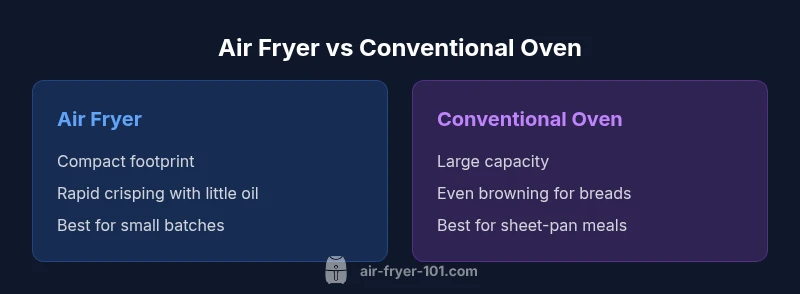
| Texture and Browning | Crispy exterior with minimal oil | Even browning and crumb in larger items |
| Typical Batch Size | Small, countertop-sized portions | Larger capacity for sheet-pan meals |
| Cooking Time Per Batch | Often shorter for small items | Usually longer due to bigger space and items |
| Energy Footprint | Lower energy per batch for small items | Higher energy use for large meals |
| Best For | Crunchy bites, reheating, small batches | Breads, casseroles, roasts and desserts |
| Preheating | Often quick preheat or no preheat needed | Typically requires longer preheat for even heat |
Pros
- Faster results for small portions
- Less oil needed for crispy textures
- Compact footprint fits on many countertops
- Excellent reheating performance with crisp outcomes
- Simple cleanup with minimal pans
Cons
- Limited capacity for large meals
- Some items may brown unevenly or require shake/toss
- Learning curve for time/temperature adjustments
- Not a perfect substitute for all baking tasks
Air fryer is not the same as baking; it complements baking for small, crispy meals.
Use the air fryer for quick, crisp results on small batches. Reserve conventional baking for large breads, sheet-pan dinners, and items that require even rise or long, even cooking.
Got Questions?
Is an air fryer the same as baking?
Not exactly. An air fryer delivers quick convection to crisp small portions with little oil, while baking uses steady heat for larger items and even rise. They share heat-based cooking, but the results and ideal foods differ.
Not exactly. Air fryers crisp small portions with little oil, while baking uses steady heat for larger items. They serve different purposes.
Can you bake in an air fryer?
Yes, you can bake certain items in an air fryer, especially small breads and snacks. Adjust temperatures and times, and avoid overcrowding to ensure even browning.
Yes, you can bake some items in an air fryer; adjust temps and times and don’t overcrowd the basket.
What foods work best in an air fryer vs oven?
Air fryers excel with crispy, small, oil-light items like fries, chicken tenders, and reheated leftovers. Ovens shine for breads, casseroles, and large roasts that require even heat and height.
Air fryers are great for crispy bites; ovens are better for breads and large meals.
Do I need to preheat an air fryer?
Many models heat quickly and don’t require a long preheat. Some recipes benefit from a brief warm-up, especially for dense items or when aiming for a uniform crust.
Some air fryers don’t need preheating, but a short warm-up can help dense foods browns evenly.
Is air frying healthier than baking in an oven?
Air frying can reduce oil usage for certain recipes, which may improve nutrition on those items. Overall health benefits depend on ingredients and portions rather than the method alone.
Air frying can lower oil use for some foods, but health benefits depend on what you cook and how much.
Can I convert oven recipes to air fryer?
Yes, many oven recipes translate with adjustments: lower temperature, shorter times, and careful spacing for air flow. Not all recipes are suitable, especially those needing tall rise.
Many oven recipes can be converted with temp and time tweaks, but not every dish works.
Quick Summary
- Choose air fryer for fast, crispy results with little oil.
- Rely on baking for large items and breads with even rise.
- Adjust times and temps when converting recipes between methods.
- Use both methods as complementary tools in a well-rounded kitchen.