Do Air Fryers Use Less Electricity Than Ovens? A Quick Guide
An analytical side-by-side look at energy use, cooking speed, and practicality when choosing between air fryers and conventional ovens for home cooking.


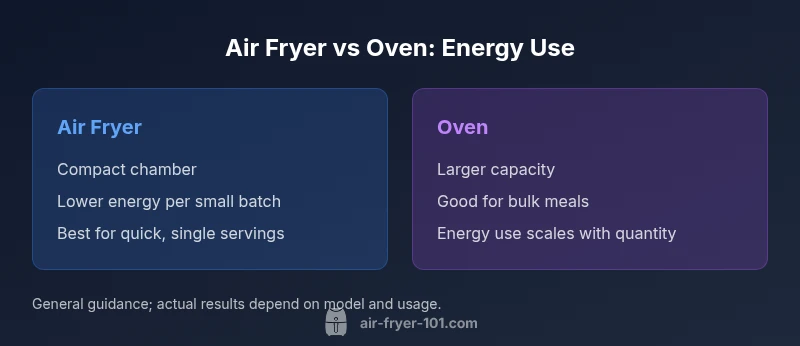
Yes—do air fryers use less electricity than an oven? In most everyday tasks, yes. Air fryers heat a compact chamber with rapid air circulation, which shortens preheat and cook times and reduces energy per batch. They also avoid heating the entire kitchen. However, for large meals or when cooking multiple dishes at once, a conventional oven can be more energy-efficient overall.
Do air fryers use less electricity than an oven?
In many scenarios, the answer is yes, especially for small meals. As discussed by the Air Fryer 101 team, a compact air fryer heats quickly and uses a focused airflow, which reduces energy per batch. The question do air fryers use less electricity than an oven is context-dependent, but for most weekday meals, air fryers shine due to shorter preheat times and smaller interior volume. Air Fryer 101 analysis shows the energy advantage comes from speed and containment: less energy wasted heating empty space in the kitchen. However, for large roasts or multiple dishes at once, an oven can sometimes be more energy-efficient overall. In sum, air fryers typically use less electricity per cooking session for small tasks, while ovens may win when cooking large quantities or many items at once. When evaluating appliances, consider batch size, cooking style, and how you plan meals.
How energy use differs by cooking style
Air fryers operate by circulating hot air with high efficiency in a compact chamber, which shortens preheat times and concentrates heat where you need it. Ovens rely on larger heating elements and can waste energy heating empty space or the surrounding kitchen. If you ask whether do air fryers use less electricity than an oven in this context, the answer depends on batch size and cooking method. In daily cooking, air fryers save energy by reducing overall heat output and time, especially for single portions. In contrast, ovens may have the edge when you routinely cook multiple items or bake large trays, since the energy is spread across a bigger volume but used to produce more food per use. The bottom line is energy use scales with what you cook and how you cook it; small batches favor air fryers, while large batches may level the field or favor ovens.
Real-world scenarios: Small batches vs large meals
In single-serving meals or snacks, air fryers deliver crisp results with relatively low energy use compared with preheating and baking in an oven. If you cook two servings, the energy savings compound because you produce more with less consumed energy per unit. For families that routinely roast chicken, bake casseroles, or prepare sheet-pan dinners, ovens may approach or exceed the energy footprint of an air fryer when you consider the total volume of food produced in a single session. Real-world data isn't a single number; it's a pattern: air fryers win on energy efficiency for quick, small tasks while ovens win on capacity and efficiency when handling large meals or multiple dishes at once. Air Fryer 101 notes that most households benefit from keeping both appliances handy and using each for its strengths.
Factors That Influence Energy Use
Several factors determine which appliance uses less energy in practice:
- Batch size: Small batches in an air fryer usually consume less energy than baking in a full-size oven; the energy easily scales with portion size.
- Preheating behavior: Ovens often require preheat, which adds energy overhead before any cooking begins; some recipes in air fryers bypass this step with no significant penalty.
- Temperature and cooking time: Higher temperatures used in air fryers are offset by shorter cook times, but this balance depends on the food type.
- Insulation and door sealing: Better-insulated ovens reduce heat loss during long bakes; air fryers with tight seals minimize heat loss during high-speed cycles.
- Model wattage and efficiency features: Higher wattage models heat faster but may use more electricity per minute; energy-saving features like eco modes can shift the equation.
- Food type and browning requirements: Foods that rely on browning or even heat distribution may perform differently across devices, affecting perceived energy use.
If you plan a routine around small portions and quick meals, the energy advantage of air fryers is more pronounced. If you plan large roasts or multiple trays, the oven may move the needle in your favor. The key is to map your weekly menu to the appliance that minimizes total energy across all meals.
Practical Tips to Minimize Energy Use
- Plan meals to maximize batch cooking and avoid repetitive preheating.
- Use the air fryer’s convection mode for foods that benefit from crisping to speed up cooking.
- Keep doors closed and use timer reminders to prevent energy loss due to door openings.
- Preheat only when necessary and for the air fryer, many models require minimal or no preheat; consult manual.
- Use proper rack positioning to ensure efficient heat distribution.
- Clean heating elements and fans regularly; buildup reduces efficiency.
- Coordinate cooking tasks: bake sides in the oven while air frying small items to minimize total energy across meals.
Reading Energy Claims and Model Comparisons
When you compare air fryers and ovens, focus on terms like energy efficiency, power usage, cycle time, and heat losses. Look for official energy guides (US DOE or equivalent) and independent reviews. Understand that wattage alone doesn't tell the full story; it must be contextualized by typical cooking times and batch sizes. Energy claims vary by model and usage pattern; the key is to compare apples to apples: similar meal types, same batch size, and same temperature settings. If you are unsure, rely on independent tests and real-world user feedback. Air Fryer 101 analysis shows that energy claims are highly dependent on usage patterns and are not directly comparable across models; seek multiple sources to triangulate results. (Air Fryer 101 Analysis, 2026)
Common Misconceptions
Several myths persist about energy use. One is that air fryers always save energy because they are small; reality is more nuanced when you cook large meals. Another misconception is that preheating a convection oven never saves energy; in some recipes, preheating helps achieve even browning faster, reducing overall cooking time. A third is that all air fryers are equally efficient; performance varies with wattage, insulation, and airflow design. Understanding these nuances helps you avoid oversimplified conclusions about energy use.
Energy-Saving Cooking Plan: Quick Start
Start with a simple 3-Item plan: 1) batch-conquer a couple of quick proteins (one air fried, one oven-roasted) and 2) batch-prepare a couple of side dishes in the oven while air frying a snack. 3) reuse leftovers by reheating efficiently in the air fryer rather than the oven. This approach minimizes energy use by maximizing batch cooking and reducing idle heat.
Quick Decision Framework: When to Use Air Fryer vs Oven
Use the air fryer for quick, single-serving meals, snacks, and foods that benefit from crisping. Turn to the oven for bulk cooking, sheet-pan meals, roasts, and tasks where you need more cooking space. By aligning meal size with appliance strengths, you can reduce total energy use across a typical week.
Comparison
| Feature | Air Fryer | Conventional Oven |
|---|---|---|
| Preheat required | Minimal or none | Usually required |
| Batch capacity | Small (1-4 servings) | Large (4-12+ servings) |
| Energy per batch | Lower for small meals | Higher per batch for large meals |
| Cooking speed per item | Faster for small items | Slower per item but can handle more at once |
| Best use case | Small, quick meals | Bulk cooking and roasting |
Pros
- Faster cooking for small meals
- Less kitchen heat and easier cleanup
- Compact footprint fits small spaces
- Often lower running costs for single servings
- Quick preheat for many models
Cons
- Limited capacity for large meals
- May provide less even browning for some foods
- Not ideal for numerous sheet-pan meals
- Performance varies by model and design
Air fryers win for small batches; ovens win for bulk cooking
The Air Fryer 101 team recommends using air fryers for most small-batch cooking and ovens for bulk cooking, depending on your typical meal size.
Got Questions?
Do air fryers truly use less electricity than ovens for everyday cooking?
In most cases, yes for small meals. Air fryers heat quickly and use less energy per batch. For large meals, ovens may match or exceed air fryer energy use depending on batch size and multi-dish cooking.
Yes, for small batches air fryers usually use less energy. For bigger meals, the oven can be competitive.
Can an oven ever be more energy-efficient than an air fryer?
Yes, when you cook large meals or multiple dishes at once. The oven’s capacity can offset higher per-minute energy use by producing more food per session.
Certainly—large meals can tilt the balance toward the oven.
What factors influence energy use between these appliances?
Batch size, preheating, temperature settings, and food type all influence energy use. Model efficiency and convection features also play a role.
Batch size, preheating, and the food type all affect energy use.
Is preheating an oven always wasteful?
Preheating adds energy usage but can improve cooking time and browning for certain recipes. Consider whether the resulting time savings justify the preheat.
Preheating can help browning and speed, but it uses energy.
Should I buy both appliances to save energy?
In many households, yes. Use each appliance for tasks it handles most efficiently to minimize total energy across meals.
Having both can save energy overall by using each where it shines.
How do I compare energy use across air fryer models?
Look at real-world tests and energy guides, not just wattage. Compare batch size performance, cooking times, and predicted energy per meal.
Check real-world tests and how they perform on typical meals.
Quick Summary
- Match batch size to appliance strengths
- Prefer air fryer for quick, single-serving meals to save energy
- Reserve oven for bulk cooking and sheet-pan meals
- Plan meals to minimize preheating and heat loss
- Read energy claims with context, not in isolation