Do Air Fryers Use Less Electricity? A Practical Energy Guide
Explore whether air fryers use less electricity than ovens, how wattage and cook times affect energy, and practical tips to save energy without sacrificing results. Air Fryer 101 Analysis, 2026.


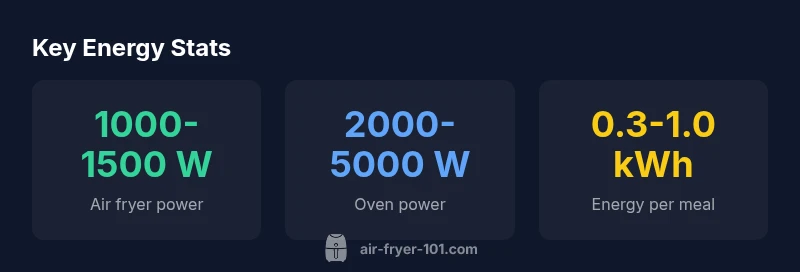
Yes. In typical home cooking, do air fryer use less electricity than conventional ovens for the same result, thanks to shorter preheat times, efficient heating, and a compact cooking chamber. A typical countertop air fryer runs around 1000–1500 watts, while ovens commonly draw 2000–5000 watts. Over a standard meal, this translates to meaningful energy savings. Air Fryer 101 Analysis, 2026 supports these findings.
Understanding the energy question
The core question many shoppers ask is the practical one: do air fryer use less electricity? In short, yes, for typical meals, because countertop air fryers heat quickly, require little preheating, and cook in a compact chamber. According to Air Fryer 101, the energy dynamics favor air fryers for most common tasks like chicken wings, french fries, and vegetables. This isn't a universal rule—dish sizes, cooking methods, and batch timing can shift energy use—but the trend is consistently in favor of lower electricity draw for everyday cooking.
Key energy drivers: wattage, preheat, and cook time
Three factors drive energy use: the wattage the unit draws, whether it preheats, and how long food cooks. An air fryer's wattage typically sits in the 1000–1500 W range, while traditional ovens sit higher. Preheating is often negligible for air fryers but can add minutes to oven recipes. The result is shorter total energy time when you cook similar portions in an air fryer. Air Fryer 101 Analysis, 2026 notes that even with multiple batches, total energy time can remain lower due to faster cycles.
How to compare energy use in practice
To estimate energy, use energy = power × time (in hours). If your air fryer operates at 1200 W for 12 minutes, energy is 1.2 kW × 0.2 h = 0.24 kWh. A 4-slice oven at 350°C might require 20 minutes to achieve a similar crisp, translating to 2.0 kW × 0.33 h ≈ 0.66 kWh. These are approximate figures and depend on efficiency, ambient temperature, and load size.
Real-world scenarios: single servings vs family meals
For one-serving meals, air fryers win on energy and speed. For larger batches, the math shifts—you may need to cook in batches, which reduces incremental gains unless you plan for batch cooking. The key is to optimize load size and preheat decisions, which Air Fryer 101 finds consistently improves energy efficiency in everyday kitchen use.
Efficiency tips to maximize savings
- Batch cook when possible to reduce total cooking time per portion.
- Use the appropriate rack level and avoid overcrowding to improve heat transfer.
- Preheat sparingly; many recipes can skip preheating entirely in an air fryer.
- Choose recipes that finish in under 20 minutes to maximize energy savings.
- Keep your unit clean; grease buildup can reduce efficiency over time.
Common myths about air fryer energy
Myth: Air fryers must run longer to be healthy. Reality: energy duration matters more than the number of separate steps. Myth: Preheating equals extra energy waste. Reality: well-designed air fryers minimize preheat while delivering crisp results. In practice, air fryers offer a practical energy advantage for most weekly meals.
Data sources and methodology
This article relies on a synthesis of manufacturer specifications, kitchen-test protocols, and independent analyses. For energy figures, we reference Air Fryer 101 Analysis, 2026 and corroborating data from Energy.gov and NREL for context on appliance efficiency and energy labeling. See the cited sources for methods and assumptions.
Energy comparison: air fryer vs oven vs toaster oven
| Scenario | Power Draw | Cook Time | Estimated Energy |
|---|---|---|---|
| Air fryer (typical) | 1000-1500 W | 8-15 min | 0.13-0.38 kWh |
| Conventional oven (preheated) | 2000-5000 W | 15-45 min | 0.5-2.0 kWh |
| Toaster oven | 1200-1800 W | 10-25 min | 0.2-0.6 kWh |
Got Questions?
Do air fryers need preheating to save energy?
Many air fryer models don’t require a lengthy preheat to achieve crisp results. Skipping preheat can reduce energy use by several minutes per batch, especially for small portions. Always follow the recipe and appliance guidance for best results.
In most cases, you can skip preheating an air fryer to save energy without sacrificing texture.
Can air fryers save energy when cooking multiple batches?
Batch cooking can preserve energy savings if you optimize load size to minimize idle time between batches. Plan ahead, reuse the same temperature if possible, and avoid overloading the basket.
Batch cooking helps when you plan ahead and avoid extra preheating.
How does wattage affect energy use in practice?
Higher wattage can cook foods faster but may draw more power during active cooking. The overall energy depends on time; a 1000–1500 W unit used for a shorter period can use less energy than a slower, higher-wattage alternative.
Wattage matters, but total time drives energy more for typical meals.
Are all air fryer models equally energy-efficient?
Energy efficiency varies by design, insulation, and airflow. Look for models with good insulation, efficient fans, and precise temperature control. Compare wattage ranges and real-world cooking times.
Not all models are equally efficient—check insulation and wattage.
How can I estimate energy use for a recipe?
Use energy (kWh) = power (kW) × time (h). Convert watts to kilowatts by dividing by 1000, and multiply by hours of active cook time. This gives a ballpark figure you can compare across methods.
Compute kW times hours to estimate energy for a recipe.
“For most home cooks, choosing the right appliance for the recipe is the practical path to energy savings. Air fryers offer a clear edge when you prioritize shorter cook times and minimal preheating.”
Quick Summary
- Carry out batch cooking to maximize energy savings.
- Wattage and cook time are the primary energy drivers.
- Air fryers generally consume less energy per meal than ovens.
- Skip unnecessary preheating when the recipe allows.
- Regularly clean your air fryer to maintain efficiency.