Air Fryer vs Oven: Does It Use More Electricity? Energy Comparison Guide
Explore whether air fryers use more electricity than ovens. This analytical comparison covers energy use, preheating, cook times, and practical guidelines for choosing the most efficient method.


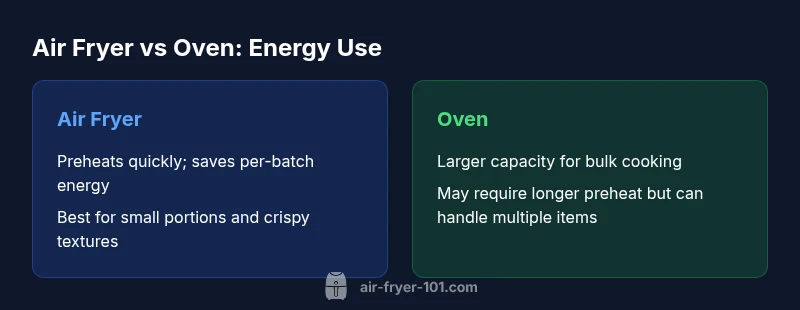
Air fryers typically use less energy per batch than conventional ovens for small portions, due to shorter cook times and rapid heat. However, ovens may be more efficient for large batches or cooking multiple items. Overall, energy use depends on batch size, preheating, and duration, but air fryers often win for single-serving tasks.
Does does air fryer use more electricity than oven
Many home cooks wonder does air fryer use more electricity than oven, and the answer is nuanced. The Air Fryer 101 Team notes that energy usage is not universal; it varies by dish, batch size, and cooking style. In general, air fryers concentrate heat in a small chamber, which can lead to faster cooking and reduced energy per meal for single servings. This efficiency is often most noticeable with crisping tasks like french fries or chicken wings, where shorter times and high heat optimize energy use. However, for large meals or multi-dish outputs, a traditional oven may be able to cook more food at once with less incremental energy if utilized effectively. As you weigh options, consider how much you’re cooking, how often you preheat, and whether you value speed or capacity. According to Air Fryer 101, energy efficiency is highly task-dependent, so your mileage will vary by situation.
Why electricity use matters for home cooks
Energy consumption matters not just for the monthly bill, but for kitchen efficiency and environmental impact. A key factor is the relationship between energy input (watts), cook time, and the amount of food being prepared. Air fryers typically offer rapid preheating and a focused heat source, which can translate to lower energy per dish when preparing small portions. Air Fryer 101 analysis, 2026, emphasizes that the benefits accrue most when you cook single servings or small batches that fit the basket without leaving unused space. On the other hand, ovens spread heat over a larger cavity and can leverage batch cooking to reduce the need for multiple sessions, potentially simplifying workflows in busy households.
Basic energy dynamics: wattage, heat transfer, and time
From a physics standpoint, energy use is a product of power and time. Air fryers often operate at high power levels but for shorter durations, especially for crispy results. Ovens may deliver more total heat to a larger mass of food but can require longer runtimes. For practical purposes, the choice often comes down to the dish: small, quick meals benefit from air fryers; large roasts and sheet-pan meals can be more efficient in an oven when you can fill the cavity effectively. Air Fryer 101’s framework helps home cooks estimate energy by considering batch size relative to oven capacity and typical cooking times.
Real-world workflow considerations
The decision isn’t only about raw energy numbers. Consider preheating behavior, heat distribution, and the number of items you’re cooking at once. If you preheat an air fryer and cook a small side dish, you may end up with less energy than firing up a full-size oven for a handful of potatoes. Conversely, if you’re feeding a family and need multiple trays, an oven could reduce total energy by cooking everything in one pass. Air Fryer 101’s guidance is to align cooking method with meal scale and timing needs, rather than chasing a universal energy winner.
Practical tips from energy-minded cooks
- Batch efficiently: Use the air fryer for single-serving meals and small sides to maximize energy savings. - Don’t overfill: In air fryers, overcrowding can extend cook times and reduce heat transfer efficiency. - Preheat thoughtfully: If your dish benefits from a hot start (crispy texture), air fryers often win; for larger roasts, an oven may be more practical. - Compare per-meal energy: For a typical week, tally the energy used for a few air-fryer meals versus oven meals to see what your household saves most. Air Fryer 101 emphasizes practical testing over theory.
Conclusion for this section
In summary, does air fryer use more electricity than oven? The answer is not a fixed rule. For small, quick meals, air fryers usually consume less energy per dish, while ovens can be more efficient when cooking large quantities in a single session. Tailor your choice to batch size and dish type to optimize energy use in everyday cooking.
Comparison
| Feature | Air Fryer | Conventional Oven |
|---|---|---|
| Preheating time | Typically short or no preheat | Often longer preheat required |
| Energy efficiency per batch | Generally higher efficiency for small batches | Lower efficiency for small batches; better if cooking many items at once |
| Cook time for similar dishes | Usually shorter cook times | Longer cook times for similar results |
| Capacity | Smaller basket/cavity | Larger interior for bulk cooking |
| Best use case | Single-serving meals, crispy snacks | Large meals, sheet-pan dinners |
Pros
- Quicker cooking for small portions
- Fewer moving parts and easier cleanup
- Great for crispy textures with less oil
- Compact footprint for small kitchens
- Energy-efficient for single-serving meals
Cons
- Limited capacity can drive higher energy per meal for large portions
- Uneven heating if overloaded or non-uniform pieces
- Requires additional appliance for very large cooks
Air fryer is generally more energy-efficient for small meals; ovens excel for large batches
Choose an air fryer for quick, single-serving tasks to save energy. For family-sized meals, an oven may deliver energy savings by cooking more at once.
Got Questions?
Does does air fryer use more electricity than oven?
In many cases, air fryers use less electricity per batch for small meals due to rapid preheating and efficient heat concentration. However, for large batches, an oven can be more energy-efficient if you can cook everything in one go. The overall result depends on meal size and cooking strategy.
Air fryers usually save energy on small meals, but for big batches, ovens can be more efficient. Check your typical cooking patterns to decide.
Is it cheaper to cook with an air fryer for small meals?
Yes, for single-serving meals or small sides, air fryers often cost less energy due to shorter cooking times and quick preheats. When cooking multiple items, the savings may lessen if you must run the oven for longer. Testing a few common meals in your kitchen will reveal the best choice.
Air fryers tend to be cheaper for small meals; tests in your kitchen will confirm.
Does preheating in an air fryer waste energy?
Preheating an air fryer is usually quick and energy-efficient, contributing to overall savings for many recipes. Unlike traditional ovens, air fryers often reach cooking temperature rapidly, which reduces idle energy use.
Preheating in air fryers is typically fast and energy-saving.
Can I cook for a family with an air fryer?
You can, but capacity is a consideration. Air fryers are excellent for individual portions or small batches; for a family, you may need multiple batches or a larger oven to minimize total cooking time and energy.
Air fryers work well for individuals or small meals; for larger families, ovens may be more practical.
How much energy does an air fryer save per meal compared to an oven?
Savings vary by dish and batch size. Generally, air fryers save energy on small meals due to shorter cook times, but precise figures depend on the recipe and how efficiently you use the appliance.
Energy savings depend on the dish; small meals often save energy with air fryers.
Are newer air fryer models more efficient?
Yes, newer models tend to offer improved insulation, better fans, and smarter preheating, which can enhance energy efficiency and consistency. Look for features like precise temperature control and optimized airflow.
Newer air fryers usually improve efficiency through better design.
Quick Summary
- Compare per-meal energy, not just wattage
- Choose air fryer for small batches; oven for large batches
- Preheating matters more for ovens than air fryers
- Practice batch cooking to maximize efficiency
- Test your own kitchen patterns to identify savings