Difference Between Air Fryer and Convection Oven: An Analytical Guide
A rigorous, data-driven comparison of air fryers and convection ovens, detailing how they work, where they excel, energy considerations, and how to choose the right tool for your kitchen.


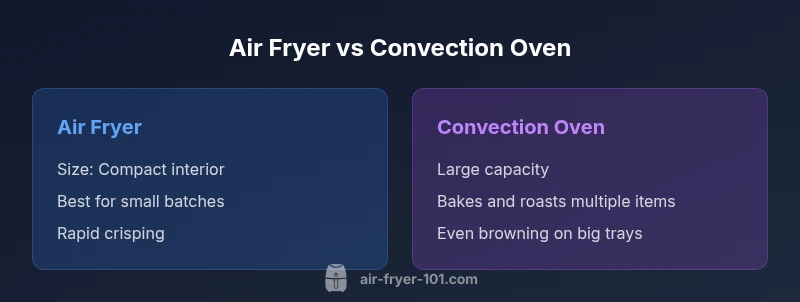
The difference between an air fryer and a convection oven comes down to size, airflow, and intended use. An air fryer is a compact countertop appliance that uses rapid hot air and a basket to crisp foods with little oil; a convection oven is a full-size oven with a fan that circulates hot air for even browning. According to Air Fryer 101, choose based on batch size, kitchen space, and versatile cooking needs.
Understanding the Difference Between Air Fryer and Convection Oven
In kitchen design conversations, many people ask about the fundamental difference between air fryer and convection oven. Both devices rely on circulating hot air to cook foods, which speeds cooking and promotes browning. However, they are different tools with distinct strengths, limitations, and typical use scenarios. Air fryers are compact, countertop appliances that use a small chamber and a perforated basket to concentrate airflow on a limited area, producing crisp textures with little oil. Convection ovens are full-size cooking environments, either standalone countertop units or built into ranges, that use racks and a larger interior to distribute heat evenly across multiple shelves.
Air Fryer 101’s analysis shows that the practical split isn’t just about physics—it's about batch size, space, and what you cook most often. If you routinely prepare small, crisp-tinished items like chicken wings or fries in modest portions, an air fryer can be faster and more energy-efficient. If you cook casseroles, sheet pan meals, or bake breads for several people, a convection oven offers flexibility, capacity, and familiar oven behavior. The choice becomes a matter of aligning your cooking style with your kitchen footprint, not just chasing the latest trend in countertop technology.
How Airflow and Heat Delivery Differ (Air Fryer vs Convection Oven)
Both air fryers and convection ovens rely on fans to move hot air, but they do so in distinct ways that influence cooking outcomes. An air fryer typically has a compact chamber with a perforated basket, which creates a focused, high-velocity column of hot air around smaller items. A convection oven uses a larger interior and racks; the fan circulates air more broadly to surround larger batches. This difference affects browning, moisture retention, and heat exposure. Air fryer designers often optimize basket geometry to maximize surface area contact with the food, which accelerates drying and crisping. In contrast, a convection oven spreads heat across multiple shelves, which can promote uniform cooking across a whole tray but may require repositioning food for even browning.
Air Fryer 101 notes that the fastest crisping results usually come from the air fryer’s concentrated airflow. However, convection ovens win when you cook for several people simultaneously, especially when you need to bake bread or roast large cuts. Understanding these dynamics helps home cooks choose the right tool for the recipe, the batch size, and the available countertop or range space. Remember: you can achieve many similar outcomes with both, but the powers and limitations of airflow differ.
Size, Footprint, and Kitchen Real Estate
One of the most practical distinctions is the physical footprint. Air fryers are designed for countertop placement and are generally small enough to store in a cabinet when not in use. Typical models range from compact 1-quart to larger 6-quart baskets, with many households choosing a single unit for quick tasks. Convection ovens, by contrast, occupy more space—whether as freestanding wall ovens, ranges with a convection setting, or larger countertop models with multiple racks. The trade-off is capacity: you can cook several sheets of food at once in a convection oven, which is invaluable for families or entertaining. If counter space is at a premium, an air fryer may win; if you regularly prepare meals for several people, a convection oven’s interior volume often justifies the footprint.
Cooking Performance: Speed, Texture, and Evenness
Crisp texture, even browning, and predictable timing matter to home cooks. Air fryers excel at rapid crisping of small items with minimal oil, leveraging a small chamber and perforated basket to maximize air contact. This setup often yields faster browning and a noticeable crunch on foods like chicken tenders, fries, and roasted vegetables. Convection ovens deliver reliable browning across larger trays and multiple dishes at once, with more conventional oven behavior that many bakers recognize. In practice, both tools can roaster, bake, and reheat; the key differences lie in texture preference, batch size, and workflow. Air fryers often require less overall time for small tasks; convection ovens shine when your cooking plan includes several items or larger roasts and bakeware.
Use Cases by Meal Type: Snacks, Main Dishes, Baking
Identifying the right tool starts with your typical meals. For quick snacks or single-portion dinners—think crispy wings, frozen fries, or roasted Brussels sprouts—an air fryer can deliver fast results with crisp edges. For family dinners, sheet-pan meals, casseroles, or baked goods—bread, muffins, and pies—a convection oven provides more space and versatility. If you enjoy experimentation, you’ll appreciate that many convection ovens offer precise temperature control and a familiar baking environment, making substitutions easier when a recipe calls for standard oven behavior. Air fryers, meanwhile, are ideal companions for finishing techniques that crave a crisp, light exterior without deep-frying.
Energy, Costs, and Maintenance Considerations
Energy efficiency and ongoing costs depend on how you use each appliance. Air fryers tend to consume less energy per cycle due to their smaller interior and shorter preheat times, making them attractive for quick, small-batch meals. Convection ovens, while possibly slower to preheat, can handle larger quantities in a single cycle, which may reduce the total number of batches required for a family meal. Maintenance differences also matter: air fryers are largely self-contained with removable baskets that are often dishwasher-safe, whereas convection ovens require more involved cleaning of racks, interior walls, and sometimes glass doors. In the long run, the choice may hinge on your typical meal size, how often you cook baked goods, and the convenience of cleaning routines.
Choosing Between Them: A Decision Framework
To choose the right tool, start with batch size and meal type. If you cook for one to three people and value speed and crisp texture for small items, an air fryer is compelling. If you regularly prepare larger meals, bake bread, or need to cook multiple dishes in one go, a convection oven provides the versatility you’ll rely on. Consider your kitchen layout: a compact countertop unit fits into tight spaces, while a convection oven is a larger, more integrated option. Finally, weigh cost and maintenance: air fryers are typically less expensive upfront and easier to clean, while convection ovens offer broader capabilities but may require more investment.
Quick-Start Tips and Simple Tests
Start with a test batch of your favorite small items to calibrate cooking times. Preheat if your model recommends it, and use a single layer for even airflow. Place a sheet pan inside a convection oven to test how it handles larger items, checking browning and doneness across the tray. For air fryers, begin with a lower temperature than you would for baking and check frequently, since the intensifying air can overcook fragile items quickly. Remember to avoid overcrowding in both devices, which can hinder airflow and lead to uneven results.
Common Pitfalls and How to Avoid Them
Common mistakes include overcrowding, neglecting preheating when appropriate, and assuming both devices are interchangeable for every recipe. Don’t attempt to bake a large loaf in a small air fryer basket; similarly, don’t expect a convection oven to provide the same quick crisp as a dedicated air fryer for small items. Also be mindful of cookware compatibility: some bakeware fits well in a convection oven but may not be suitable for air fryer baskets due to air exposure or size constraints.
Practical Quick-Start Guide
For practical use, keep a short, recipe-specific plan in mind. If you’re new to either device, begin with simple foods you already know cook well in one appliance, then gradually expand to more complex dishes. Maintain a clean, unobstructed air path around the food, and practice batch planning to minimize repetitive cooking tasks. With time, you’ll tune your settings to match your preferences for texture, moisture, and doneness.
Comparison
| Feature | Air Fryer | Convection Oven |
|---|---|---|
| Size & footprint | Compact countertop, typically 1–6 qt basket | Full-size oven or large countertop with racks |
| Airflow design | Focused airflow in a small chamber around a basket | Broad airflow across multiple shelves |
| Cooking speed | Often faster for small batches | Slower preheat for larger batches, but good for multi-dish cooking |
| Texture outcomes | Crispy textures with little oil on small items | Even browning across trays, versatile texture control |
| Capacity per batch | 2–4 servings typical in a single run | Multiple sheets or dishes, 4+ servings depending on rack setup |
| Energy usage | Lower energy per cycle for quick tasks | Higher total energy but efficient for large meals |
| Ease of cleaning | Removable baskets, often dishwasher-safe | Racks and interior require more effort to clean |
| Best-for scenarios | Small households, quick crisping tasks | Larger meals, baking, roasting, multi-dish cooking |
Pros
- Clear use-case distinction between small-batch crisping and full-meal versatility
- Typically lower upfront cost for entry-level air fryers
- Fast preheat and short cook times for snacks and single portions
- Compact footprint saves valuable counter space
Cons
- Limited capacity for large meals in many air fryer models
- Convection ovens demand more space and can be heavier to move
- Crisp results in air fryers may vary with different foods compared to deep-frying
- Cleanup can be more involved for convection ovens due to racks and interior
Air fryer is best for small, quick crisping tasks; convection oven excels for large meals and baking versatility
If you mostly cook for one or two people and crave fast, crisp results with minimal oil, the air fryer is a strong fit. For families or entertainers needing multi-dish meals and baked goods, the convection oven offers greater capacity and flexibility.
Got Questions?
What is the main difference between an air fryer and a convection oven?
The primary difference is in size, airflow, and intended use. An air fryer uses a compact chamber and basket with high-velocity air for fast, crispy results. A convection oven is a larger oven that distributes heat more broadly, suitable for baking and cooking multiple dishes at once.
The main difference is size and capability: air fryers are for quick crispy results in small batches; convection ovens handle larger meals and baking.
Can I use a convection oven like an air fryer?
Yes, you can replicate many air-fryer tasks in a convection oven by using high heat and a single tray. Expect similar browning, but the timing and texture may differ because of batch size and airflow dynamics.
You can use a convection oven for many air-fryer-style tasks, though results may vary with batch size and tray setup.
Are air fryers more energy-efficient than convection ovens?
Air fryers often use less energy per batch due to smaller interior and shorter preheat times, but overall energy use depends on batch size and what you’re cooking. For large meals, a convection oven may be more efficient overall.
Air fryers save energy per small batch, but big meals may favor convection ovens for fewer overall cycles.
Which is better for baking bread: air fryer or convection oven?
Convection ovens are generally better for bread and larger baked goods due to stable interior temperature and ample space. Air fryers can bake small items, but the limited interior size can restrict loaf size and oven-like browning.
Convection ovens win for bread and larger baked goods; air fryers are great for small, quick bakes.
Do convection ovens require special cookware?
Most standard oven-safe bakeware works in a convection oven. In an air fryer, avoid bulky items that block airflow and ensure baskets or racks fit properly. Always check manufacturer guidance for your model.
Use regular oven-safe pans in convection ovens; for air fryers, keep airflow clear and use appropriate basket inserts.
Quick Summary
- Assess batch size before buying: small vs large meals
- Consider kitchen space for footprint and convenience
- Balance texture preference with cooking versatility
- Factor in energy use and maintenance when choosing
- Test with your favorite recipes to fine-tune settings