Air Fryer Times vs Oven: A Practical Comparison
A thorough comparison of air fryer times vs oven, with practical guidance, pros/cons, and conversion tips for healthier, faster meals.


How Air Fryer Times vs Oven Differ in Heat Transfer and Food Reactions
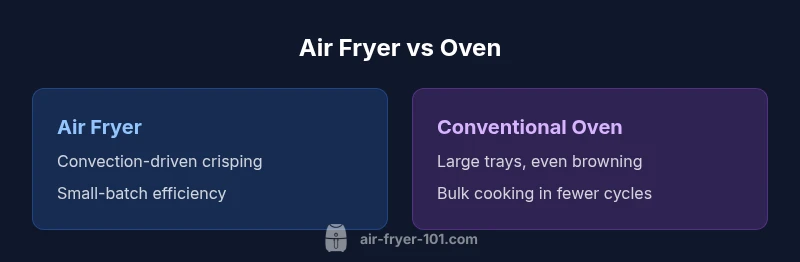
Air fryer times vs oven fundamentally reflect how heat moves and how quickly moisture escapes. Air fryers use high-velocity convection that hugs the food from multiple angles, creating a rapid surface dry-out that yields crisp textures with minimal oil. Ovens rely more on radiant heat from elements combined with ambient air, which can produce browning but may require more time and sometimes more oil for the same crust. According to Air Fryer 101, these differences are most noticeable with smaller, breaded items and with foods that benefit from a fast, focused sear. Large trays and dense foods, on the other hand, tend to benefit from the oven’s capacity and even heat distribution, even if the overall time is longer. This section helps you understand why those divergences happen and how to use them to get consistent results, whether you’re reheating leftovers or cooking a full dinner.
Key Factors That Change Cooking Times
Cooking times shift with several practical factors. Food type and composition matter: proteins, starches, and vegetables respond differently to intense airflow. Smaller, delicate items brown quickly, while dense foods may require more time in the oven to reach the same interior doneness. Size and thickness drive surface area to volume; a thin cut fries crisp rapidly, a thick chop browns slowly inside. Surface coatings, marinades, and oil application also affect heat transfer; dry coatings crisp faster, while wet coatings create steam that slows browning. Preheating habits vary by model and recipe; some air fryers heat up in moments, while ovens need a longer warm-up. Starting temperature of the food influences timing as well: starting from a fridge-cold state typically adds time and can affect texture. Batch management matters: a single layer yields the best air flow, while crowding reduces convection efficiency. Altitude and humidity can subtly shift outcomes. Air Fryer 101 analysis shows that understanding these factors helps you predict when to lean on the air fryer or the oven for best texture and doneness.
Common Foods: Timings for Proteins, Vegetables, and Frozen Goods
Proteins tend to develop a crisp exterior quickly with air fryers, while interior doneness depends on thickness and fat content. Lean cuts can finish faster on the air fryer, whereas denser fillets may benefit from oven heat to reach a safe internal texture without drying. Vegetables with high surface area, like florets or slices, brown rapidly in the hot air, yet can stay tender inside if not overcrowded. Dense vegetables, such as potatoes, may need more time to soften in a conventional oven, though air fryers can produce a crunchy exterior with less oil. Frozen foods often benefit from quick impulse heat to re-crisp surfaces; items like fries or nuggets develop texture with minimal oil. Reheating leftovers in the air fryer can restore crispness more reliably than using a microwave for many items. These patterns help you build reliable intuition for everyday cooking and reheating tasks.
Preheating: Do You Need It and How It Affects Time
Preheating is model- and recipe-dependent. Some air fryers reach cooking temperature unusually quickly, making preheating optional for many items. In other cases, especially with thicker cuts or dense foods, a brief warm-up can improve uniformity at the start of cooking. Ovens typically benefit from an initial preheat, particularly when you’re cooking multiple trays or large pieces that need to begin cooking evenly. If you skip preheating on air fryers, monitor early progress and be prepared to adjust. The key idea is to align your approach with the food’s density and the appliance’s specific heat behavior rather than relying on a fixed timer.
Load Size, Placement, and Airflow
Air fryer performance hinges on how foods are arranged. A single layer with space between pieces maximizes airflow and promotes even browning. Crowding can create uneven results and longer overall cooking times as hot air struggles to reach every surface. For ovens, tray arrangement matters too, but larger cavities mean airflow is less direct, so you may need to rotate trays or reposition items for uniform browning. When evaluating batch size, think in terms of surface area exposure rather than total volume. A modest batch spread in an air fryer or on a single oven rack often yields better outcomes than a full, dense stack.
Energy Efficiency and Time: Comparing Costs and Environmental Impact
Air fryers are often perceived as energy-efficient for small meals due to their compact size and shorter cycles. Air Fryer 101 analysis shows that the energy profile can be favorable for quick, single-serving or light-batch tasks, but this advantage diminishes if you’re cooking large quantities that would otherwise require multiple air fryer batches. Ovens, though larger and sometimes slower for small tasks, can be more efficient for bulk cooking because they consolidate multiple servings into one cycle. The takeaway is to match the appliance to the batch size and the desired texture rather than assuming one device universally wins on energy.
How to Convert Oven Times to Air Fryer Times
A practical approach is not to chase a precise minute count but to think in steps. Start with the same temperature if possible or a modest drop, and reduce cooking time by checking early for doneness. Use a thin item as a reference point for initial testing, then apply the same principle to thicker foods. For items on a rack, give space for air to circulate and avoid overcrowding. If you keep the food in a pan or on a tray designed for air fryers, the conversion process becomes more predictable. Remember: it’s better to check early and adjust than to overcook.
Real-World Scenarios: Quick-Reference Timelines
These scenarios illustrate typical patterns without committing to fixed times. Reheating leftover fried foods is usually faster and yields crisper textures in an air fryer. Roasting vegetables in the oven can produce deeper browning and caramelization when you’re cooking for a crowd. For proteins, a compact air fryer can deliver a crisp crust on smaller portions, while the oven shines when you’re aiming for even doneness across larger cuts. In a real kitchen, you’ll frequently decide based on batch size, texture preference, and how much time you can allocate. The goal is to know the trade-offs and apply a flexible approach that achieves consistent results.
Practical Tips and Common Pitfalls
- Avoid overcrowding the basket or rack; it hampers airflow and browning.
- Use a light spray or a thin oil coating to improve browning on dry surfaces.
- Let thicker pieces rest briefly after cooking to allow juices to redistribute.
- For breaded items, ensure an even coating to prevent soggy spots.
- When in doubt, test a small batch before scaling up to a full recipe.