How Long in Air Fryer Compared to Oven: Timing Guide
A rigorous, evidence-based look at how long foods take in an air fryer versus a traditional oven, with practical conversions, caveats, and tips from Air Fryer 101.


In most cases, foods cook faster in an air fryer than in a conventional oven due to rapid air circulation and a smaller cavity. For a direct comparison, expect shorter cook times for many proteins and vegetables with less preheating required. However, results vary by food type, batch size, and model. Air Fryer 101 notes that times can differ across brands.
Understanding timing: how long in air fryer compared to oven
Timing is the core question when evaluating air fryers against ovens. The air fryer’s design relies on a powerful convection current that creates a moving curtain of hot air around foods. This mechanism often reduces overall cooking times for smaller items and lean proteins, while also producing crisper exteriors with less added fat. When you ask how long in air fryer compared to oven, the answer is not a fixed number but a range influenced by particle size, thickness, moisture content, and whether the food is fresh, frozen, or prepped with a light coating. A practical way to frame this is: air fryers typically shorten cook times for bite-sized pieces and foods that benefit from high surface area, but large or dense items may require time closer to oven values. The key is to view air-frying as a performance that scales with batch size and food geometry, not a universal time shortcut for every dish. From a consumer standpoint, this means you should expect shorter times for many common items, but always verify doneness with a thermometer or visual cues.
In exploring how long in air fryer compared to oven, we also consider preheating. Air fryers generally preheat quickly, sometimes in just a few minutes, which can shorten the total meal time even further. This factor is especially impactful when you’re cooking multiple small items back-to-back. The takeaway is to start with the food’s oven time as a rough baseline, then trial with a reduced air-fryer time and check for doneness. Air Fryer 101’s analysis emphasizes that accurate results come from testing and noting your specific model’s quirks, rather than relying on a single universal conversion.
The physics of hot air and browning
The fundamental physics behind air fryers is convection at high velocity. A compact chamber concentrates heat and circulates it aggressively around the food, promoting rapid browning on the exterior while faster heat transfer reaches the interior. This is why the surface texture often develops more quickly in an air fryer than in a standard oven, given similar temperatures. The effect is more pronounced for small, uniformly shaped pieces and foods with a bit of surface moisture that can evaporate rapidly. Conversely, large roasts or thick slabs of meat have interior heating challenges that can narrow the advantage. In practice, the crispness factor and interior doneness hinge on air flow, basket design, and how evenly heat penetrates the item. The net implication for timing is straightforward: when you cut items small and arrange them in a single layer, you typically shorten total cook time and gain a crisper exterior, all while avoiding long preheat periods common with ovens. Air Fryer 101’s team notes that basket cleanliness, oil usage, and browning goals all influence the final timing outcome.
Preheating, batch size, and how they skew timing
Preheating a traditional oven often adds several minutes to total meal time, especially when you need to reach a uniform cooking temperature for large trays. In contrast, many air fryer models preheat quickly or even don’t require a formal preheat for small batches. Batch size matters because air fryers have a finite basket capacity. When you overcrowd the basket, air circulation is impeded, which can elongate cook times and inhibit browning. This makes it critical to cook in multiple small batches or to arrange items in a single layer with space between pieces. The timing implication is clear: if you’re cooking for a crowd, the air fryer’s faster times can be offset by batch-based sequencing. Conversely, for quick weeknight meals, the faster preheat and high-velocity air can yield a noticeable time save. Air Fryer 101’s analysis underscores that users should think in terms of batches, not a single long cook, to optimize overall meal throughput.
Food categories and timing nuances
Different foods respond differently to air frying versus oven cooking. Vegetables, when cut evenly, typically finish faster in an air fryer with a vibrant color and crisper texture. Lean proteins like chicken tenders or shrimp often reach the desired internal temperature quicker, especially with a light oiling to promote browning. Frozen items such as fries and chicken nuggets can also benefit from shorter total times due to concentrated heat and agitation. Baked goods—cookies, small pastries, or scones—tend to replicate oven results but require careful monitoring to avoid over-browning in the hot air stream. Dense items, like bone-in chicken thighs or large roasts, may still require longer times or more frequent turning if you want uniform doneness. The practical takeaway is that the air fryer excels with smaller, uniform pieces, enabling faster execution and a crisp finish, whereas larger, uneven pieces may exhibit timing nuances that resemble oven behavior.
Practical timing strategies: checking doneness, rest time, and conversions
To optimize timing in real kitchens, employ a proactive doneness-check strategy. Use a calibrated thermometer to confirm safe internal temperatures rather than relying solely on time. Plan to reduce oven times by roughly a third as a starting point, then dial up or down based on results. Resting meat after cooking is important to redistribute juices and finalize carryover cooking, which can influence the apparent doneness when you slice into it. When converting oven-based recipes, a stepwise approach helps: (1) keep the same temperature or reduce by a small margin; (2) cut the total time by about 20-30% as a starting point; (3) check early and often, especially the first time you try a new recipe; (4) shake or flip items midway to ensure even exposure. This practical framework—start with a baseline, explore adjustments, and measure results—helps you achieve consistent outcomes across different foods and models.
Common myths and misconceptions about air fryer timing
A common myth is that air fryers always cook faster for every food. In reality, the benefits depend on food type, size, and moisture, as well as the model’s airflow pattern. Another misconception is that you never need to preheat. While many models preheat quickly, some items still benefit from a brief warm-up, particularly thicker cuts. Yet another myth is that air fryers don’t work well for baking; while results differ from a conventional oven, many snacks and small baked goods can be produced with excellent texture. Finally, some cooks believe larger batches automatically extend the time beyond oven values; in truth, staying within a single-layer layout and avoiding overcrowding preserves the time advantage. The bottom line is to treat air fryer timing as a set of adaptive rules rather than a fixed timetable; adjust based on food geometry, batch size, and observed doneness.
How to convert oven times to air fryer times: a step-by-step approach
Converting oven recipes to air fryer instructions requires a simple, repeatable method. Start with the oven temperature and cook time as a baseline. Reduce the time by roughly one-quarter to one-third, depending on the item’s size and whether a crispy finish is desired. Keep temperatures close to the oven setting or tweak slightly higher if you want faster browning. Shake or flip the food halfway through to promote uniform exposure to hot air. When in doubt, monitor doneness with a thermometer or visual checks, then adjust for future attempts. Record your adjustments alongside your recipe to build a personal library of effective air fryer timings for your most-loved dishes.
Choosing the right model for timing reliability
Not all air fryers deliver identical results. Variations in basket design, fan power, and cavity geometry can influence heating rate, airflow, and browning texture. A model with flexible temperature control, a wide temperature range, and reliable internal fans tends to yield more consistent timings across a variety of foods. Consider capacity relative to your household size; a compact unit is ideal for singles and couples and excels at quick, small-batch meals, while a larger model can handle family-sized portions with coordination of multiple rounds. Controls and presets can help, but manual timing and a digital thermometer remain the most dependable tools for precise doneness. Air Fryer 101’s guidance emphasizes matching your device’s capabilities with your typical meals to optimize both time and texture.
Real-world timing map: by food category
In real kitchens, timing differences vary by category. For vegetables, aim for shorter cook times with even-sized pieces to maximize browning. For chicken or fish, ensure internal temperatures meet safety standards while using a light coat of oil to promote crispness. For frozen items like fries, expect near-instant browning provided you spread them in a single layer and avoid overcrowding. For baked goods, monitor closely; some air fryers excel at cookies or small pastries, while larger loaves or delicate cakes may require oven-like handling. By thinking in terms of batch size and geometry, you can estimate timing with greater confidence and achieve a reliable balance of texture and doneness.
Conclusion: timing decisions that fit your kitchen reality
The core takeaway is that timing in air fryers versus ovens is not universally fixed. It’s a function of item size, moisture, lipid content, model capabilities, and batch management. Use oven baselines as starting points, apply a cautious time reduction, and verify doneness with proper tools. Over time, you’ll build a personal rulebook tailored to your most-used recipes and devices. Air Fryer 101’s ongoing evaluation shows that consistent results come from deliberate practice, precise measurements, and attentive observation of how your chosen model handles each dish.
Comparison
| Feature | Air fryer | Conventional oven |
|---|---|---|
| Preheat time | Typically quick to preheat or no formal preheat required for small batches | Often longer (several minutes up to 15+), especially for large trays |
| Cooking time for common items | Generally shorter for small, flat, or breaded pieces; crisping is rapid | Often longer, especially for larger or thicker items; browning takes longer |
| Evenness of browning | Crisp, uniform exterior with consistent airflow | Can be uneven without convection or proper tray rotation |
| Energy use per batch | Lower total energy for small batches due to faster cook times | Higher energy if multiple oven batches are needed or preheating is long |
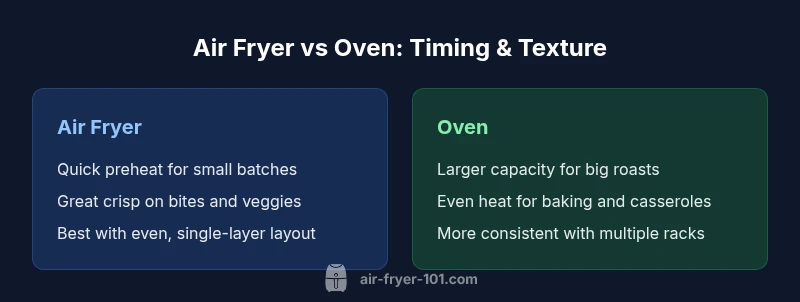
| Best for | Small to medium batches; quick weeknight meals; snacks | Large roasts, casseroles, and baking where volume matters |
| Capacity | Limited by basket size; ideal for 1-4 servings | Larger capacity and multiple racks available in some models |
| Ease of use | Simple controls; quick learning curve; fewer steps | Requires tray management and potential preheating; more space to manage |
Pros
- Faster overall meals for small items
- Crisp textures with little or no added oil
- Quick preheat and less energy waste for small batches
Cons
- Limited capacity may require multiple batches
- Some foods don’t brown evenly without shaking or turning
- Not all recipes translate perfectly from oven timings
Air fryer generally wins for speed and crispness, but ovens excel in large-scale baking
Choose an air fryer for quick, small-batch meals with crisp textures. Opt for a traditional oven when cooking large quantities or dense baked goods that benefit from steady, even heat.
Got Questions?
Can I use oven times as a starting point for air fryer cooking?
Yes. Treat oven times as a baseline and reduce by roughly 20-30% for air fryer foods, then adjust based on doneness. Always verify with a thermometer when safety matters (meat, fish, poultry).
Yes—start with the oven time, cut it by about a quarter to a third, then check doneness with a thermometer or by texture.
Do all foods cook faster in an air fryer?
Not every item benefits equally. Small, breaded, or fatty items often crisp up faster, while very large or dense pieces may take similar or longer times. Always test a new recipe.
Most small items cook faster, but large or dense foods may not. Test and adjust.
Should I preheat an air fryer for best timing?
Many models preheat quickly, and some items don’t require preheating at all. For consistency, preheat when you’re going for a crisp exterior on breaded items or when the recipe calls for it.
Preheating helps consistency; use it if you’re aiming for extra crispness.
How do I convert oven temperatures for air fryers?
Start with the same temperature or reduce slightly by about 15-25°C (25-45°F) for most recipes. Time reductions are usually more impactful than temperature changes.
You can start with the same temp or a bit lower; time is the more powerful lever to adjust.
Is an air fryer worth it for snacks and small meals?
For frequent single-serve meals or snacks, an air fryer often provides faster, crisper results with less oil. For larger families, weighing capacity against oven efficiency matters.
Great for quick, crispy snacks and small meals, especially if you cook often for one or two.
Quick Summary
- Start with oven baselines, then reduce time by about a third as a starting point
- Cook in single layers to maximize air circulation and browning
- Use a thermometer and visual checks to verify doneness
- Preheat conventions vary by model; test your device
- Record your adjustments to build a personal timing guide