How Long in Air Fryer vs Oven: A Practical Timing Guide
Compare air fryer and oven cooking times for common foods, with preheating tips, batch guidance, and practical conversion rules to help you optimize meals and choose the right appliance.


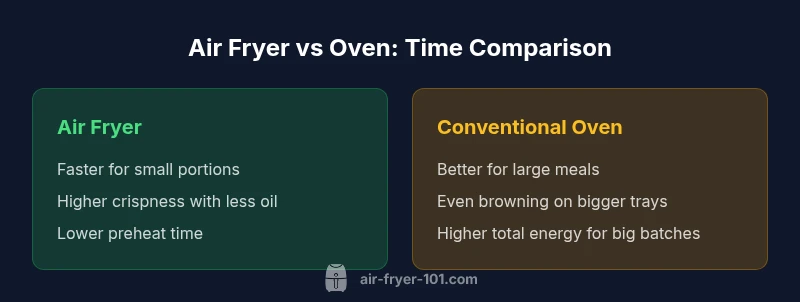
For most home cooks, how long in air fryer vs oven depends on the food and batch size. In general, air fryers cook faster for small portions and deliver crisp textures with less preheat time, while ovens handle larger batches and foods that require even browning. See the detailed chart below for exact times by food type.
What Drives Timing in Air Fryer vs Oven
Cooking times are not just about a clock. They depend on heat transfer, air flow, moisture, and how many items you’re cooking at once. An air fryer circulates hot air rapidly around a compact chamber, delivering crisp exterior with relatively quick cook times. A traditional oven relies on a larger cavity to heat more evenly, which can produce browning across a sheet but may require longer preheating and longer cook times for the same result. According to Air Fryer 101, the starting temperature of the food, its thickness, and whether you preheat influence the actual time. The result is that how long in air fryer vs oven is a spectrum rather than a fixed value, varying by food type, portion size, and your model. In this guide we’ll break down typical ranges, explain the logic behind them, and show how to apply them in everyday cooking.
Preheating: When to Preheat and When to Skip
Preheating can save time for some recipes but isn’t always necessary. Air fryers heat quickly and often don’t require a long preheat, especially for small, dry items. Ovens usually benefit from a preheat to ensure the interior reaches the target temperature, which improves accuracy for meat and baked goods. As a rule of thumb, preheat the oven for most sheet-pan meals or baked items, and use the air fryer preheat only when starting from room temperature or frozen foods. Air Fryer 101 notes that preheating times vary by model, but the goal is to minimize the gap between your food going in and the oven or fryer reaching cooking temperature.
Small Snacks and Appetizers: Fries, Nuggets, and More
Small, thin items cook quickly in air fryers due to rapid air movement. Typical times for fries, chicken nuggets, and small vegetables in a 350–400°F (175–205°C) air fryer range from roughly 6–12 minutes, with shake/flips around the halfway point to promote even browning. In a conventional oven, the same items often take longer, usually 12–20 minutes at 375–425°F, depending on thickness and whether convection is used. If you’re starting from frozen, expect the air fryer to beat the oven on total time for many snack foods.
Proteins and Meats: Chicken, Pork, and Seafood
Proteins respond to surface area and moisture loss. Boneless chicken breasts often finish quicker in an air fryer (roughly 10–15 minutes at 360–400°F) than in a standard oven (about 18–25 minutes at 375°F). Pork chops and shrimp can also cook faster in the air fryer, while tougher cuts or larger roasts typically need oven time to ensure tenderness and even cooking. Always use a thermometer to verify safety and avoid overcooking.
Vegetables and Frozen Foods: Fresh vs Frozen
Fresh vegetables take advantage of the air fryer’s crisping ability: carrots, broccoli, and peppers can finish in under 15 minutes at high heat, with a quick toss halfway. Frozen vegetables are often ready sooner in the air fryer than in the oven, but you may need to shake the basket to redistribute and prevent sogginess. In the oven, frozen veggies may take longer but can roast more evenly on a sheet when spread out.
Baking and Desserts: Cakes, Cookies, and Pastries
Baking in an air fryer is possible but not always ideal for all recipes. Cookies can sometimes be done in 6–9 minutes at 320–360°F, while a small cake or brownie may require more careful timing to prevent overbrowning. Conventional ovens provide more consistent results for most cakes, muffins, and pastries due to larger cavity and easier temperature control. If you test, start with oven times and then adjust downward for the air fryer in small increments.
Batch Size and Spacing: How Much Can You Cook at Once?
One of the biggest differences is capacity. Air fryers typically work best with a single layer and limited space, which makes them perfect for quick, small portions but less efficient for bulk cooking. Ovens can accommodate multiple trays and larger quantities in a single cycle, though you still need to ensure even air flow and avoid overcrowding. When you’re cooking for a crowd, plan multiple batches or switch to the oven for high-volume tasks.
Food Thickness and Surface Area: Why Size Matters
Thicker items or foods with uneven shapes will take longer to reach the internal target temperature, and the exterior may brown unevenly in either appliance. In air fryers, thin or small items heat quickly and crisp nicely, while thicker pieces require longer times or may need to be finished in the oven. In ovens, uniform thickness and consistent sheet spacing help achieve even browning across a full tray.
Temperature vs Time Tradeoffs: How to Optimize
If you’re chasing speed, increase temperature within the recommended range and shorten the time slightly, then check for doneness. If you aim for even browning and tenderness, use the lower end of the temperature range and extend the cooking time as needed. Remember that every model differs, so treat these ranges as starting points and adjust based on your results.
Practical Tips and Recipe Conversions: From Oven to Air Fryer
Converting an oven recipe to air fryer usually means reducing both temperature and time. A practical starting rule is to reduce the oven temperature by about 20–30% and reduce total cook time by about 20–25%, then check for doneness with a thermometer or visual cues. For baked goods and delicate items, consider partial air fryer use or finishing in the oven to maintain texture and rise.
Common Mistakes and How to Fix Them
Common issues include overcrowding the basket, not preheating when needed, and failing to flip or shake items for even browning. Avoid using heavy batters or too much oil, which can lead to uneven texture. If food sticks, use parchment or light oil spray and ensure there’s adequate space between pieces for air circulation.
Setup, Cleanup, and Consistency
Maintain consistent results by cleaning the basket and tray regularly, using non-stick liners or parchment when appropriate, and verifying that your cooking surfaces are clean. For repeatable results, keep a log of temperatures, times, and outcomes for your most-used foods. This helps you build reliable timing habits over weeks of cooking.
Comparison
| Feature | Air Fryer | Conventional Oven |
|---|---|---|
| Typical preheat time | 2-5 minutes | 8-15 minutes |
| Small-item cook time (e.g., fries, nuggets) | 6-12 minutes | 12-20 minutes |
| Medium-item cook time (1-1.5 lb) | 12-18 minutes | 25-35 minutes |
| Crispness and texture | Crisp exterior with minimal oil | Generally browns evenly; may require convection |
| Batch capacity | 1-2.5 lbs per batch (single layer) | 3-5+ lbs per batch depending on rack space |
| Energy use per batch | Lower energy for small batches | Higher energy for large batches plus preheat |
| Best for | Quick snacks and single servings | Large trays, sheet-pan meals, baking |
Pros
- Faster results for small portions
- Crispy texture with little or no oil
- Lower energy per batch for small meals
- Less preheat time on many models
Cons
- Limited capacity for large meals
- Not all foods translate well (wet batters, large roasts)
- Some models have uneven results unless you shake or flip food
Air fryer is best for quick, small meals; oven shines for large batches and baking
For daily quick meals, the air fryer wins on speed and crispness. For family dinners or sheet-pan meals, the oven remains the practical choice. Use both depending on portion size and dish type.
Got Questions?
Can I replace oven cooking with an air fryer for every dish?
Air fryers excel with small, dry items and speedy snacks, but they aren’t ideal for large meals or certain baking tasks. Large roasts, multiple sheet-pan meals, or delicate batters may fare better in a conventional oven. Use the air fryer for quick turns and snacks, and reserve the oven for bulk cooking and baking where volume and rise matter.
Air fryers are great for quick snacks, but for big meals or complex bakes, the oven often wins.
Should I preheat an air fryer or oven before cooking?
Preheating is often quick for air fryers and beneficial for items starting cold. Ovens typically benefit from preheating to ensure reliable internal temperatures, especially for meats and baked goods. Use preheat guidance from your model and recipe type.
Preheat the oven for consistent results; air fryers usually preheat fast, but follow your model’s guidance.
What foods are best suited for air fryer timing vs oven timing?
Air fryers shine with fries, nuggets, and crisp vegetables in quick time. Ovens excel with large trays, roasts, casseroles, and baked goods that need steady, even heat. Start with air frying for snacks and shift to the oven for big family meals.
Air fry for quick snacks; bake larger meals in the oven.
How do I convert a recipe from oven to air fryer?
Convert by lowering both temperature and time: a common starting point is reduce the oven temperature by about 20–30% and shorten total cook time by 20–25%, then check for doneness with a thermometer or by visual cues. Adjust as needed for thickness and moisture.
Lower temps and reduce time when moving from oven to air fryer; check for doneness early.
Do air fryers use less energy than ovens?
Air fryers can use less energy per batch when cooking small items due to faster cook times and smaller cavity, but total energy depends on batch size, model efficiency, and whether preheating is required. For large meals, ovens may still be comparable or more energy-efficient if you can cook multiple items at once.
Air fryers often use less energy per batch for small meals; larger meals may level the field.
Quick Summary
- Choose air fryer for small portions and crisp texture
- Use oven for large batches and even browning on trays
- Avoid overcrowding to maintain air flow
- Preheat appropriately for best results
- When converting recipes, reduce time and temperature for air frying