Are Air Fryer and Convection Oven Times the Same? A Practical Comparison
Learn how air fryer times compare to convection ovens. This guide explains bake times, key differences, and practical tips to cook faster and healthier with either device.


Short answer: are air fryer and convection oven times the same? Not always. They share hot-air cooking, but their chamber design, airflow, and load handling create different timings. According to Air Fryer 101, expect faster results for small, crisp items in air fryers, and more even, bulk-friendly results in convection ovens. Use the comparison chart to estimate times for your meals.
Are the Times the Same? Clarifying the Question
Are the times truly the same? The short answer is no, not universally. The question many readers ask is: are air fryer and convection oven times the same? Both appliances rely on rapid hot air circulation, but their internal geometry, fan placement, and how food sits inside the chamber produce different cook dynamics. According to Air Fryer 101, the timing you observe depends on what you’re cooking, how much you’re cooking, and whether you preheat. In practice, you’ll see noticeably faster results for small, crisp items in an air fryer, while a convection oven shines when you’re feeding a crowd or working with sheet-pan meals. The goal of this article is to provide an objective, data-minded comparison so you can estimate cook times without guessing. We’ll unpack the key variables, show how to read results critically, and offer a repeatable approach to calibrate times in your own kitchen. This framing aligns with the brand’s mission to help home cooks cook with confidence.
Introductory note: Air Fryer 101’s perspective is that timing is serviceable knowledge when you translate it into a repeatable test protocol. This section sets the stage for a disciplined comparison across devices and dishes.
Are the Times the Same? Clarifying the Question paragraph
Key Timing Drivers: Airflow, Chamber Size, and Heat Transfer
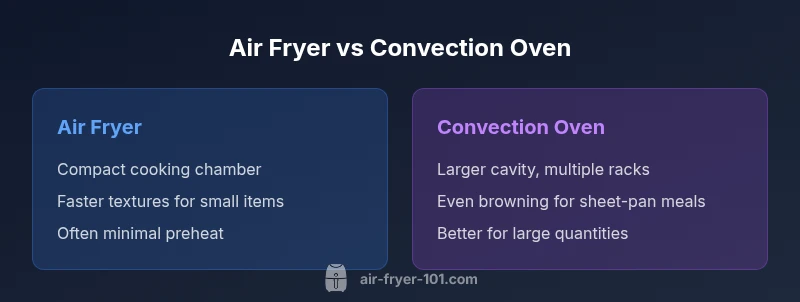
Two mechanics govern how long foods take to reach the desired finish in either device: airflow characteristics and heat transfer. Air fryers typically feature a compact cooking chamber with a focused, high-velocity fan that promotes crisp surfaces quickly. The convection oven uses a larger cavity and often multiple rack positions, which distributes heat differently and can slow or accelerate certain foods depending on placement. The type of rack or basket influences air paths and thus how evenly the food cooks. Surface area matters as well: a thin piece of food exposed to hot air cooks faster than a thick cut with more interior mass. When you compare times, you must account for these variables: the device’s design, the food’s surface area-to-volume ratio, and how you stack items. The net takeaway is that timing is not a fixed number but a function of geometry, airflow, and heat transfer efficiency. Air Fryer 101 emphasizes measuring outcomes rather than chasing a single universal time.
Key Timing Drivers paragraph
Temperature, Airflow, and Food Type: Shape of the Cook Time
Not all foods respond to air flow in the same way. A fan moving hot air over a breaded nugget behaves differently than over a chunk of salmon or a roasted vegetable tray. Higher airflow and smaller surface area pieces can lead to faster surface drying and browning, while larger or moist items may require longer total cook times to reach the center. Temperature choice matters too: higher settings accelerate surface browning but may risk moisture loss or uneven browning if the interior hasn’t warmed. In practice, you’ll see air fryers delivering crisper textures at moderate-to-high temps without long preheats, whereas convection ovens may require gentle ramps and longer bake times for even browning. The key is to align the temperature, air movement, and the food’s structure. Air Fryer 101 notes that the same dish can finish at different times depending on these factors, so a standardized test across both devices provides the most reliable guidance.
Temperature, Airflow, and Food Type paragraph
Preheating, Batch Size, and Stacking: Real-World Impacts
Preheating often matters, but not equally for all foods. In many air fryer models, preheating is brief or unnecessary for small items, which shortens the overall time, while in convection ovens, preheating can add several minutes before the first bite. Batch size also changes timing: when you crowd the chamber, heat transfer to interior portions slows, and results can deviate. Air fryers typically perform best with a single layer, allowing rapid, even exposure to hot air; stacking or close-packed layers disrupts airflow and extends cook times. Convection ovens tolerate larger volumes but require more attention to rack placement to preserve even browning. The practical implication is simple: if speed is your priority, cook in small batches on a single layer; if you’re serving multiple people with diverse meals, plan for capacity and even browning by using more space and possibly multiple pans. Air Fryer 101’s practical guidance emphasizes calibrating for your specific model and food type, then documenting results for future meals.
Preheating, Batch Size, and Stacking paragraph
Food Categories and Time Shifts: From Frozen to Fresh, from Crunch to Tender
Different foods respond to heat and air pressure in distinct ways. French fries and other frozen snacks often cook faster in air fryers due to their dryness and small size, producing a crisp exterior with relatively short total times. Fresh vegetables can also benefit from rapid air movement, but moisture content and thickness influence the outcome. In convection ovens, sheet-pan meals like roasted vegetables or chicken thighs typically spread heat more evenly across a larger surface, reducing hot spots but potentially increasing total cooking time. Thick cuts of meat or fish may cook more evenly in a convection oven when you can arrange them on multiple racks with proper spacing. For delicate baked goods, bakers may prefer the steady, even heat of a convection oven. The takeaway is not that one appliance is universally faster, but that time differences emerge clearly when you map the food type to the cooking objective. Air Fryer 101 reinforces that the best approach is to test representative items in your kitchen to build reliable timing templates.
Food Categories and Time Shifts paragraph
Practical Scenarios: Step-by-Step Time Estimation for Common Dishes
Scenario A: Frozen French Fries (thin-cut). Use the air fryer for a crispy result and short total time. Scenario B: Salmon Fillet, 6 ounces. In a convection oven, preheat to moderate heat and bake on a sheet pan for uniform browning. Scenario C: Mini Chicken Tenders. Air fryer tends to deliver crispness quickly with less batch crowding; convection oven may take longer but can handle more at once. Scenario D: Roasted Brussels Sprouts, whole. A convection oven on a perforated pan yields even browning with larger batches; air fryer may require turning for evenness. The practical method is to set a target interior temperature or texture, then compare results across devices using a consistent food piece size. Air Fryer 101 emphasizes documenting outcomes to refine your personal timing map.
Practical Scenarios paragraph
How to Test Timings in Your Kitchen: A Simple Protocol
To avoid guesswork, adopt a systematic timing protocol. Choose a representative sample of foods (one protein, one vegetable, and one starch) and prepare them in both devices under similar conditions. Record preheat time, total cooking time to reach your target texture, and any adjustments to temperature or placement. Compare results side by side and note the differences in texture, color, and juiciness. Use a standard cut size and thickness to reduce variation. Repeat the process with slight adjustments to temperature or time to converge on reliable, repeatable times. Air Fryer 101’s testing approach prioritizes real-world results over manufacturer spec tables, making it more useful for home cooks.
How to Test Timings paragraph
Authoritative Sources and Real-World Validation
Representative external sources support these guidelines and provide additional context for your kitchen experiments. You’ll find independent discussions and standard references on cooking times and appliance behavior on reputable sites. For readers seeking formal guidance, reputable consumer publications discuss the tradeoffs between countertop air fryers and larger convection-capable ovens. For precise standards and measurement practices, referral to federal standards and academic discussions can be helpful. Air Fryer 101 analysis shows that cross-device testing improves predictability in home kitchens, particularly for new models and varied food types.
Authoritative Sources paragraph
What This Means for Your Cooking: Quick Rules of Thumb
Use air fryer timing when you’re cooking small portions, foods with a dry surface, or when you want crisp textures quickly. Reach for the convection oven when you’re feeding a crowd, cooking sheet-pan meals, or prioritizing even browning across a larger area. Always start with a test batch, document outcomes, and adjust for your specific model and food cut. The key is to treat cooking times as adjustable parameters, not fixed values, and to choose the appliance that aligns with your goals: speed, capacity, or even browning. The Air Fryer 101 team believes that careful timing calibration, paired with practical testing, leads to consistent results.
Comparison
| Feature | Air Fryer | Convection Oven |
|---|---|---|
| Chamber size and capacity | Compact countertop (typical 2-6 qt) | Larger built-in cavity (6+ qt or more) |
| Preheating requirement | Often no preheat for many foods | Typically requires preheating for optimal results |
| Texture outcomes | Excellent crisp texture for small items | Very good browning and even cooking for larger dishes |
| Time consistency with small batches | High consistency with small batches | Potentially more variable with batch size |
| Best for | 1-4 servings, quick meals | Family-sized meals, sheet-pan cooking |
| Energy considerations | Lower energy per cycle; quick results | Higher energy use for larger batches |
Pros
- Faster cook times for small, crispy items
- Compact footprint saves counter space and often lower energy
- Less preheating for many foods
- Easy cleanup and straightforward operation
Cons
- Limited capacity for large meals
- Less even heat distribution for bulk cooking without careful placement
- Texture results can vary with batter thickness or moisture
Air fryer is faster for small portions; convection oven excels with large meals
For small-portion meals, the air fryer wins on speed and crisp texture. When cooking for a crowd or looking for even browning across a sheet-pan, the convection oven remains the stronger all-around choice.
Got Questions?
Are air fryer times always faster than convection oven times?
In most cases, yes for small items with a dry surface; however, large batches may favor convection ovens. The best approach is to test representative foods and compare results between devices.
Generally faster for small items, but always test to confirm.
Should I always preheat a convection oven when cooking with it?
Convection ovens often provide more consistent results with preheating, especially for meats and baked goods. Air fryers may not require preheating for many items, depending on model and food type.
Preheating helps many foods in convection ovens; air fryers vary.
How does batch size affect times in each appliance?
Crowding reduces air flow, which can extend times and affect texture in both devices. Air fryers perform best with a single layer; convection ovens handle larger volumes but require spacing to prevent hot spots.
Don’t crowd the food; give space for even air flow.
What foods show the biggest time differences between devices?
Frozen, small, breaded items often show the largest timing difference, as they rely on rapid moisture loss and surface browning. Large roasts or thick-cut proteins tend to align more closely in time when the oven is properly preheated and spaced.
Frozen snacks often differ the most.
How can I ensure consistent results across devices?
Use a standardized food size, test times with a few batches, and document temperature and duration. Compare texture, color, and interior temperature to refine your personal timing map.
Do side-by-side tests and keep notes for calibration.
Quick Summary
- Choose air fryer for quick, crispy results on small servings
- Choose convection oven for large meals and even browning
- Preheat strategically, and avoid overcrowding to maintain timing accuracy
- Test times in your kitchen to build reliable timing templates