Air Fryer to Oven Time Conversion: A Practical Guide
Master air fryer to oven time conversion with practical rules, easy formulas, and real-world examples to adapt air-fryer recipes for a standard oven confidently.


Why the conversion matters
Air fryer to oven time conversion matters because it unlocks flexibility in meal planning and reduces wasted ingredients. When you swap devices, your instinct might be to treat the oven like a larger air fryer, or vice versa, but the heat source, air movement, and cooking surface change how quickly food browns and cooks through. For a busy family weeknight, having a reliable rule of thumb lets you reuse favorite air fryer recipes without hunting for new ones. According to Air Fryer 101, learning a realistic conversion helps home cooks cut down on trial-and-error, saving time and energy. The approach isn't about perfection; it's about predictability. Start with a conservative estimate, then fine-tune based on texture and internal temperature. This section lays out the logic behind the method and how to apply it across foods like vegetables, grains, and proteins, so you can navigate the kitchen with confidence rather than guesswork.
How air fryer vs oven cooking times differ
Air fryers cook with rapid air movement and a compact chamber that concentrates heat, which speeds up browning and crispiness. Ovens provide larger heat zones and slower heat transfer, which can lengthen overall cooking times. The goal of air fryer to oven time conversion is to estimate how much longer an oven bake will take for the same food. Temperature choices matter; higher oven temps can compensate for longer times but may affect texture. Expect differences based on pan type, placement, and whether you preheat. In practice, the oven's larger mass and longer heat-up time can mean a shift in both timing and texture, especially for items that rely on a dry surface or browning.
Core concept: the math behind the conversion
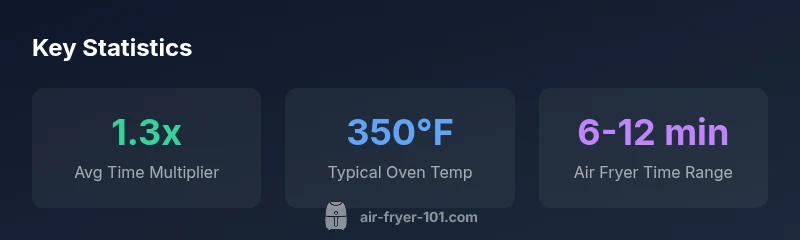
At the heart of air fryer to oven time conversion is a simple, teachable formula. A practical starting point is to estimate oven time by adjusting the air fryer time with a temperature ratio and a conservative multiplier: ovenTime ≈ round( airTime × (airTemp ÷ ovenTemp) × 1.25 ). The term (airTemp ÷ ovenTemp) captures how much hotter the air fryer typically runs relative to a conventional oven, while the 1.25 multiplier accounts for differences in heat transfer, pan size, and airflow. This keeps the method accessible and easy to apply in the kitchen. Remember that this is an estimate; real results will vary with dish type, pan, and oven model. The calculator on this page will help you experiment safely.
Practical conversion rules you can memorize
Here are simple, repeatable guidelines you can apply when converting from air fryer to oven:
- Start with ovenTime ≈ airTime × (airTemp ÷ ovenTemp) × 1.25, then round to the nearest minute.
- If your oven is hotter or you’re using a metal sheet, you may reduce the multiplier toward 1.0 for crisper results and shorter times.
- If the oven is cooler or you’re using a deep baking dish, increase the multiplier toward 1.5 to account for slower heat transfer.
- Preheat the oven if the recipe specifies it; preheating may slightly lengthen the initial phase but improves consistency.
- Space food on the pan and avoid stacking; airflow is the key to even cooking in both devices.
- Use a timer and check a few minutes before the expected finish; test for doneness and adjust upcoming batches accordingly.
Common foods and example conversions
These are approximate conversions to illustrate the idea. Remember: start with small batches to calibrate.
- French fries: Air fryer 8–12 minutes. Oven: 20–25 minutes at 425°F.
- Chicken nuggets: Air fryer 8–12 minutes. Oven: 18–22 minutes at 400°F.
- Mixed vegetables: Air fryer 6–10 minutes. Oven: 15–20 minutes at 425°F.
- Tofu bites: Air fryer 8–12 minutes. Oven: 15–20 minutes at 400°F.
- Shrimp: Air fryer 6–8 minutes. Oven: 8–12 minutes at 425°F.
Factor checks and troubleshooting
If results are underdone or overdone, adjust in small increments (2–3 minutes) and reassess. The size and shape of food, the cookware, and whether you’re using a rack or tray all affect heat transfer. If you consistently need more time in the oven, try increasing the oven temperature slightly and rotating the tray halfway through. Keep a log of adjustments to improve accuracy over time. Remember that some foods brown better in air frying due to rapid dry heat, and those same foods may require more patience in a conventional oven.
Quick-reference timing table and calibration steps
| Food | Air Fryer Time (min) | Oven Time (min) | |---|---:|---:| | French fries | 8–12 | 20–25 | | Chicken nuggets | 8–12 | 18–22 | | Mixed vegetables | 6–10 | 15–20 | | Small chicken pieces | 6–10 | 15–18 |
Use this table as a starting point, then adjust by texture and doneness cues. For best results, calibrate with your own oven using the foods you bake most often.
Real-world calibration steps
To tailor conversions to your kitchen, start with a small batch when trying a new food. Record the air fryer time, air temperature, oven temperature, and your observed oven time. Compare results across multiple trials and note whether you preferred crisper edges or softer centers. Over a few weeks, you’ll build a personal conversion log that makes future adjustments faster and more reliable. This practice reduces waste and increases confidence when you’re cooking for guests or busy weeknights.