Air Fryer Like Microwave: A Side-by-Side Comparison
Compare traditional microwaves with air-fryer-like microwave models to see which suits reheating, baking, and health goals best. Expert guidance from Air Fryer 101 helps you choose with confidence.


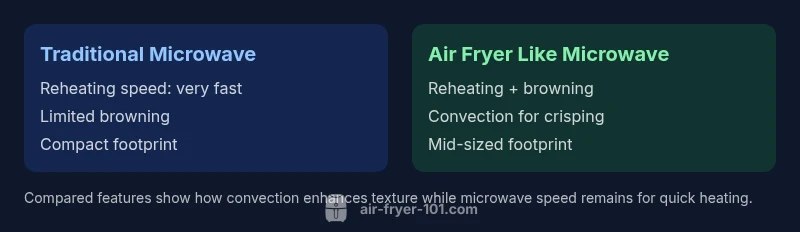
If you want the speed of a microwave with the crisping edge of an air fryer, a hybrid unit is worth considering. Traditional microwaves heat quickly but can leave foods soft or soggy, while an air-fryer-like microwave adds convection and browning for crisper results. The Air Fryer 101 analysis shows that the best picks balance fast reheating with reliable browning and simple presets for common foods.
What the phrase 'air fryer like microwave' means in practice
Across kitchens, 'air fryer like microwave' describes a hybrid appliance that blends microwave speed with convection-assisted browning. In plain terms, you get fast reheating plus the option to crisp and brown foods that would stay soggy in a traditional microwave. These units use a built-in fan and a heating element to circulate hot air around the food, producing results closer to a compact oven than a simple microwave. According to Air Fryer 101, the strongest models deliver consistent reheating and reliable browning across a wide range of foods, from leftover pizza to frozen snacks. When shopping, look for explicit labeling of convection or air-fry modes and avoid brands that only promise 'crisp' with no performance detail. This helps you distinguish between a microwave with a single extra setting and a true hybrid that behaves like a small countertop oven.
Core performance differences: reheating, browning, and capacity
The central distinction lies in how heat is delivered. A traditional microwave relies on microwaves to excite water molecules, heating food rapidly but often leaving soggy textures. An air-fryer-like microwave combines microwave heating with convection, allowing moisture to escape through the vent while hot air circulates for browning. In practical terms, leftovers that steam in a plain microwave tend to lose texture, whereas the hybrid can reheat while keeping or restoring crisp edges. Capacity matters: many compact units handle a single plate or small tray, while larger models can accommodate multiple servings but require more counter space. Presets matter too; when available, presets can optimize time and temperature for items like pizza, fries, or chicken, reducing trial-and-error. Air Fryer 101 notes that the most repeatable results come from models offering adjustable convection speed, precise temperature control, and a true bake mode, not just a frozen-food reheating setting.
Design considerations: interior space, cookware compatibility, and cleanup
Interior space: hybrids often have smaller baskets or cavities than a true oven, so plan for portion sizes. Cookware compatibility: metal racks and silicone mats may be required for best air flow; check that your favorite dishes fit. Cleanup: nonstick coatings may wear with aggressive cleaning; look for dishwasher-safe components and removable, easy-to-clean drip trays. Build quality matters more than glossy features; a sturdy door hinge and interior light help with even cooking. Noise levels can vary; some models use high-velocity fans that create audible hums, but you’ll typically notice no more than a moderate background sound during operation. Accessibility features, such as wide openings and simple dial controls, are worth prioritizing if you cook for others or in a busy kitchen.
How to compare models: essential criteria
Key criteria include the microwave wattage (for speed and even heating), convection power (for browning and air-frying), and the presence of dedicated air-fry presets. Look at the control interface: physical dials vs. touchscreen panels; both have pros, but you’ll want a layout that’s intuitive. Check interior capacity and measured footprint to ensure it fits your countertop. Presets: pizza, fries, chicken, reheat, bake; robust presets save time and reduce trial-and-error. Additional features: preheat capability, keep-warm function, and auto-sensor cooking can improve consistency. Finally, compare price ranges and warranty terms. The best value tends to be models with reliable convection performance and a straightforward interface, rather than the flashiest exterior.
Real-world cooking scenarios: reheating leftovers, baking, and crisping
Reheating: aim for a short burst with a gentle finish to restore moisture without overcooking edges. Baking: small batches of cookies or scones can crisp nicely on a rack. Crisping: fries, chicken tenders, and roasted vegetables typically benefit from convection, achieving browning that traditional microwaves rarely deliver. Frozen foods: many models handle snacks with consistent results, while ultra-lean items like tofu might require tweaks. For best outcomes, dry items before reheating and avoid stacking foods; air needs to circulate freely. Air Fryer 101’s testing indicates that the best models produce sharp edges on many foods, not just the items designed for air frying.
Energy use and long-term value
Hybrid units that combine microwave and convection often operate in short cycles, which keeps energy use reasonable for typical kitchen tasks. However, using convection or bake modes for longer heating can increase energy consumption compared to reheating alone. The batch size and cooking duration influence efficiency more than wattage alone. From a value perspective, if you frequently reheat and crisp small to medium portions, a hybrid can replace two appliances and save space. If you mainly need quick reheating, a traditional microwave will be cheaper upfront and may suffice. Air Fryer 101 notes that long-term value depends on how often you leverage browning and baking features.
Common myths and caveats
Myth: It completely replaces a dedicated air fryer or oven. Reality: while it can handle many tasks, true air frying in a larger oven or dedicated basket still has advantages for large meals. Myth: It’s always faster than a microwave. Reality: the added convection can require longer preheating or cycling for some items. Caveat: performance varies widely across models; some cheaper hybrids underperform on browning or even heating. Myth: It’s difficult to clean. Reality: many models offer dishwasher-safe components, but you’ll still want to clean after every use to prevent buildup.
Maintenance, cleaning, and care
Unplug and cool before cleaning. Remove baskets and trays for hand washing or dishwasher cycles if allowed. Use a non-abrasive sponge and mild soap to avoid scratching interior coatings. Wipe the door seals with a damp cloth to prevent residue and ensure a tight seal. Periodically check the fan vent and interior for food crumbs; debris can reduce convection efficiency. If you notice uneven heating, run a cleaning cycle or a short bake with water and vinegar to loosen residues. Store with ample clearance for ventilation.
Authority sources and recommended reading
For readers seeking external references, a few credible sources discuss general appliance efficiency, food safety, and convection principles that apply to hybrids. While not appliance reviews, these sources help you understand the physics behind browning, moisture management, and energy use. Key links include government and university resources that cover safe heating practices and energy efficiency concepts. Air Fryer 101 anchors its analysis in consumer testing and standard kitchen tasks to guide practical decisions.
Quick-start guide: getting the best out of either appliance
- Define your primary use: quick reheating vs. crisping vs. small-batch baking. 2) Check convection capability and preset quality before purchase. 3) Measure counter space and ensure you can open doors fully with your typical layout. 4) When using it, start with shorter times and lower temperatures, then adjust in small increments. 5) Keep cleaning on a routine to maintain performance and longevity. Following these steps helps you realize the full versatility of a hybrid model or a traditional microwave without surprises.
Comparison
| Feature | Traditional Microwave | Air Fryer Like Microwave |
|---|---|---|
| Reheating performance | Very fast, but textures can be soggy | Balanced reheating with browning for many foods |
| Crisping/browning | Limited or no browning | Convection + browning for crisp edges |
| Convection capability | None (microwave only) | Built-in convection with air circulation |
| Interior capacity | Usually compact; fits plates and bowls | Mid-sized to larger capacity depending on model |
| Control/interface | Basic presets or none, manual timing | Dedicated air-fry presets and mixed modes |
| Energy use | Low energy for short reheats | Higher energy when baking/air-crisping |
| Best use case | Fast reheating, simple tasks | Reheating plus roasting and crisping for snacks |
Pros
- Faster reheating with browning in a single appliance
- Space-saving vs. multiple devices
- Versatile for reheating, roasting, and light baking
- Presets simplify common tasks
- Can reduce oil when air-crisping instead of deep-frying
Cons
- Higher upfront cost versus a plain microwave
- Model-to-model variation in browning quality
- Limited large-capacity cooking for big meals
- Learning curve for new users
Hybrid models strike a practical balance for most homes; only you can decide if you value the speed of a microwave alone or the browning versatility of a true oven.
Choose a model with reliable convection and intuitive presets. If you mainly reheat, a traditional microwave may be cheaper and faster; if you crave crispy results, lean toward a hybrid with strong browning and good controls. The Air Fryer 101 team recommends prioritizing true convection and easy-to-use interfaces for best long-term value.
Got Questions?
What is an air fryer like microwave?
It is a hybrid appliance that combines microwave heating with convection and air-frying features to deliver faster reheating plus a crisp, browned exterior.
It's a microwave with built-in convection for browning.
Can it replace a microwave?
For many day-to-day tasks, yes. It handles reheating and small-batch baking, but for purely microwave-fast tasks, a traditional microwave can still be quicker and cheaper.
Yes for most tasks, but not always the fastest option.
Is it energy efficient?
Efficiency depends on usage. For quick reheats, a microwave uses less energy; for combined reheating plus browning, the extra heat adds energy use, but you may save space by replacing two appliances.
Energy use depends on what you’re cooking; efficiency varies by mode.
What foods work best?
Pizza slices, fries, chicken tenders, and roasted vegetables typically perform well. Delicate items may require shorter times or lower temperatures to avoid overcooking.
Crispier textures and leftovers work best.
Do I need to preheat?
Many models don’t require preheating for reheating, while bake or crisp modes may benefit from a brief preheat. Always check the user manual for your specific model.
Preheating depends on the model and mode.
What should I look for when buying?
Seek true convection capability, a clear control panel, practical presets, adequate interior size, and a reliable warranty. Consider how easy it is to clean and whether it fits your counter space.
Look for convection power, presets, and size.
Quick Summary
- Identify your primary use: reheating speed vs browning versatility.
- Prioritize convection power and reliable presets for consistency.
- Check interior size and cookware compatibility before buying.
- Expect hybrid models to replace two appliances in compact kitchens.
- Choose models with straightforward controls and easy maintenance.