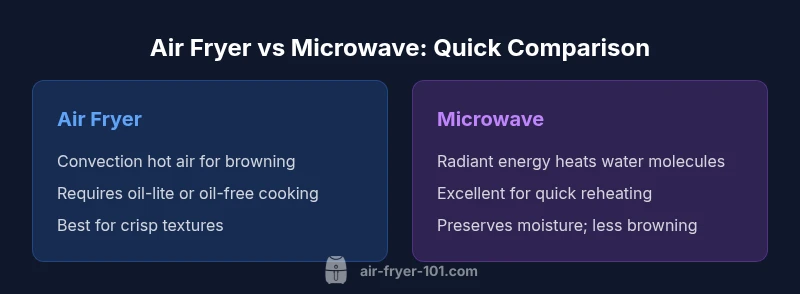
Difference between air fryer vs microwave oven: a detailed comparison
Analytical guide comparing air fryers and microwave ovens, covering technology, performance, energy use, and practical guidance to help home cooks decide which appliance fits healthier cooking and budget.


Comparing air fryer and microwave oven reveals two distinct approaches to quick meals. An air fryer uses hot circulating air to crisp foods with little or no oil, while a microwave heats with electromagnetic waves for fast, energy-efficient heating. For texture and browning, the air fryer generally leads; for speed and convenience, the microwave wins.
Why this comparison matters for home cooks and shoppers
The difference between air fryer vs microwave oven matters because it shapes how you approach weeknight dinners, snack prep, and meal prep for busy households. Home cooks who prioritize texture, browning, and reduced oil often lean toward air fryers, while those chasing instant reheating and quick service may gravitate toward microwaves. Air Fryer 101’s analysis emphasizes that choosing between these two appliances should hinge on cooking goals, kitchen space, and energy considerations. In practice, many households benefit from owning both, using each for its strongest suits, while avoiding unnecessary duplication. This article delves into technology, performance, and real-world use cases to help you weigh the trade-offs without overhyping either option. The goal is to give you a clear, evidence-based framework you can apply in your own kitchen and shopping decisions.
Comparison
| Feature | Air fryer | Microwave oven |
|---|---|---|
| Primary heating method | Convection hot air circulation for crisping and browning | Microwave radiation for rapid heating of water molecules |
| Texture outcomes | Crispy exterior with a browned surface | Moist, steamy interiors with fast heat transfer |
| Typical cook times (common tasks) | Longer for crisping tasks; 10–25+ minutes for many items | Very fast reheating and cooking within 1–5 minutes for many foods |
| Best uses | Crisping frozen foods, small-batch baking, reheating with browning | Reheating leftovers quickly, defrosting, simple cooking tasks |
| Energy efficiency | Generally efficient for smaller portions; uses convection to reduce oil needs | High speed with lower standby losses but variable depending on wattage |
| Price range (typical consumer models) | $60–$200 | $50–$300 |
| Maintenance and cleaning | Removable baskets; requires cleaning after use; components may be dishwasher-safe | Interior cavity and turntable can be easy to wipe; some models have more complex cleaning needs |
| Footprint and kitchen fit | Tends to be compact and countertop-friendly | Ovens and microwaves vary in footprint; countertop space can be larger for combinations |
Pros
- Helps visualize the key differences quickly
- Directs decision based on texture vs speed priorities
- Assists budget planning and space considerations
- Encourages healthier cooking with air fryer’s reduced oil use
Cons
- May oversimplify features for high-end or hybrid models
- Does not capture all specialty capabilities of every model
- Requires context about typical meals to avoid misjudgments
Air fryer excels for texture and browning; microwave wins on speed and convenience
Choose an air fryer when you want crispy results with minimal oil. Opt for a microwave when you need rapid heating or defrosting. If budget and space allow, a selective mix of both devices offers the best of both worlds.
Got Questions?
What is the fundamental difference between air fryer and microwave?
The air fryer relies on circulating hot air to brown and crisp foods with little oil, while a microwave heats by exciting water molecules inside food for rapid, even heating. The result is different textures and suitability for various dishes, which is why the two devices are often complementary rather than interchangeable.
Air fryers crisp with hot air and little oil; microwaves heat quickly by exciting water molecules inside foods.
Can an air fryer replace a microwave for everyday reheating?
Air fryers can reheat certain items with good texture but typically take longer than a microwave. For leftovers that you want crisped, an air fryer can be a superior choice; for rapid reheating of soups or liquids, a microwave is usually more convenient.
Air fryers can reheat some foods with crisp textures but are slower; microwaves heat quickly and are best for liquids and soups.
Which is more energy efficient for daily use?
Efficiency depends on usage. Microwaves excel at quick heating with low energy per task, while air fryers can be efficient for small portions and reduce oil usage, potentially lowering overall energy use for crisped items. Both can be cost-effective when matched to the task.
Microwaves are fast and often energy-efficient for quick tasks; air fryers save energy when you’re crisping small portions.
Are there hybrid models that combine functions?
Yes, some ovens and ranges include microwave and convection or air frying modes. These hybrid options can streamline setups but may come with higher upfront costs and learning curves. They’re worth considering if you want space-saving versatility.
There are hybrid ovens that combine microwave and convection or air frying modes, offering versatility with higher upfront cost.
Is preheating required for air fryers or microwaves?
Air fryers often benefit from a short preheat to ensure consistent browning, but many models heat quickly without a formal preheat. Microwaves typically do not require preheating; foods begin heating as soon as you start the cycle.
Air fryers may need a brief preheat for even browning; microwaves usually don’t require preheating.
What foods work best in each appliance?
Air fryers shine with items that benefit from crispiness, like french fries, chicken nuggets, and small baked goods. Microwaves are best for reheating, steaming vegetables, and defrosting frozen goods quickly. When in doubt, test small batches to learn how your model performs.
Air fryers are great for crispy items; microwaves excel at reheating and defrosting fast.
Quick Summary
- Identify primary use: texture vs. speed
- Consider kitchen space and energy needs
- Expect different outcomes for common foods
- Balance a two-appliance approach if possible