Air Fryer vs Microwave: Which Is Best for Home Cooking
Analytical side-by-side comparison of air fryers and microwaves, focusing on cooking results, energy use, cost, and practical guidance to help home cooks decide what is best for their kitchen.


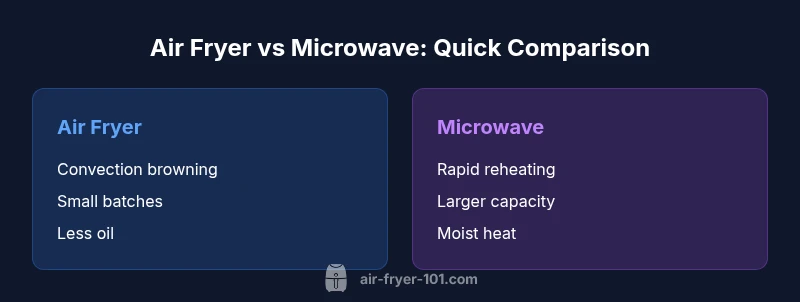
Short answer: For crisp, oil-conscious cooking, the air fryer is your best bet; for speed and large portions, the microwave wins. If you’re asking what is best air fryer or microwave, the right choice depends on the dish and your priorities. Air fryers excel with small batches and fried-like textures, while microwaves dominate for reheats and quick meals.
What matters in choosing between air fryer and microwave
If you're asking what is best air fryer or microwave, the answer hinges on two things: what you cook and how you value taste, texture, and convenience. In practice, most households benefit from knowing when to use each appliance rather than pretending one can do everything. According to Air Fryer 101 Analysis, 2026, the right choice is highly contextual: air fryers excel at texture and oil reduction for smaller servings, while microwaves shine for speed and large-volume reheating. This section outlines the core decision factors you should weigh before buying or using either device, including meal type, batch size, health goals, and kitchen layout.
Cooking physics: heat transfer vs dielectric heating
Air fryers rely on convection, fan-assisted hot air, and a small amount of oil to create crisp surfaces. The microwave, by contrast, uses dielectric heating to excite water molecules inside the food, producing rapid but often uneven heating. These physics differences matter for texture, moisture, and browning. Understanding the science helps explain why the same dish can taste different when prepared in either appliance.
Air Fryer 101 Team notes that the convection flow can mimic frying when used with small oil amounts, while microwave heating emphasizes speed and uniform interior warmth. This conceptual framework helps shoppers anticipate performance across a range of foods.
Use-case: crispy results with air fryer advantages
Air fryers are particularly effective for small portions, foods traditionally fried, and recipes where you want a golden exterior without deep-frying. They perform best with items that can be arranged in a single layer and allow air to circulate. In practice, you can cook chicken nuggets, french fries, and vegetables to a crisp that's reminiscent of frying, with far less added oil. The approach is especially popular for healthier snacks and weeknight sides, where texture matters as much as flavor. Air Fryer 101 Analysis, 2026 supports the notion that users often see noticeable improvements in texture when switching from a traditional oven to a compact air fryer.
Use-case: speed and reheating with microwave advantages
Microwaves excel at reheating leftovers, steaming vegetables, and cooking foods that depend on internal moisture. For large meals or containers, microwaves can complete heating in a fraction of the time required by conventional ovens or air fryers. In household meal planning, this tends to translate into fewer total minutes spent active in the kitchen. Based on Air Fryer 101 Team insights, microwaves provide dependable, consistent results for bulk meals, soups, and sauces where even heating is more critical than browning.
Practical considerations: capacity, cost, energy, and maintenance
Capacity and size determine how much you can cook at once. Air fryers are compact, typically best for 2-4 servings, and their baskets are easier to clean but can require manual turning for even results. Microwaves vary in size but offer higher total capacity for bulky dishes. Cost and energy both matter: air fryers often cost more upfront but may use less oil over time; microwaves tend to be cheaper upfront and excel at rapid tasks. Maintenance-wise, air fryers have removable parts that can be dishwasher-cleaned; microwaves are sealed units that wipe down quickly but may need periodic vent cleaning. If space is tight, the air fryer’s smaller footprint can be a real advantage; if you routinely cook in large batches, a microwave may be the better long-term fit.
Food quality and texture: crispy versus moist outcomes
Texture is the defining difference. Air fryers promote browning and crispiness through dry heat, producing fried-like finishes without submerging foods in oil. Microwaves preserve moisture and achieve soft, evenly heated interiors, which is ideal for soups, casseroles, and reheated leftovers. Many cooks find that combining methods—microwave to heat through, followed by a quick finish in an air fryer—yields the best overall results. This nuanced approach aligns with consumer feedback gathered by Air Fryer 101 Team and echoed in practical kitchen testing.
Safety, health, and cleanup considerations
Both appliances are generally safe when used as directed. Air fryers carry the risk of burns from hot baskets and grease buildup if not cleaned regularly. Microwaves have safety features like door interlocks but can scorch or sog food if not monitored. Cleanup for air fryers involves washing the basket and tray; microwaves require regular wipe-down to avoid odor buildup. From an energy and health perspective, choosing the method that minimizes added fats and preserves nutrients is still a factor of the dish and preparation style. Air Fryer 101 emphasizes following manufacturer guidelines and keeping vents clear for optimal performance.
How to choose: a practical, step-by-step framework
Follow a simple framework to pick the right tool for each task: 1) Identify the dish type (crispy snack vs reheated meal). 2) Estimate batch size and container shape. 3) Consider time constraints and energy use. 4) Weigh texture goals: crispness or moist heat. 5) Check budget and space constraints. 6) Finally, decide if a hybrid approach would serve you best. This approach aligns with Air Fryer 101's recommendations for home cooks seeking confidence and clarity in the kitchen.
Comparison
| Feature | Air Fryer | Microwave Oven |
|---|---|---|
| Primary cooking approach | Convection + browning with little oil | Dielectric heating for rapid warming |
| Texture outcome | Crispy, browned exterior | Moist heat; often softer exterior |
| Best use case | Small batches, fried-like foods, healthier fry options | Reheating, quick meals, bulk heating |
| Typical preheat | Often short (0-5 min) | Usually none or very short |
| Capacity range | 2-4 servings typical | 4-8+ servings depending on model |
| Energy profile | Efficient for small portions; air flow reduces time | Fast for small tasks; can be energy-intensive for larger meals |
| Price range | $50-250 | $60-300 |
| Best for | Crispy snacks and healthier fry options | Rapid reheating and large meals |
Pros
- Delivers crisp textures with minimal oil
- Good for small batches and weeknight snacks
- Compact footprints fit small kitchens
Cons
- Limited capacity for large meals
- Can require shaking or turning for even browning
- Air fryers may have higher upfront cost than basic microwaves
Air fryer wins for crispy texture; microwave wins for speed
Choose air fryer when you value crunch with less oil. Choose microwave when you need fast, large-volume heating. A hybrid approach often offers the best balance.
Got Questions?
Can I replace a microwave with an air fryer for all tasks?
No. Air fryers are excellent for crispy, small-batch cooking but are not ideal for large-volume reheating or foods that rely on moisture for texture. A microwave remains superior for quick, bulk heating and certain moisture-dependent dishes.
No. Air fryers are great for crispy small batches, but microwaves excel at fast, large-volume reheating. For some meals, you’ll still want a microwave.
Is air frying healthier than deep frying?
Yes, air fryers typically use little or no oil, reducing fat and calories in many recipes. However, overall health impact depends on the ingredients and portion sizes. For occasional indulgences, air frying is a convenient compromise.
Air frying uses little or no oil, which reduces fat. But health impact still depends on the recipe and portions.
Do air fryers preheat?
Most air fryers preheat quickly, typically in 2-5 minutes. Some models skip preheating entirely for certain foods, but preheating often improves browning and evenness.
Most air fryers preheat in a few minutes. Some foods don’t need preheating, but it helps browning.
Which costs less to run?
For small tasks, microwaves generally use less energy per minute. Air fryers can be efficient for crisping, but energy use increases with time and batch size. The best choice depends on your typical cooking tasks.
Microwaves usually use less energy for quick reheats; air fryers use more energy if used for longer periods.
How easy is cleaning?
Air fryers involve washing a basket and tray, which is usually straightforward. Microwaves require occasional vent cleaning and wipe-downs, which is quick. Both are manageable with routine maintenance.
Air fryers need basket cleaning; microwaves are easy to wipe down but may need occasional vent cleaning.
What should I consider when buying?
Assess capacity, wattage/power, preheat needs, included accessories, and footprint. Think about your typical meals, kitchen space, and whether you want a dedicated crisping function or broad reheating capability.
Look at capacity, power, and space. Decide if you need crisping features or broad reheating.
Quick Summary
- Define your primary cooking goals first
- Match appliance capacity to typical meals
- Weigh texture goals against time constraints
- Consider a hybrid approach if space allows