Air Fryer vs Microwave: What to Buy in 2026
A data-driven comparison of air fryers and microwaves to help home cooks decide what to buy for healthier cooking, convenience, and budget in 2026.


If you're asking what to buy air fryer or microwave, this comparison breaks down the trade-offs between speed, texture, energy use, and cost. For most homes, a microwave handles quick reheating and large batches, while an air fryer adds crisp texture with little oil for smaller portions. The choice depends on your cooking goals and kitchen space.
Deciding factors at a glance
Choosing between an air fryer and a microwave starts with your daily cooking habits. If most of your meals revolve around reheating leftovers, steaming vegetables, or melting cheese on top, a microwave offers speed and convenience. If you regularly crave crisp textures, fried-like foods with less oil, or you cook small portions that benefit from browning, an air fryer delivers results you can taste. According to Air Fryer 101, the optimal decision hinges on balancing texture goals with space and budget. Start by listing your top five everyday tasks (reheating, roasting, crisping, defrosting, melting) and mapping which device handles each best. This simple audit often reveals that many households don’t need a single best device, but rather a practical blend that minimizes trade-offs.
In this guide, you’ll see how the two devices differ in operation, what foods they excel at, and how to evaluate long-term value. The aim is to translate kitchen tasks into concrete buying criteria—without guessing about hypothetical performance from brand promises. The Air Fryer 101 team emphasizes clarity: understand the core trade-offs, then pick the option that aligns with your routine, space, and budget.
How each device works: the physics behind air frying vs microwaving
Air fryers rely on a heating element paired with a fan that circulates hot air around the food. That rapid air movement creates a browning effect similar to frying, but with little or no oil. Microwave ovens use dielectric heating, generating waves that excite water molecules in the food to create heat from inside out. The practical upshot is different texture and depth of flavor: air frying tends toward crisp outside with a drier interior, while microwaving yields moist, uniform reheats. Both technologies have safety considerations—keep vents clear, avoid metal in the microwave, and monitor nonstick surfaces. The key takeaway is that the underlying physics drives texture more than speed or capacity, so your choice should reflect the textures you value most and the foods you prepare most often.
Practical implication: if you primarily reheat dense leftovers with crisp edges in mind, an air fryer tends to outperform a microwave for that use case. If you routinely need fast warmth for large batches, the microwave’s dielectric heating excels at throughput. Air Fryer 101’s analysis indicates that many kitchens benefit from understanding which tasks map cleanly to each device before buying.
Texture outcomes: crispness, browning, moisture
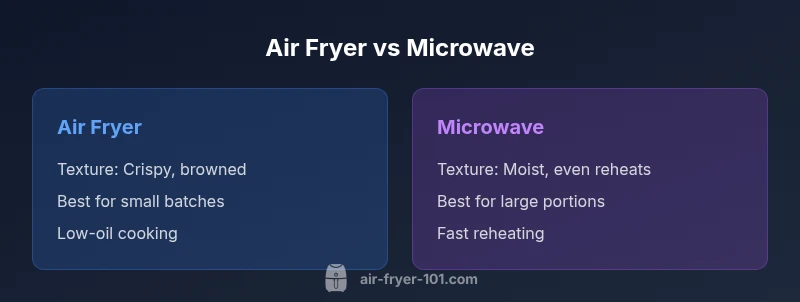
Texture is where air fryers shine. The combination of heated air and a compact cooking chamber promotes browning and a crisp exterior, which makes items like fries, chicken tenders, and roasted vegetables more appealing without deep-frying oil. Microwaves, by contrast, are optimized for moisture retention and speed, producing soft, uniform textures that are ideal for reheated casseroles, soups, and steamed vegetables. Material choices (metal racks, air fryer baskets, ceramic inserts) influence airflow and browning; nonstick coatings simplify cleanup but can affect browning. If your goal is a homemade version of fried foods with less oil, prioritize an air fryer. If your priority is fast, large-volume reheating, a microwave is more suitable. For many households, this contrast alone justifies owning both—each device covers a different texture niche.
As you evaluate models, consider the foods you crave most, how often you cook in batches, and whether you value a crunchy finish on a few items or consistent moisture across meals. Air Fryer 101’s observations emphasize texture as a deciding criterion. Foods that benefit from browning—think crispy coatings or roasted edges—are where the air fryer usually earns merit.
Reheating efficiency: speed vs quality
Reheating is a core kitchen task, and speed often dictates device choice. Microwaves excel at rapid warmth, particularly for liquid-based or soft foods like soups, stews, and leftovers with uniform moisture. Air fryers take longer to reheat, but they can recapture texture on items that dry out in the microwave, such as leftover pizza crusts or fried foods. If speed trumps texture, the microwave is your go-to; if you want to restore a near-fried finish to small portions, an air fryer shines. When deciding, consider portion size, the type of leftovers, and how you value texture after reheating. If you often reheat large dinners, you may appreciate a secondary device for crisping tasks to avoid soggy results. Trends show many households optimize by using both devices for different reheating needs, rather than relying on a single appliance for everything.
To maximize efficiency, plan a two-step reheating approach: use the microwave for rapid warmth, then finish with a short air-fry cycle for texture. This approach can deliver fast results without sacrificing quality.
Batch size and cooking capacity
Batch size is a practical constraint that affects daily utility. Air fryers typically offer smaller baskets and trays, which means you may need to cook in multiple batches when feeding a family or guests. Microwaves vary in capacity, with larger turntables or drawer-style units enabling bigger loads per cycle. If you routinely prepare meals for several people, a microwave’s higher throughput can reduce overall cook time, but you’ll miss out on crisp textures unless you add a dedicated air frying step. The decision here hinges on your household size, how often you cook for others, and whether you prefer a multi-batch workflow or one quick, large-batch reheating session.
For compact kitchens, even a modest air fryer can be a valuable second workhorse, letting you tackle crisp tasks without occupying the stove or oven. Air Fryer 101 notes that space efficiency should be treated as a design constraint rather than an afterthought; measure your counter space and door clearance before purchasing.
Energy use and long-term cost considerations
Energy consumption is a factor, but the calculus is not simply “smaller device equals better value.” Air fryers may use less energy per batch for small portions due to rapid surface browning, but they may require more time to cook larger meals. Microwaves are typically efficient for quick reheating, yet leaving them running for extended periods can accumulate energy use. Long-term cost considerations also include replacement parts, nonstick coatings, and the durability of baskets or racks. Rather than chasing the cheapest upfront price, compare the lifetime costs of two devices based on how often you cook each type of dish, the expected maintenance, and the frequency of replacements.
Air Fryer 101’s research indicates that households that pair both devices often report higher perceived value, because each appliance covers different cooking needs without forcing compromises on texture or speed. If you cook a mix of fried-like foods and quick reheats, the combined value can justify investing in both devices.
Space, durability, and controls
Countertop real estate matters. Air fryers come in compact, ergonomic forms that fit on crowded counters, but they still occupy space and can be easily bumped. Microwaves vary in size, with larger models offering more interior capacity but occupying more footprint. Durability hinges on build quality, material choices, and how you use the appliance. Look for features that actually matter to your routine: simple manual controls for quick tasks, or programmable presets for frequently prepared foods. If you want to minimize cleanup, prioritize models with dishwasher-safe baskets, coated interiors, and removable racks. When evaluating controls, ensure the device offers intuitive temperature and time adjustments, plus safety features such as auto shutoff and child locks. Air Fryer 101’s team suggests prioritizing reliability and ease of maintenance over flashy presets, since dependable performance reduces frustration during busy weeks.
Safety, materials, and cleaning
Safety and cleanliness should guide your selection. Microwave interiors are typically easy to wipe, but you should avoid metal components inside and ensure proper wattage matching to your cooking needs. Air fryers require regular cleaning of the basket and tray to prevent oil buildup, and some models use coatings that can wear over time if not cared for correctly. Choose appliances with durable coatings, non-toxic materials, and readily available replacement parts. Both devices benefit from a quick wipe-down after use and regular deep-clean routines to maintain performance and minimize lingering odors. Air Fryer 101 emphasizes that safe material choices and straightforward cleaning routines contribute to long-term satisfaction and appliance longevity.
Food categories best suited for each device
- Air fryer: small batches that benefit from browning, crispy coatings, and oil-conscious cooking (e.g., fries, chicken wings, roasted vegetables, air-fried snacks).
- Microwave: reheating large volumes quickly, soft textures, melting tasks, and foods with high moisture content (e.g., soups, stews, dumplings, rice). If you need to melt cheese or reheat leftovers in a hurry, the microwave usually wins. Both devices can handle a surprising variety of foods when used thoughtfully, but texture and speed preferences drive the best choice for any given dish.
Budgeting: initial purchase and long-term value
When budgeting, weigh upfront cost against long-term utility. Air fryers range in size and feature sets, with higher upfront costs often accompanied by more versatile cooking options and fewer deep-frying needs. Microwaves generally offer lower initial prices, with pricing reflecting wattage, capacity, and additional features like convection or grilling modes. Instead of chasing the lowest price, assess how each device aligns with your typical meals, the frequency of use, and your tolerance for multiple appliances on the countertop. A smart plan for many homes is to start with a compact air fryer for crisp tasks and a mid-range microwave for speed and volume, then add specialized tools only if you identify a clear need.
How to combine devices for maximum flexibility
Many kitchens benefit from having both devices working in tandem. Use the microwave for quick warming and defrosting, then finish with a brief air-fry cycle to restore crisp texture. This two-stage approach often yields better overall results than relying on a single appliance for diverse tasks. If space is limited, look for compact air fryers with enough capacity to handle daily snacks and small meals, while selecting a microwave with a larger interior for batch reheating. A deliberate combination strategy can maximize convenience without compromising texture or speed.
Comparison
| Feature | Air Fryer | Microwave |
|---|---|---|
| Cooking Method | Rapid air circulation with a heating element | Dielectric heating of water molecules in food |
| Texture & Browning | Crispy exterior with browned edges | Moist, uniform reheating with less browning |
| Heating Speed | Typically slower for larger portions, fastest for small batches | Generally fastest for reheating and simple tasks |
| Capacity & Batch Size | Smaller baskets; multiple batches may be needed for large meals | Larger interior capacity; ideal for bigger portions |
| Energy Use | Efficient for small portions; energy use scales with batch size | Efficient for quick reheating; energy use depends on duration |
| Maintenance & Cleaning | Basket and tray cleaning; regular oil residue care | Minimal interior cleaning; wipe surfaces between uses |
| Best For | Crisping small portions and oil-conscious cooking | Fast reheating and large-volume meals |
Pros
- Helps reduce oil when crisping foods
- Adds texture variety and kitchen versatility
- Compact options fit small spaces
- Visible texture improvements with proper use
- Supports healthier cooking without sacrificing flavor
Cons
- Air fryers may require multiple batches for large meals
- Air fryers occupy counter space and require setup
- Microwaves can’t brown foods as effectively as air fryers
- Microwaves may heat unevenly if not properly preheated or rotated
Air fryer wins texture-focused tasks; microwave wins speed and capacity.
Choose an air fryer if crisp texture and oil-conscious cooking are top priorities. Choose a microwave if you need fast reheating and larger batch capacity. For many households, a strategic combination offers the best overall flexibility.
Got Questions?
Is an air fryer better than a microwave for reheating leftovers?
Air fryers can improve texture and crispness in reheated items, but they take longer than microwaves. If you value a crispy finish on certain foods, an air fryer is worth it; for quick warmth across many leftovers, the microwave remains faster. Use both if you want best of both worlds.
Air fryer gives crisp reheats but is slower; microwaves are faster for most leftovers. Many people use both to balance speed and texture.
Can you replace a microwave with an air fryer?
In most homes, you cannot fully replace a microwave with a single air fryer because microwaves excel at speed and large-volume reheating. An air fryer is excellent for crisping small portions. If your tasks are mostly quick reheats in large batches, a microwave may suffice; otherwise, keep both for flexibility.
Air fryers are great for crisping small portions, but microwaves handle fast reheating in large batches. You’ll likely want both if you cook a range of foods.
Which is cheaper to operate daily?
Microwaves typically have lower upfront costs and are often cheaper per-use for reheating simple meals. Air fryers can be economical for crisping small portions but may incur higher upfront costs. The best approach is to estimate how often you’ll use each task and compare long-term costs accordingly.
Microwaves usually cost less upfront and per use for reheating; air fryers cost more upfront but can save oil and provide texture.
Do air fryers require oil?
Air fryers require little to no oil to achieve a crisp finish, which can reduce added fats. You can use a small amount of oil for certain recipes to improve browning, but many foods still crisp well with virtually no oil.
They use little or no oil. You can still add a tiny amount for extra browning if you like.
Are there health considerations when choosing between these devices?
Both appliances can support healthier cooking when used thoughtfully. Air fryers reduce oil usage for fried-like foods; microwaves do not add fat or alter food nutrients inherently. The healthiest choice depends on your cooking methods and food choices, not the appliance alone.
Air fryers can cut oil in fried foods; microwaves don’t add oil. It’s about how you cook, not the device itself.
What should I buy for a small kitchen: air fryer or microwave?
For tiny spaces, a compact air fryer complements a microwave, offering crisp results without expanding the footprint of your cooking area. If space is extremely tight, you might start with a dual-purpose microwave that includes convection or grilling plus a small air fryer later.
In a small kitchen, consider a compact air fryer plus a microwave, or a microwave with convection if you must choose one.
Quick Summary
- Define your primary use to pick the right device
- Assess countertop space before buying
- Consider batch size and meal frequency
- Air fryer for crisp textures; microwave for speed
- Many kitchens benefit from having both devices