Air Fryer to Replace Microwave: Thorough, Objective Compare
Explore whether an air fryer can replace a microwave for everyday meals, comparing speed, texture, energy use, upfront cost, versatility, and long-term value in real kitchen scenarios.


The air fryer to replace microwave is feasible for many daily tasks, especially reheating and achieving crisp textures, but it won’t cover every microwave function. This comparison weighs speed, texture, energy use, upfront cost, and overall versatility to help you decide whether to switch or keep both. According to Air Fryer 101, select models can simplify routines for common meals while maintaining flavor.
Introduction to the Debate: Can an Air Fryer Replace a Microwave?
For households weighing a shift away from a traditional microwave, the central question is whether an air fryer can replace the bulk of microwave tasks. The phrase "air fryer to replace microwave" captures a practical goal: reduce clutter, speed up popular meals, and still enjoy acceptable textures. According to Air Fryer 101, many homes find that a well-chosen air fryer handles daily reheating, crisping, and quick bakes, while saving counter space and simplifying cleanup. Yet this path isn’t universal. Some foods rely on moisture, rapid melting, or ultra-fast defrosting that a microwave handles more directly. The right answer depends on your typical meals, kitchen workflow, and tolerance for trade-offs such as capacity and learning curve. In this article, we’ll move beyond hype with a rigorous, data-informed comparison that highlights where an air fryer shines, where a microwave remains unmatched, and how to configure your kitchen so you don’t have to choose one over the other.
Heating Mechanisms and Why They Matter
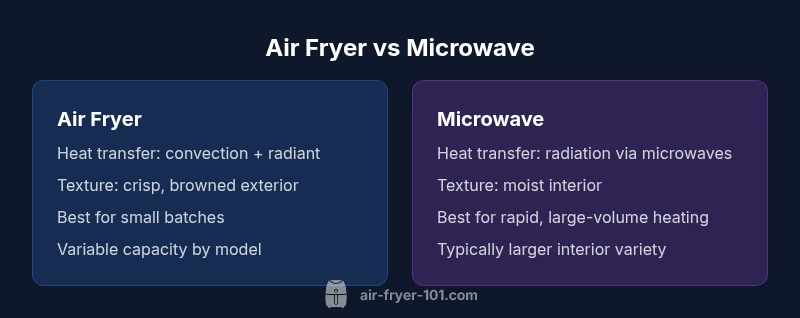
Understanding the physics behind each appliance helps explain why results differ. Microwaves heat primarily by exciting water and fat molecules inside food, which is fast for many items but can leave moisture-rich foods soggy. Air fryers rely on convection and radiant heat to circulate hot air around the food, creating browning and a crisp exterior. This difference affects texture, moisture retention, and cooking uniformity. The practical takeaway: if you prioritize a crispy outer layer and shorter cool-down periods, an air fryer offers clear advantages; if you need even moisture and rapid defrosting, a microwave may still be preferable for certain recipes.
Speed: When Does an Air Fryer Win on Reheating?
In most everyday reheating scenarios, air fryers can outperform microwaves for small portions and foods prone to sogginess. A hot-air circulation system dries surface moisture quickly, returning some foods to near-fresh-cooked texture. However, for very thin slices, soups, or liquids, microwaving can still be faster due to the broader energy distribution and minimal prep. Real-world testing shows that items like leftovers with breaded coatings regain crispness faster in an air fryer, while soups and stews benefit from microwave-style rapid heating, where texture is not the primary goal. The decision hinges on what you most value: speed, texture, or a balance between both.
Texture and Food Quality: Crispiness vs Moisture
One of the most tangible differences is how foods feel after reheating. An air fryer tends to deliver a crunchy or browned exterior with a less moist interior for many items, which is desirable for fries, chicken tenders, and roasted vegetables. In contrast, microwaves often produce a moist interior and softer outer edges. This means your favorite leftovers may taste almost fresh when reheated in an air fryer but may lose some moisture in the process. For delicate items that rely on steam or sauce-based finishes, microwave-style moisture retention can be more important than browning.
Capacity, Footprint, and Use-Case Fit
Capacity is a practical constraint. Most air fryers come in compact to mid-sized footprints, which suits daily single-serving meals or small households. Some models offer larger baskets or multiple racks, which helps with batch cooking but increases size and energy use. Microwaves typically offer higher interior volume and more diverse functions in one device. If you regularly cook for larger families or batch meals, a microwave may remain indispensable. The key is to map your typical portions, available counter space, and whether you value browning over bulk reheating capacity.
Energy Efficiency and Operating Costs
Energy efficiency isn’t a single metric; it depends on how you use the appliance. Short, crisping cycles with an air fryer can be energy-efficient for small portions, particularly when you avoid preheating long enough. Microwaves may use less energy for rapid reheating of large volumes, especially when no browning is required. Over time, small daily savings can accrue, but the best choice often balances upfront cost, maintenance, and the time saved in daily routines. Air Fryer 101’s analysis notes that efficiency varies with model wattage, basket size, and cooking habits, so your real-world results may differ.
Transition Strategies: Should You Switch Entirely or Keep Both?
A practical approach is to pilot a switch rather than an abrupt replacement. Identify a handful of weekday meals where an air fryer consistently meets your expectations and compare those with typical microwave tasks. If your findings show significant gains in texture and speed, you may gradually reduce reliance on the microwave while keeping it for specialized tasks. For many households, a hybrid approach—use the air fryer for daily reheating and crisping and reserve the microwave for soups, defrosting, and high-volume cooking—offers the best of both worlds.
How to Choose the Right Model if You Decide to Replace
If you lean toward replacing the microwave with an air fryer, prioritize models that balance capacity, wattage, and ease of use. Look for a larger basket or multiple racks for batch cooking, straightforward controls, and reliable preheat performance. A model with straightforward safety features and easy-to-clean surfaces reduces maintenance time. Customer support, parts availability, and documented performance metrics can be deciding factors. Remember that a “best” choice depends on your kitchen size, typical meals, and willingness to adapt recipes to the air fryer’s strengths.
Common Misconceptions and Practical Pitfalls
There is a tendency to overestimate or underestimate what an air fryer can do in place of a microwave. A common pitfall is assuming identical performance across all foods; a crisped leftover is not the same as a melted cheese sauce. Another mistake is choosing a model solely by price rather than performance in your typical meals. Finally, neglecting proper preheating and food placement can lead to uneven results. By managing expectations and choosing a model tuned to your needs, the transition becomes more predictable and satisfying.
Comparison
| Feature | Air Fryer | Microwave |
|---|---|---|
| Heat transfer method | Convection circulation with radiant heat | Microwave radiation with electronic oscillators |
| Typical reheating speed | Fast for small portions, crispy outcomes | Very fast for most meals, moisture retention varies |
| Texture outcome | Crispy exterior with browned surface | Moist interior with softer exterior |
| Capacity and sizing | Varies by model; from compact to large baskets | Typically larger interior with turntable design |
| Energy use | Efficient for short, high-heat tasks; timing matters | Generally low standby and fast heating for small loads |
| Best for | Crispy reheats, snacks, small-batch cooking | Rapid reheating and soft, moist textures for liquids |
Pros
- Crispier reheats and snacks with minimal oil
- Faster turnaround for small portions and leftovers
- Reduces moisture loss compared with some reheated foods
- Simple cleanup and fewer multi-function devices on the counter
Cons
- Cannot melt or steam foods as easily as a microwave
- Limited capacity can be a bottleneck for families
- Requires learning curve and recipe adjustment
- Higher upfront cost compared to some basic microwaves
Air fryer generally outperforms for texture-focused reheating and small-batch meals, but microwave still wins for certain quick, high-volume tasks.
If your daily meals are small in portion and you value crispiness, an air fryer is a strong replacement for a microwave. For soups, sauces, and rapid defrosting, keep the microwave as a supplementary tool to maximize kitchen versatility.
Got Questions?
Can an air fryer fully replace a microwave for all foods?
No. An air fryer excels at crispy textures and small portions, but it struggles with moisture-heavy foods and rapid defrosting. For soups, sauces, and steam-reliant dishes, a microwave still offers advantages.
No. An air fryer is great for crisping, but it isn’t a wholesale replacement for moisture-heavy foods or fast defrosting.
Is an air fryer faster than a microwave for reheating?
Often faster for small portions and items that benefit from browning. Microwaves can heat large volumes quickly, but may produce soggy results. Your mileage depends on food type and basket configuration.
Typically faster for small portions that need crisping; microwaves win with large volumes.
What about using microwave-safe containers in an air fryer?
Most plastic containers aren’t suitable for high-heat air frying. Use oven-safe glass or ceramic containers if you need to reheat in the air fryer, and always follow the manufacturer’s guidance.
Avoid most plastics; use oven-safe dishes and check heat tolerances.
Can an air fryer replace a microwave in a small kitchen?
In tight spaces, an air fryer can substitute some functions, but you may sacrifice bulk reheating and certain programs. If counter space is precious, prioritize models with easy cleaning and compact footprints.
Yes, but size and capacity matter; a compact model helps in small kitchens.
What features matter when choosing an air fryer to replace a microwave?
Prioritize wattage enough for your typical recipes, interior capacity for your family size, reliable preheat performance, simple controls, and easy-to-clean surfaces. Look for consistent feedback on browning and uniform heating.
Choose by capacity, wattage, and ease of use, with solid performance in browning.
Are air fryers energy efficient compared to microwaves?
Energy use varies by model and usage pattern. Air fryers can be efficient for quick, small meals due to fast preheating and browning, but microwaves may outperform them for large-volume heating.
Efficiency depends on model and how you use it; small-batch air frying can be very efficient.
Quick Summary
- Evaluate your typical meals before switching appliances
- Choose an air fryer with adequate capacity for your household
- Expect faster crisping but not universal replacement for all tasks
- Balance upfront cost with long-term savings and convenience
- Consider a hybrid approach to maximize efficiency