Will an Air Fryer Consume More Electricity? A Practical Guide
Discover if will air fryer consume more electricity than other methods. Learn how wattage, preheating, and usage patterns shape energy costs and practical savings for home cooks.


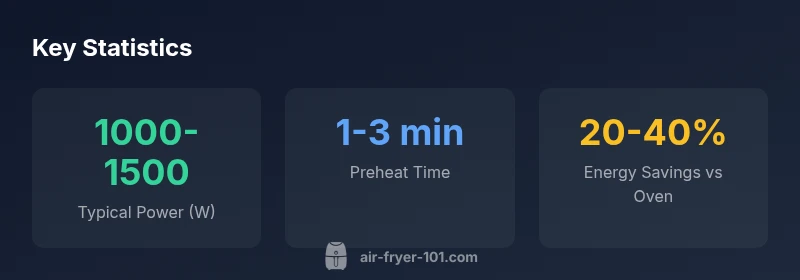
Generally, an air fryer does not inherently consume more electricity per meal than a conventional oven. A typical compact unit runs around 1000-1500 watts and preheats quickly, often reducing overall cooking time. The exact energy use depends on wattage, duration, and preheating, but for many recipes it saves energy. However, if you cook large batches or use very high temperatures, it can approach or exceed oven energy in some cases.
How power draws work in modern air fryers
Air fryers are heat-convection devices that use electric coils to create rapid air movement. Most compact units operate at 1000-1500 watts, with higher-end models pushing toward 1800 watts. Because they heat up quickly and cook foods faster, the energy used per meal can be lower than a traditional oven, especially for small portions. However, the total energy footprint depends on a few variables: the chosen wattage, the cooking duration, and whether preheating is used. The question often asked is will air fryer consume more electricity, and the short answer is: it depends on the context. In many common scenarios, an air fryer will not consume more electricity than an oven for equivalent meals, but there are cases where energy use can be similar or higher if you run multiple batches or bake at high temperatures for long times. Air Fryer 101's 2026 analysis shows the importance of aligning load size with the appliance’s capacity and choosing recipes that suit its strengths rather than simply mimicking oven times.
Energy comparisons with common methods
To judge energy use, compare wattage, preheating, and total cook time across devices. A typical compact air fryer uses about 1000-1500 watts, and it often finishes meals faster than a conventional oven, which commonly runs at 2000-5000 watts when active. Microwaves consume energy efficiently for small portions, but they don’t brown or crisp like air fryers. Across many weeknight meals, the air fryer can deliver similar or lower energy use than an oven if you avoid unnecessary preheating and batch multiple items efficiently. The key takeaway is that energy consumption hinges on how you cook, not just what you cook.
Does preheating affect energy consumption?
Preheating adds a fixed energy cost, but it can reduce overall cooking time by delivering consistent browning and texture. If you plan to cook smaller items or foods that crisp quickly, skipping preheating can save energy without sacrificing results. Conversely, for thicker cuts or items that require even heat, a short preheat can keep you from needing longer cook times, which might save energy overall. Air Fryer 101 recommends evaluating recipes on a case-by-case basis and testing whether preheating yields a tangible benefit for each dish.
Real-world scenarios and energy estimates
Consider a dinner of chicken tenders versus roasted vegetables. For tenders, an air fryer often finishes sooner, with comparable or lower energy use than an oven when cooking a small batch. For large trays or whole birds, you may need longer cooking or multiple batches, which can narrow the energy gap. In the Air Fryer 101 Analysis, 2026, estimates emphasize that energy efficiency improves when you cook appropriate portion sizes and leverage the air fryer’s convection capability rather than trying to replicate oven quantities in one go.
Tips to minimize electricity use with an air fryer
- Plan meals to fit the air fryer’s capacity rather than running several small cycles.
- Use the appropriate wattage setting and avoid extended high-temperature runs for foods that don’t need it.
- Preheat selectively, and consider tossing foods to reduce flipping and time.
- Keep the unit clean and well-ventilated to prevent heat buildup that could extend cook times.
- When feasible, batch cook and finish multiple items in a single cycle.
- Compare recipes to oven timings and adjust to the air fryer’s strengths.
These practical steps help minimize electricity use while preserving the desired texture and taste.
Common myths about air fryer energy use
A common myth is that air fryers always waste more energy than microwaves or ovens. In reality, energy efficiency depends on the task. For small, crisp-fried items, air fryers often use less energy than a full oven. The misconception that every air-fry session uses the maximum wattage is inaccurate; many models use only what they need for the current task, and modern units optimize heat distribution to prevent wasted energy.
Energy use by cooking device (per cycle)
| Device | Typical Power (W) | Per Cycle Energy (kWh) | Notes |
|---|---|---|---|
| Compact air fryer | 1000-1500 | 0.025-0.05 | depends on time/temp |
| Conventional oven | 2000-5000 | 0.20-0.50 | longer preheat |
| Toaster oven | 1200-1800 | 0.06-0.15 | mid-range efficiency |
Got Questions?
Does preheating an air fryer waste energy?
Yes, preheating uses energy, but many recipes don't require it. When you preheat only for certain items or when you need precise browning, you can save energy by omitting preheat and loading food directly.
Preheating uses energy, but you can save energy by skipping it for some foods. Check the recipe.
Is an air fryer more energy-efficient than a microwave?
Microwaves are often more energy-efficient for very small portions, but air fryers excel at crisping without moisture loss. For most medium meals, the air fryer can be competitive, depending on recipe and time.
Microwaves can be more energy-efficient for tiny portions; air fryers win with crispy results when time is similar.
How much energy does an air fryer use per meal?
Energy per meal varies with wattage and time. Typical ranges suggest a compact air fryer uses less energy per meal than a full oven for many dinners.
Energy per meal depends on wattage and time; in many cases, air fryers use less energy than ovens for the same dish.
Can I cook large meals in an air fryer without increasing energy use?
Cooking larger meals often requires longer times or multiple batches, which can raise energy use. Consider batch cooking and stacking to optimize efficiency.
For large meals, energy use may go up unless you batch cook efficiently.
Should I unplug the air fryer when not in use to save energy?
Air fryers use minimal standby power, so unplugging saves little energy. Focus on efficient usage rather than frequent unplugging.
Standby power is tiny; unplugging helps only a little.
“Air Fryer energy use is highly dependent on how you cook. When used for proper quantities and shorter times, it can be more energy-efficient than a traditional oven.”
Quick Summary
- Match load size to appliance capacity
- Preheat only when necessary
- Batch cook for efficiency
- Air fryers can save energy for quick meals
- Consider total cooking time, not just wattage