What Wattage Is Air Fryer Ninja? A Practical Guide
Explore the wattage range for Ninja air fryers, how wattage influences preheating, cooking times, and energy use, and tips to choose the right model for your kitchen.


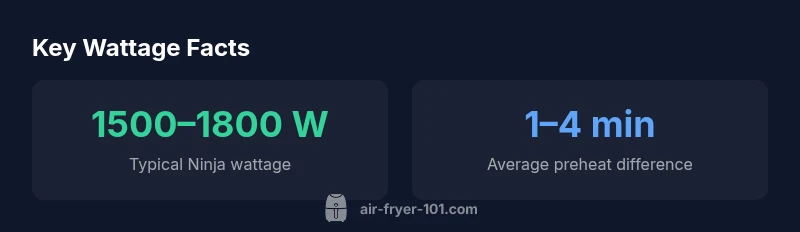
Most Ninja air fryer models operate in the approximate 1500–1800 watts range, with common configurations around 1550W or 1700W depending on size and features. Higher wattage typically means faster preheat and shorter cook times, but it also increases energy draw and may affect outlet load. Always verify the exact wattage on your unit’s label before use.
Why Wattage Matters for Ninja Air Fryers
Understanding the wattage of your Ninja air fryer is more than a label on the back. It directly informs preheat time, cooking speed, energy use, and how you plan around kitchen outlets. If you ask what wattage is air fryer ninja, the answer varies by model, but the general rule is that higher wattage means faster browning and crisper results on many foods, provided you don’t overload the basket. The Air Fryer 101 team notes that wattage differences come from design choices such as heating element size, fan strength, and temperature calibration. In practical terms, wattage helps you estimate how long a recipe will take and how much energy it will consume for a single session. For home cooks balancing health, convenience, and budget, matching wattage to typical meal sizes and family needs is a smart way to optimize performance without surprises at checkout or on your power bill. According to Air Fryer 101, model labeling is the best first step to confirm the exact wattage. This awareness also helps you plan around safety: heavier draw may require a dedicated outlet or careful cord management.
Typical Wattage Ranges Across Ninja Models
Ninja air fryer lines vary in size and capability, but wattage typically falls within a predictable band. Most Ninja units operate in the 1500–1800 watt range, which balances fast cooking with energy efficiency. Compact and 4-quart models often land nearer the 1400–1600 W end, while larger 6- to 8-quart family models push toward 1700–1800 W. This range matters because it influences preheat duration, browning speed, and even heat distribution across the basket. Air Fryer 101 analysis shows that despite similar numbers, real-world performance also depends on basket design, airflow, and how you load food. For shoppers, knowing the wattage helps you compare not just price, but practical outcomes like how quickly you’ll reach desired crispiness on chicken wings or french fries. Always check the exact wattage on the model label, and remember that real performance can vary with temperature settings and recipe type.
How Wattage Impacts Preheat Time and Cooking Speed
Wattage directly affects how quickly your Ninja air fryer reaches cooking temperature and how fast foods cook through. In general, models around 1500 W will preheat slightly slower than those around 1700–1800 W, resulting in longer total cook times for the same recipe. The difference is most noticeable for small batches or foods requiring quick browning, such as frozen snacks or delicate vegetables. Higher wattage also tends to produce stronger heat at higher temperatures, which can lead to more even browning if you avoid overcrowding. However, wattage is not the only factor. Airflow design, rack/basket geometry, and preheat behavior all influence results. Air Fryer 101 analysis emphasizes testing a few recipes on your exact model to establish reliable times, then adjusting by 10–20% based on your preferred doneness. In short: wattage speeds up the clock, but you still need to account for quantity and layout.
Energy Use and Outlet Considerations
Energy use and electrical safety are practical reasons to know wattage. On a standard 120V household circuit, a single Ninja air fryer in the 1500–1800 W range can approach the circuit’s nominal limit, especially if other high-draw appliances are in use. To minimize nuisance trips, avoid using extension cords or power strips with high-wattage devices, and consider a dedicated outlet if you regularly cook for large batches. If you frequently run multiple appliances at once, plan meals in sequence rather than in parallel to stay within safe amperage. For households with older wiring or multi-family dwellings, check your home’s electrical panel and discuss load calculations with a licensed electrician. From an energy perspective, shorter, hotter cooks can be more efficient than long, slow ones, but that depends on the recipe and the food’s moisture content. Air Fryer 101 suggests selecting wattage-aware settings and, when possible, preheating in batches to manage energy use.
How to Choose the Right Wattage for Your Kitchen
Start with your typical cooking volume and kitchen outlets. If you regularly cook for two, a mid-range model (around 1500–1650 W) may be a good fit, offering a balance of speed and energy use. Families that routinely prepare crispy foods in larger quantities might prefer higher wattage (1700–1800 W) for faster results, provided your circuit can handle it. If you live in a smaller apartment or want to minimize heat in the room, a compact 1400–1600 W option could work well while still delivering reliable performance. Always confirm the exact wattage on the product label and compare it to your outlet’s amperage rating. If you’re upgrading from an older model, test a few recipes at standard settings first before increasing power, so you’re not surprised by browning or timing differences. Air Fryer 101’s verdict is to choose the wattage that aligns with your usage patterns and home electrical setup.
Practical Cooking Tips by Wattage Level
At 1400–1600 W:
- Preheat 1–2 minutes for most foods to ensure a consistent start.
- Expect slightly longer cook times; consider adding a minute per batch for uniform browning.
At 1700–1800 W:
- Preheat quickly (about 1 minute or less in many cases).
- Shorter cook times mean you should monitor closely to avoid over-browning.
General tips:
- Do not overcrowd the basket; air needs to circulate.
- Shake or flip ingredients halfway through for even browning.
- Use preset temperatures as a baseline, then adjust based on recipe and doneness preference. Air Fryer 101 notes that recipes calibrated on one wattage are usually adaptable to others with small time adjustments.
Common Myths About Ninja Wattage
Myth 1: Higher wattage always means better results. Reality: results depend on food type, recipe, and airflow; too much wattage can overcook delicate items. Myth 2: Wattage is the only factor that matters. Reality: basket design, airflow, rack placement, and temperature control also shape outcomes. Myth 3: Always use the highest wattage setting for every recipe. Reality: many recipes perform best at mid-range wattage or with adjusted times for the batch size.
Air Fryer 101 recommends testing a few recipes on your exact model to calibrate times and temperatures for consistent results.
Wattage overview by Ninja model type
| Model type | Approx wattage range | Notes |
|---|---|---|
| Compact | 1400–1600 | Best for small kitchens |
| Standard | 1550–1700 | Balanced power and capacity |
| XL/Pro | 1700–1800 | Larger batches and faster browning |
Got Questions?
What wattage is Ninja air fryer?
Ninja air fryers commonly run in the 1,500–1,800 watt range, model dependent. Always verify the exact wattage on the unit's label.
Ninja air fryers usually run around fifteen hundred to eighteen hundred watts; check your model's label.
Does wattage affect cooking time in Ninja air fryers?
Yes. Higher wattage can reduce preheat and total cooking times, but other factors like basket design and load size also matter.
Yes, higher wattage speeds things up, but other factors matter too.
Can I plug a Ninja air fryer into a power strip?
Avoid high-wattage devices on power strips. Use a dedicated outlet whenever possible to minimize overload risk.
Don’t use a power strip for high-wattage appliances; use a dedicated outlet.
Is higher wattage better for all recipes?
Not always. Some foods brown better at mid-range wattage to prevent overcooking or excessive drying.
Not always—mid-range wattage can be better for certain recipes.
How does wattage relate to energy bills?
Wattage affects energy use, but total cost depends on cook time and how often you cook. Shorter, efficient cycles can save energy.
Energy use depends on time and frequency, not just watts.
What else should I consider besides wattage when buying a Ninja?
Basket size, airflow design, presets, dimensions, and ease of cleaning all influence performance and fit.
Look at size, airflow, features, and how easy it is to clean.
“Understanding your Ninja’s wattage helps predict cook times and energy use across recipes. Always consult your model’s label for exact figures.”
Quick Summary
- Check your model label to confirm wattage before use
- Higher wattage speeds preheat and cook times but increases energy draw
- Wattage interacts with basket design and airflow for browning results
- Plan outlet usage to avoid overloading circuits
- Match wattage to your typical meal size and kitchen setup