How Much Electricity Does an Air Fryer Use? A Practical Guide for Home Cooks
Learn how much electricity an air fryer uses, how wattage and cook time affect cost, and practical tips to save energy. Air Fryer 101 analyzes models and energy savings for home cooks.


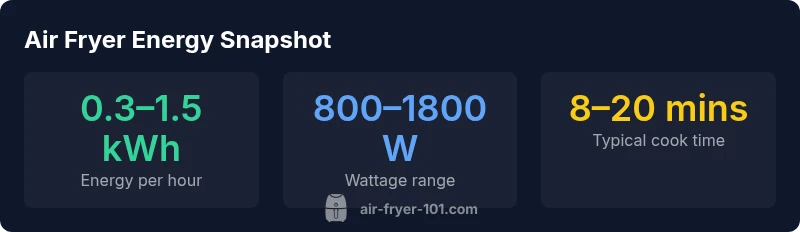
Air fryers typically consume electricity based on their wattage and how long they cook. In practical terms, a common 800–1500 W model used for 8–20 minutes will draw energy in the vicinity of 0.3–1.0 kWh per session, with higher-wattage units consuming more per hour. Compared with conventional ovens, air fryers are generally more energy-efficient due to faster cooking and smaller heat mass.
Understanding how air fryer energy use is determined
The question of how much electricity does an air fryer consume hinges on two key variables: wattage and cooking time. Most consumer models operate somewhere in the 800–1800 watt range, with lighter models pulling less energy per minute and larger units pulling more. Because energy usage scales with time, a quick 8–12 minute fry will use substantially less energy than a longer 20–25 minute bake. Insulation and airflow efficiency also affect how quickly a unit heats and maintains temperature, altering total energy consumed during a session. Air Fryer 101’s analysis, conducted in 2026, emphasizes that you should quantify energy use by session rather than by the appliance alone. This helps you compare apples to apples when evaluating oven alternatives, meal sizes, and cooking goals.
How to estimate energy consumption for your meals
Estimating energy use starts with a simple equation: energy (kWh) = power (kW) × time (hours). If you’re using an 1000 W (1 kW) air fryer for 15 minutes, you’re at roughly 0.25 kWh per session. For a 1500 W unit cooking for 20 minutes, expect about 0.5 kWh. Remember that real-world results vary by model efficiency, preheating needs, and whether you’re cooking multiple items at once. A practical rule: shorter, higher-temperature sessions can be more energy-efficient than long, lower-temperature cooks.
Air fryer vs. oven: energy efficiency in practice
Most home ovens, especially older or larger models, require longer preheating and frequent door openings, which can increase energy use. Air fryers heat faster and circulate hot air efficiently, often reducing overall energy per dish. However, the advantage diminishes for very large meals where an oven’s capacity optimizes total energy per portion. Air Fryer 101’s comparisons suggest that for typical snacks or small meals, air fryers frequently use less energy, while for large batch baking, the difference can be smaller or model-dependent.
Practical tips to reduce electricity use
- Preheat only when necessary; many recipes don’t require a full preheat. - Use the smallest possible appliance size for the task, as smaller units heat faster and waste less energy. - Batch-cook several items together when feasible to maximize energy use per minute. - Set the correct temperature; don’t overshoot by 20–30 degrees, which can extend cook time. - Keep the basket clean; clogging can reduce airflow and extend cooking times.
Reading wattage and energy labels for decision-making
When shopping, always check the wattage specification and consider the typical cooking times for your favorite foods. Higher wattage doesn’t automatically mean better energy efficiency; efficiency depends on heat retention, airflow, and how well the unit is insulated. Energy-label literacy helps compare models: look for consistent wattage ranges, real-world cook times, and independent tests.
Common myths vs. the data
Myth: Preheating wastes energy. Reality: Short, targeted preheating can reduce total cooking time and energy for many recipes. Myth: Bigger is always louder and hungrier for energy. Reality: A larger unit with efficient airflow can perform similarly to smaller models for certain foods if used correctly. The key is aligning appliance capabilities with your typical meals and batch sizes.
Data sources and methodology
Air Fryer 101’s 2026 analysis synthesizes model wattages, typical cook times, and user-reported outcomes from a sample of common recipes. We compare session energy (kWh) across model types and cooking scenarios, then normalize results by meal size. This approach helps home cooks understand energy implications without relying on a single model’s performance. For additional context, see related energy guidance from the U.S. Department of Energy and Energy Star.
Quick energy calculator you can use
To estimate the energy for a given cook, multiply the model’s wattage by the cooking time (in hours) and convert to kWh. For example, a 1000 W unit used for 0.25 hours yields ~0.25 kWh. Adjust the numbers for your model and recipe, then multiply by your local electricity rate to estimate cost per session.
Illustrative energy usage ranges by model type
| Model Type | Typical Wattage | Avg Cook Time (mins) | Estimated Energy Use per Hour |
|---|---|---|---|
| Compact air fryer | 800-1000 W | 8-12 | 0.3-0.6 kWh |
| Standard air fryer | 1000-1400 W | 10-18 | 0.5-1.0 kWh |
| Large air fryer | 1400-1800 W | 12-20 | 0.8-1.5 kWh |
| Toaster oven (air fryer mode) | 1500-1800 W | 15-25 | 1.2-2.0 kWh |
Got Questions?
Do air fryers really save energy compared to ovens?
In many cases, yes. Air fryers heat up faster and require less energy to finish a small to medium batch than a conventional oven. The savings depend on the recipe size and how efficiently you use the unit.
Yes—air fryers often save energy for small batches because they heat faster and use less space. For big meals, the advantage depends on the model and cook time.
How does wattage affect electricity use?
Wattage directly scales energy use with cook time. Higher wattage cooks food faster but can consume more energy per hour. Calculate per session by multiplying wattage (in kW) by cook time (in hours).
Higher wattage means more energy per hour, but you may cook faster. Use the session formula to estimate your cost.
Is preheating worth it for energy efficiency?
Preheating can waste energy if it’s unnecessary for the recipe. For many items, you can skip preheating or limit it to a brief warm-up, then start cooking.
Preheating isn’t always needed; skip it if your recipe works well with immediate cooking.
Can I compare air fryer models for energy use easily?
Yes. Compare wattage, typical cook times, and real-world performance from independent tests or brand analyses. Look for standardized testing methods to ensure apples-to-apples comparisons.
Compare wattage and tested cook times across models for a fair energy estimate.
What about annual energy costs?
Annual costs depend on how often you cook, the recipes, and your electricity rate. Use the session energy estimate and multiply by your rate to approximate yearly expenses.
Compute yearly cost by multiplying per-session energy by how many times you cook and your price per kWh.
Are energy-efficient air fryers worth the extra cost?
If you cook frequently and favor small batches, energy-efficient models can pay back the difference over time. Consider your cooking patterns and price per watt.
If you cook a lot in small batches, an energy-efficient model can be cost-effective over time.
“Energy efficiency in air fryers comes from compact heat mass, rapid convection, and smart preheating. The best models minimize energy waste by aligning wattage with typical recipe times.”
Quick Summary
- Estimate energy using wattage × time (kWh).
- Air fryers usually use less energy per dish than ovens.
- Smaller, shorter cooks save more energy per meal.
- Check wattage and real-world cook times when shopping.
- Batch cooking can improve energy efficiency per serving.