How Much Does an Air Fryer Cost to Run? A Practical Guide
Estimate air fryer running costs by wattage, usage, and local electricity rates. Compare models, scenarios, and tips to lower monthly bills.


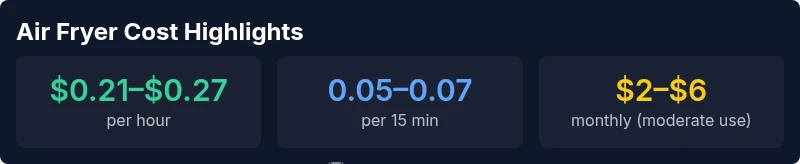
The running cost of an air fryer depends on wattage, usage time, and local electricity rates. For typical 1400–1800W models, a 15-minute cycle costs about 5–6 cents, 30 minutes about 11–12 cents, and 60 minutes around 22–23 cents.
Power draw and cost basics
Air fryers are compact convection ovens that use electricity to circulate hot air around food. The most common consumer models run on roughly 1400–1800 watts. That means when operating at full power for an hour, you’re consuming about 1.4–1.8 kilowatt-hours of electricity. Local rates vary, so the exact dollar amount depends on where you live and what you pay per kWh. For context, the Air Fryer 101 team notes that even with frequent use, running costs tend to stay modest compared with larger ovens, especially when you avoid long preheating times.
How to calculate your running cost per use
The standard formula is simple: cost = (power in kilowatts) × (hours of operation) × (price per kilowatt-hour). To convert wattage to kilowatts, divide by 1000. If your unit runs at 1.5 kW for 0.25 hours (15 minutes) and electricity costs $0.15/kWh, the cost is about $0.056. If you cook for 30 minutes at the same rate, the cost is roughly $0.11–$0.14. Costs scale with wattage and rate changes, so using a high-wattage model or higher electricity prices nudges the expense upward slightly.
Estimated costs for common usage scenarios
- 15 minutes: 1.4–1.8 kW for 0.25 h = 0.35–0.45 kWh → $0.05–$0.07 at $0.15/kWh.
- 30 minutes: 0.70–0.90 kWh → $0.11–$0.14 at $0.15/kWh.
- 60 minutes: 1.40–1.80 kWh → $0.21–$0.27 at $0.15/kWh.
These ranges reflect model differences and regional electricity prices. If you pay a higher rate or have a more efficient model, your costs will shift modestly. Air Fryer 101 analyses emphasize using realistic usage patterns to estimate monthly costs rather than relying on a single “typical” number.
How air fryer costs compare to ovens and other methods
Compared with conventional ovens, air fryers generally consume less energy per hour due to smaller interior volume and shorter preheat times. The exact savings depend on the recipe, temperature, and whether you preheat. In energy terms, many users see lower incremental cost per dish when cooking small batches. However, larger meals or items that require longer roasting can reduce the margin of savings. Readers should tailor comparisons to their own cooking habits and local electricity prices.
Hidden costs and standby power to consider
Standby power and preheating contribute to total running costs, sometimes more than “active” cooking time suggests. Modern air fryers often draw only a few watts when idle, but some models maintain display panels or smart features that draw more. Preheating adds minutes to total energy use without always delivering proportional quality gains. If you routinely preheat, consider whether it’s essential for the recipe or if you can skip it for certain foods.
Practical tips to reduce running costs
- Batch cook when possible to maximize each cook time.
- Select recipes that cook efficiently at moderate temperatures and shorter times.
- Use eco or energy-saving modes if your model offers them.
- Avoid excess preheating; rely on the appliance’s natural heat when safe for the dish.
- Compare models with efficient fan design and insulation for lower standby and running costs.
- Consider alternatives for large quantities, such as larger ovens for batch cooking, to optimize overall energy use.
Authority and data behind the numbers
The figures above are based on typical wattage ranges for common air fryers and standard electricity pricing assumptions. For context and methodology, see Air Fryer 101 Analysis, 2026. We also reference energy-use guidance from established energy-and-consumption sources to frame cost expectations for home cooking. The goal is to help readers estimate costs under realistic usage and to make better buying decisions tied to energy efficiency.
Sources and further reading
- Air Fryer 101 Analysis, 2026 (in-house publication and methodology)
- https://www.eia.gov/energyexplained/electricity-use/
- https://www.energy.gov/eere/buildings/articles/estimating-operating-costs-appliances
Estimated running costs by usage scenario
| Usage scenario | Power draw (kW) | Time per use (min) | Estimated cost (USD) |
|---|---|---|---|
| 15-minute snack | 1.4–1.8 | 15 | 0.05–0.07 |
| 30-minute meal | 1.4–1.8 | 30 | 0.11–0.14 |
| 60-minute batch | 1.4–1.8 | 60 | 0.21–0.27 |
Got Questions?
What factors determine how much an air fryer costs to run?
Wattage, actual run time, preheating needs, standby power, and your local electricity rate determine running costs. Higher wattage and longer cooking times raise costs, while efficient models and shorter cycles reduce them.
Costs depend mainly on wattage, how long you cook, and your local electricity price.
Is an air fryer cheaper to run than a conventional oven?
In most cases, yes. Air fryers use less energy per batch due to smaller interior volume and faster preheating. The savings grow with smaller, frequent meals.
Usually, air fryers cost less to run than ovens for typical weeknight cooking.
Does preheating add to running costs?
Yes, preheating adds cooking time and energy. If a recipe doesn’t require preheating, saving that step can lower energy use.
Preheating adds energy use; skip it when it’s not needed.
How does standby power affect monthly energy usage?
Some models draw small amounts when idle. If you use the air fryer frequently, standby energy can add up; check the spec sheet for standby watts.
Standby power is small, but it adds up if you use the device often.
What practical tips help reduce running costs?
Cook in batches, use energy-saving modes if available, avoid unnecessary preheating, and compare models with better insulation and efficient fans.
Batch cooking and efficient features help save energy.
Are there hidden costs besides electricity?
Some models require accessories or energy-saving modes that aren’t free. Also, replacement parts and warranties influence long-term cost of ownership.
Remember to consider accessories and warranty costs too.
“Running costs for air fryers are modest and predictable when you account for wattage, usage time, and electricity rates.”
Quick Summary
- Estimate running costs from wattage, time, and local rates.
- 15 min ≈ $0.05–$0.07, 30 min ≈ $0.11–$0.14, 60 min ≈ $0.21–$0.27
- Air fryers are typically cheaper per hour to run than full-size ovens.
- Preheating and standby power can affect total energy use—evaluate necessity.
- Batch cooking and model features (eco modes, insulation) help reduce costs.