How much does an air fryer cost to run per hour?
Learn how to estimate the hourly electricity cost of running an air fryer, what factors affect it, and how to compare models for budget-minded home cooks.


how much does an air fryer cost to run per hour?
According to Air Fryer 101, understanding running costs helps home cooks compare models without surprises. The core idea is simple: electricity cost is driven by power draw and how long you run the device. If you know the wattage and your local price per kilowatt-hour (kWh), you can estimate the cost in minutes or hours of operation. This section sets the stage for practical budgeting, recipe planning, and selecting a model that fits your household needs.
For most families, air fryers are a convenient tool for quick meals. The cost to run per hour scales with how aggressively you cook, how often you use the appliance, and the efficiency of the unit. In general, higher-wattage models burn more energy per hour, while newer designs with better airflow can reduce overall cooking time without sacrificing results. Keep in mind that energy prices vary by region and by time of day, which means your hourly cost can shift slightly over the year.
If you want to compare models or estimate your personal cost, start with two numbers: the wattage printed on the device and the price per kWh from your utility bill. Then apply the standard formula (kW × hours) × price per kWh. This is also helpful when planning batch cooking or adjusting recipes to reduce total energy use.
costCenterNotApplicable":null
wordCount":null}
Key factors that affect hourly cost
Several factors determine the exact running cost of an air fryer per hour. First is wattage: most popular models sit in a range of about 800 to 1500 watts. Second is how long you cook; longer cooking times raise energy use, while shorter, high-efficiency cycles can produce similar results with less energy. Third is your electricity rate; households in different regions pay different prices for each kilowatt-hour, and some utility plans offer lower rates during off-peak hours. Fourth, insulation and airflow efficiency matter: better airflow can cook faster, lowering both time and energy per dish. Finally, preheating and batch cooking habits influence total energy consumption.
wordCount":210}
How to estimate your cost per hour
To estimate hourly running costs, you only need a couple of inputs: your air fryer’s wattage and your electricity rate. The standard formula is straightforward: hourly cost = (power in kW) × (cost per kWh). Convert watts to kilowatts by dividing by 1000. For example, a 1200W unit uses 1.2 kW when on, so cost per hour equals 1.2 × rate per kWh. If you plan multi-hour sessions, multiply by the number of hours you run it. If you use multiple times per day, sum the hourly costs across sessions.
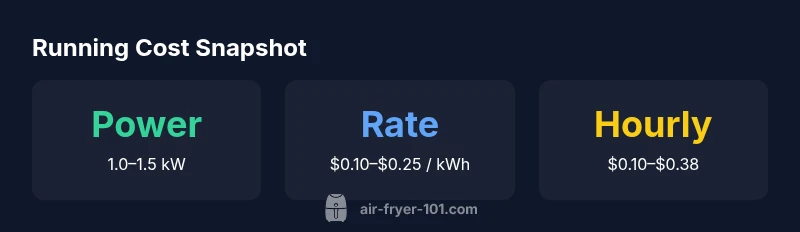
Note: electricity rates can be expressed as a range (e.g., $0.10–$0.25 per kWh). Using a range helps you build a cost band rather than a single figure. If you want a more nuanced estimate, consider how long you actually cook per meal and whether you preheat. These adjustments can shave a few tenths of a dollar per hour.
wordCount":230}
Practical examples and scenarios
Let’s translate the math into practical examples. For a common 1000–1200W air fryer, the hourly energy use is about 1.0–1.2 kWh if operated for a full hour. If your local rate falls in a band like $0.10–$0.25 per kWh, the hourly cost would range roughly from $0.10 to $0.30 per hour for a full hour of operation. If you frequently cook in shorter bursts, such as 15–20 minutes per session, the cost per session drops to roughly $0.03–$0.10, depending on wattage and rate. For higher-wattage models (around 1500W), expect the hourly cost to sit near the upper end of these ranges, with an energy per hour around 1.5 kWh. These scenarios help you budget for weekly meal plans and compare models before buying.
wordCount":230}
Tips to reduce running costs without sacrificing results
- Choose a model with efficient airflow and appropriate wattage for your typical meals. A 1000–1200W unit is often a good balance of speed and energy use.
- Batch cook when possible. Cooking multiple meals in one session reduces the number of startup cycles and can lower overall energy per serving.
- Optimize preheating. If a recipe doesn’t require preheating, skip it to save energy; if preheating is necessary, limit the duration to a fixed window.
- Use programmable or smart features to time cooking cycles to during off-peak hours if your utility offers lower rates. This can lower your overall energy costs over a month.
- Maintain your air fryer. Clean baskets and maintain seals; a clean unit operates more efficiently, reducing run time for the same results.
wordCount":140}
Common mistakes and safety considerations
- Leaving an air fryer unattended for extended periods can be a safety hazard and waste energy if you’re not adjusting for the actual cooking time.
- Don’t overfill the basket; crowded meals take longer and waste energy as airflow is restricted.
- Ensure proper ventilation to avoid smoke or odor buildup in small spaces. Placement near heat-sensitive items should be avoided.
- Always use a heating element that matches the recipe’s requirements; mismatched settings can lead to longer cooking times and higher energy use.
wordCount":140}