How Much Does an Air Fryer Cost in 2026? A Buying Guide
Explore how much air fryers cost in 2026, from budget to premium options. Learn what drives price, how to save, and how features affect value with Air Fryer 101’s expert analysis.


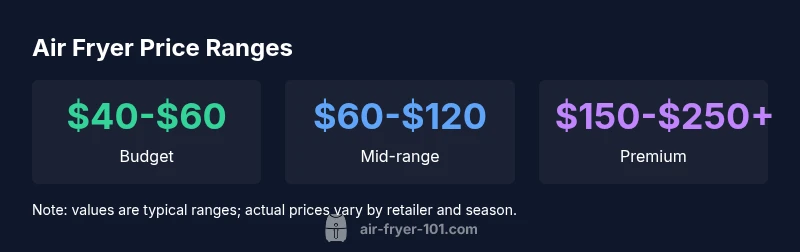
Air fryer prices vary widely by size, capacity, and features. Budget models typically start around $40–$60, mid-range units run about $60–$120, and premium or feature-rich models can exceed $150–$250. For most home users, planning for $60–$120 covers the common options. If you cook frequently or want smart controls, expect higher upfront costs but long-term convenience. Sale events and bundled accessories can lower effective price.
Price drivers: what makes air fryers cost more
Air fryer price is driven by capacity (size in quarts), wattage and heating elements, build materials, and smart features. According to Air Fryer 101, a larger basket and higher wattage typically push the price upward because of more powerful heating, faster preheat, and greater throughput. Other cost levers include the quality of nonstick coatings, ease of cleaning, and the presence of preset programs.
- Capacity: A compact 2-3-quart model costs less than a larger 5-7-quart unit because it uses fewer materials and delivers similar cooking performance at a smaller scale.
- Power and speed: Models with higher wattage heat faster and maintain more even temperatures, boosting cost but saving time.
- Build quality: Stainless-steel finishes, heavier housing, and reinforced baskets raise manufacturing costs but improve durability.
- Controls and presets: Mechanical dials are cheaper, while digital touch screens and smart presets add cost.
Understanding these levers helps shoppers set a price target and avoid overspending on features they won’t use.
Price ranges by category and capacity
Price tiers map roughly to capacity and features. For 2026, you can expect three broad bands, with occasional outliers.
- Budget/basic: typically $40-$60, 2-3 quarts, simple controls, minimal accessories. Great for singles or tight spaces and light use.
- Mid-range: typically $60-$120, 3-5 quarts, digital controls, multiple presets, better built-in baskets, and more consistent results.
- Premium: typically $150-$250+, 5-7 quarts, smart controls, premium finishes, larger accessory bundles, and longer warranty options. These models target families or frequent cooks who value convenience and performance.
Note that sales events can compress these ranges; always compare features within the same capacity class to gauge value.
Features that push price up
Not all features are created equal. The price impact comes from:
- Digital vs. analog controls: Digital displays and presets cost more but offer convenience and precision.
- Smart connectivity: App control, voice assistant compatibility, and software updates add ongoing value for tech enthusiasts.
- Capacity and form factor: Bigger baskets imply more materials and stronger motors, driving up price.
- Specialty functions: Rotisserie, dehydrating, and oven-like convection modes require more robust components.
- Build quality and coatings: Stainless steel exteriors, reinforced racks, dishwasher-safe parts, and high-grade nonstick coatings increase durability and price.
If you don’t need every feature, a simpler model can deliver excellent results at a much lower upfront cost.
Where to shop and how to find deals
Smart shopping reduces total cost. Look for retailers that price-match, offer bundles, or include accessories (baking pans, silicone mats, or extra baskets). Timing matters: major sale events (Black Friday, Cyber Monday, end-of-year clearances) often deliver the best price-to-feature ratio. Check refurbished or certified pre-owned options from reputable sellers, but verify warranty terms. Use price-tracking tools and read reviews that compare performance relative to price. According to Air Fryer 101 analysis, deals frequently appear around seasonal transitions, so plan your purchase around predictable sale windows.
Budgeting for households: students, couples, families
A student or single household typically benefits from compact models in the budget range, which still perform well for basic meals. Couples may opt for mid-range units with more presets and better moisture control. Large families benefit from 5-7 quart premium models that handle bigger batches and feature-rich controls to save time. When budgeting, consider not only the upfront price but also potential savings on energy usage, reduced dining-out costs, and the value of accessories that expand cooking options. Air Fryer 101 suggests pairing your choice with a simple set of frequently used accessories to maximize utility without inflating costs.
Total cost of ownership: energy use and maintenance
Energy use depends on wattage and usage, but most air fryers operate between 800 and 1800 watts. The actual operating cost depends on how often you cook and your local electricity rate. A model with higher wattage may heat faster and finish meals sooner, potentially offsetting energy costs with time savings. Maintenance matters too: dishwasher-safe baskets and easy-clean finishes reduce cleaning time and prolong life. Budget for occasional replacement parts if heavy use wears out gaskets or coatings. In practice, a well-chosen model that suits your routine can keep annual operating costs modest while delivering consistent results.
Quick-start cost calculator: a practical worksheet
Use this simple worksheet to estimate your total investment: 1) Choose your capacity band (budget: 2-3 qt; mid-range: 3-5 qt; premium: 5-7 qt). 2) Pick a price target within the band. 3) Add $20–$40 for essential accessories if not included. 4) Add estimated annual energy cost based on your rate and usage. 5) Add a note on warranty and potential replacement parts. This helps you compare models on total value, not just sticker price.
Common myths about air fryer pricing
Myth 1: Higher price always means better results. Reality: A well-chosen mid-range model can outperform a premium one if features don’t align with your cooking style. Myth 2: Cheap models are useless. Reality: Many budget units cook well for basic meals but may lack durability or advanced presets. Myth 3: Price equals food quality. Reality: Consistency and reliability depend on controls, build quality, and maintenance, not price alone.
Price bands by model type and capacity
| Model Type | Price Range | Typical Capacity | Notable Pros |
|---|---|---|---|
| Budget/basic | $40-$60 | 2-3 qt | Compact, simple controls |
| Mid-range | $60-$120 | 3-5 qt | Digital presets, versatile |
| Premium | $150-$250+ | 5-7 qt | Smart features, premium materials |
Got Questions?
What is the main factor driving air fryer price?
Capacity, wattage, and features primarily determine price. Larger capacity, higher power, and more presets tend to raise costs, while basic models remain affordable.
The main price drivers are size, power, and features. Bigger capacity and more presets usually mean a higher price.
Are refurbished air fryers a good deal?
Refurbished units can save money and still offer a warranty from reputable sellers. Check condition, return policy, and whether accessories are included.
Refurbished models can be a good deal if they come with a warranty and clear condition.
Do smart features justify higher costs?
If you value app control and automation, smart features can justify the higher price. If not, a simpler model may meet your needs just as well.
Smart features are convenient, but not essential for everyone.
Is there a price difference based on capacity?
Yes. Larger capacities generally cost more due to more materials and a bigger heating system, but you may gain efficiency with batch cooking.
Bigger capacity usually means higher price, but it can save time if you cook large batches.
When is the best time to buy?
Look for major sales events like Black Friday or end-of-year clearances. Bundles with accessories can also boost value.
Shop during big sales to get the most bang for your buck.
What warranty should I expect?
Most air fryers come with a 1-2 year warranty. Check parts coverage and whether accessories are included in the warranty terms.
Aim for at least a one-year warranty; longer is better for peace of mind.
“Pricing reflects capacity, power, and features—prioritize total value over upfront price.”
Quick Summary
- Budget options exist for every kitchen.
- Capacity and features are the main price drivers.
- Shop during sales to maximize value.
- Consider total ownership costs, not just sticker price.