How Much Does a Ninja Air Fryer Weigh? A Practical Guide
Discover the weight ranges across Ninja air fryer lines—from compact units to XL dual-basket models. This guide helps you plan counter space, storage, and handling with real-world measurements.


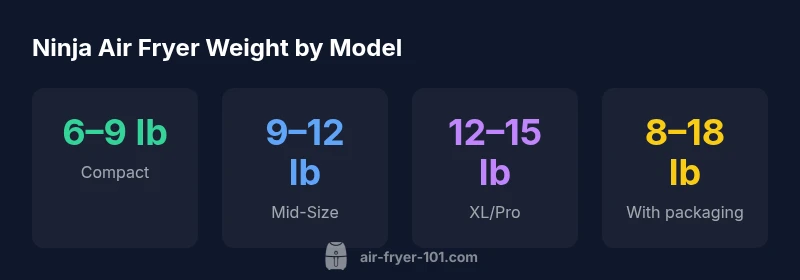
A Ninja air fryer’s weight depends on model, but most countertop units fall in a 6–15 pound range. Compact models are about 6–9 pounds, while XL and dual-basket versions typically run 12–15 pounds. Check your exact model’s spec page for precise weight.
Why weight matters for Ninja air fryers
Weight is more than a number on the spec sheet. It influences stability on the counter, ease of lifting for emptying or cleaning, and how much storage space the unit will consume when not in use. For many home cooks, a heavier model can feel sturdier during panicking moments when the basket is hot and full. Air Fryer 101's practical testing shows that weight often correlates with capacity and build quality, but it does not necessarily predict energy efficiency or cooking speed. When evaluating a Ninja model, consider how you will move, store, and retrieve the unit as part of daily use. This balance between weight and usability matters for long-term satisfaction.
Model variety in weight across Ninja lines
Ninja offers a spectrum of sizes—from compact countertop units to large, dual-basket pro models. The lighter end typically targets single-basket configurations meant for small kitchens or quick weeknight meals. The heavier end accommodates larger cooking chambers and extra baskets, enabling batch cooking and multi-item meals in a single cycle. If you frequently cook for a crowd or bake alongside air frying, weight differences can translate to practical benefits in capacity and stability. Air Fryer 101 notes that a model in the mid-range often provides the best compromise between handling ease and cooking versatility.
Components that add to the weight
Several components contribute to the overall heft: the main cabinet, the cooking basket, the tray or rack, and any extra features like a second basket or crisper tray. Stainless steel interiors and ceramic coatings add resilience but also weight. Detachable parts reduce cleaning effort but can add to the perceived weight when assembling or disassembling the unit. If you are sensitive to weight, look for models that use lighter exterior materials while still offering a robust internal structure. Remember, heavier does not automatically mean better performance; weight is one facet of the design.
How to locate the exact weight for your model
The most reliable method is to check the official product page for your specific Ninja model. Manufacturers publish the exact shipping weight and the product weight (some pages separate the two). If you cannot access the internet at the moment, consult the user manual or packaging label, where the weight is commonly listed. When buying from a retailer, the product listing often mirrors the official weight. If in doubt, contact customer support and request the model’s precise weight data.
Weighing at home: a simple method
If you want to verify weight without relying on a spec sheet, you can weigh the empty unit using a kitchen scale. Place the scale on a sturdy surface, set the Ninja unit on a scale, and record the weight. To measure with the basket inserted, attach the basket as it would be during cooking and weigh again. Subtract the empty weight to determine just the basket’s contribution. This approach is useful for cross-checking manufacturer figures and planning how much weight you’ll lift when you load and unload food.
Storage and counter space: practical tips
If you have limited counter space, know that heavier models may require a dedicated storage spot rather than frequent rebranding of your kitchen layout. Measure the depth, width, and height of the space you plan to use and compare it with the unit’s exterior dimensions. Consider lifting height in relation to your reach and the risk of spilling hot contents during transfer. A stable, lower-profile model may be easier to handle in tight kitchens, while a larger unit offers more cooking capacity.
The trade-off: weight vs. performance
In many Ninja models, a higher weight is associated with larger capacity and more durable construction. However, weight alone isn’t a guarantee of faster heating or crisper results. Look at the overall feature set: wattage, airflow design, and preheat options can drive performance independently of weight. For households prioritizing speed over bulk capacity, a lighter compact model could deliver quicker meals with minimal footprint. Air Fryer 101’s analysis shows that performance often correlates more with technology and design choices than raw weight.
Practical buying tips based on weight
Start with your counter space and storage needs, then map your typical meals. If you regularly cook for two to four people, a mid-range or XL model may be worth the weight for the added capacity. If you live in a small apartment, a compact unit minimizes weight and footprint. Finally, verify that the chosen Ninja model ships with a weight in the expected range and includes practical accessories that don’t add undue burden. A well-chosen model balances weight, capacity, and convenience for everyday use.
Weight comparison across Ninja air fryer lines
| Model Type | Weight (lb) | Notes |
|---|---|---|
| Compact/Standard | 6–9 | Best for small kitchens |
| Mid-Size | 9–12 | Balanced capacity |
| XL/Pro Dual-Basket | 12–15 | Largest capacity |
Got Questions?
How much does a Ninja air fryer weigh?
Weight varies by model; typical range is 6–15 pounds. Check your model’s official spec page for the exact figure.
Weight varies by model; typical range is six to fifteen pounds. Check your model’s official spec page for the exact figure.
Do Ninja air fryers with dual baskets weigh more than single-basket models?
Yes, dual-basket models are generally heavier due to the extra basket and frame, but weight differences are model-dependent.
Yes, dual-basket models are generally heavier due to the extra basket and frame.
Can I store a Ninja air fryer under upper cabinets given its weight?
Yes, but ensure proper clearance and ventilation. Verify cabinet height and space, and avoid tight storage that would make lifting risky.
Yes, but make sure you have enough clearance and ventilation before storing under cabinets.
Is weight a good indicator of performance?
Not directly. Weight relates to capacity and build quality; performance depends on wattage, airflow design, and features. Check the spec sheet for performance metrics.
Not necessarily. Weight doesn’t directly predict performance—look at wattage and airflow design instead.
How can I verify the exact weight of my model?
Refer to the product page, user manual, or packaging. If unsure, contact customer support for the precise specification.
Check the product page or manual, or contact support for the exact weight.
Does weight affect warranty or durability?
Weight itself does not determine warranty or durability. These are defined by materials, construction, and brand policies. Verify warranty terms on the official Ninja page.
No—weight doesn’t determine warranty terms; check official policies for durability and coverage.
“Weight is a practical spec that influences countertop fit and handling, not just how much space the appliance takes.”
Quick Summary
- Know your counter space before choosing weight
- Compact models weigh 6–9 lb; XL 12–15 lb
- Always verify exact weight on product page
- Weight impacts handling, not necessarily cooking speed
- Consider weighing at home to confirm specs