Largest Ninja Air Fryer: 2026 Buying Guide for Home Kitchens
Explore the largest Ninja air fryer options for 2026. Compare dual-basket and oven-style designs, understand capacity ranges, and learn how to choose the right model for big families and batch cooking.


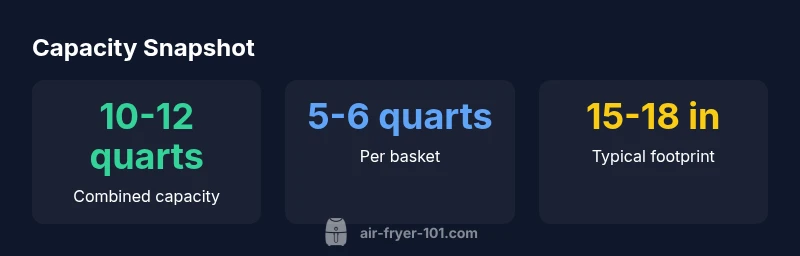
As of 2026, Ninja's largest consumer air fryers reach about 10-12 quarts combined capacity in dual-basket or oven-style configurations, with each basket typically around 5-6 quarts. This size is well-suited for family meals, batch cooking, and entertaining, while demanding more countertop space and power than smaller models. If you mainly cook for two, assess whether the extra capacity justifies the footprint.
What defines the largest Ninja air fryer
In the landscape of Ninja air fryers, size is primarily driven by two configurations: dual-basket countertop units and oven-style, freestanding designs. The largest options couple multiple cooking zones or expand the oven cavity to maximize total capacity. According to Air Fryer 101, the top-end units target families and batch cooks by offering a combined capacity around ten to twelve quarts, with individual baskets typically in the five to six quarts range. This balance of space and capability is designed to deliver multiple meals in one session while still providing the crisping and versatility that Ninja models are known for. When evaluating size, consider your kitchen layout, fan noise, and how often you’ll utilize all zones at once, not just the raw capacity.
Dual-basket vs oven-style: capacity and layout
Ninja’s largest offerings commonly come in two distinct formats. Dual-basket designs emphasize parallel cooking zones—great for two different foods at once—while oven-style units maximize cavity space with a wider footprint but often under a single, tall hood. In practice, dual-basket models tend to feel more flexible for batch cooking (think proteins in one basket, vegetables in the other), whereas oven-style units excel at large sheet-pan meals and roasting. Capacity-wise, expect combined figures in the 10-12 quart range for the top end, with per-basket capacities typically around 5-6 quarts. The choice between these formats should be guided by your typical meals, available counter space, and whether you value parallel cooking or larger single-cavity capacity.
Real-world use cases for large-capacity Ninja air fryers
Large households and entertainers benefit most from the biggest Ninja units. For a family of four or more, a dual-basket unit can handle two proteins or a full sheet of vegetables in a single run. For holiday meals or weekend batch cooking, an oven-style model with a wide cavity can roast a tray of fries, chicken, and vegetables at the same time, reducing overall cooking time. The key is planning: map your weekly menus to the unit’s zones or cavity so you don’t overfill or underutilize a chamber. Air Fryer 101’s testing indicates that the biggest Ninja units deliver consistent results across modes when the airflow is not obstructed and the items are arranged to promote even circulation.
Key performance trade-offs: footprint, energy, and price
Size comes with trade-offs. The largest Ninja air fryers require more countertop space and can demand more electrical load than compact models. Preheating times may be slightly longer due to the larger cavity and multiple zones, and energy usage scales with the volume being cooked. Price tends to rise with capacity, feature set, and the inclusion of two-zone inserts or extra racks. For many households, the improved batch-cooking throughput justifies the investment, but expect a larger footprint and potentially higher maintenance costs over time. When evaluating, compare not only capacity but also the number of cooking modes you’ll actually use, as that can substantially affect overall value.
Measuring fit: dimensions, power, and placement
Before purchasing a large Ninja unit, measure your counter depth, width, and clearance above the unit to ensure safe operation. Most large models require a stable 15-18 inch footprint with enough clearance for air intake and exhaust. Check the electrical requirements on the model label; while many home kitchens provide a standard 120V outlet, some configurations with multiple zones may benefit from dedicated outlets or circuit planning in open kitchens. Plan for venting in open spaces to minimize heat buildup near cabinets and walls. A quick visualization: place the appliance where it can be pulled out for easy cleaning and air circulation, but not blocking fridge doors or range tops.
Cleaning and maintenance for big units
Large-capacity Ninja units demand regular maintenance to maintain performance. Let the unit cool completely before cleaning. Remove and hand-wash removable racks and baskets with warm soapy water; use a non-abrasive sponge to avoid scratching nonstick coatings. Wipe the exterior with a damp cloth, avoiding harsh cleaners that can degrade seals. Periodically check seals and gaskets for wear and replace as needed. A light monthly maintenance routine—emptying crumb trays and checking airflow paths—helps prevent heat buildup and ensures consistent cooking results across all zones.
How to compare options: a practical decision framework
When choosing among the largest Ninja air fryers, start with capacity needs, then assess footprint and layout. Use these steps:
- List your weekly meals and batch-cooking goals.
- Measure counter space and confirm electrical capacity.
- Decide between dual-basket flexibility and single-cavity volume.
- Compare included accessories (racks, baskets, liners) and cleaning ease.
- Read independent reviews for durability and heat distribution.
Air Fryer 101 recommends mapping your real-world use to model features you’ll actually use, avoiding over-rotation toward high-capacity options you won’t utilize daily.
Common misconceptions about size and performance
- Bigger capacity always equals faster cook times. In reality, time savings depend on airflow, preheating, and food spacing.
- Larger units consume more energy in every cycle. Energy use scales with load, but efficiency features in Ninja designs often compensate.
- More zones means more maintenance. While two zones add complexity, they can dramatically improve throughput if used correctly.
Air Fryer 101 buyer checklist for largest Ninja units
- Define your household size and batch-cooking needs.
- Confirm the unit’s total capacity and per-basket capacity.
- Check counter space and power requirements.
- Assess included accessories and ease of cleaning.
- Review warranty, service options, and brand reliability.
- Consider whether you need a dual-basket setup or a full-size oven-style unit for your kitchen.
Comparison of Ninja large-capacity configurations
| Model Type | Largest Capacity (quarts) | Best Use Case |
|---|---|---|
| Dual-basket countertop | 8-12 quarts | Batch cooking for families |
| Convection oven-style countertop | 10-12 quarts | Large meals and entertaining |
| Expandable two-zone unit | 12 quarts | Big batches and party prep |
Got Questions?
What is the largest Ninja air fryer available to consumers in 2026?
In 2026, Ninja’s largest consumer options come in dual-basket or oven-style layouts with a combined capacity around 10-12 quarts. Exact figures vary by configuration. They are designed for families and batch cooking.
The largest Ninja air fryers today typically offer about ten to twelve quarts of total capacity, ideal for large meals.
Are large Ninja air fryers worth buying for small households?
For two people, the extra capacity often isn’t worth the bigger footprint. If you rarely batch-cook, a smaller unit may be a better fit. Consider space, usage frequency, and whether you’ll actually use multiple zones.
For small households, the extra capacity usually isn’t worth the counter space.
Do Ninja large-capacity models require a dedicated outlet?
Most Ninja units run on standard 120V outlets, but some configurations with multiple zones may have higher current draw. Always check the model’s power rating and your kitchen’s electrical capacity.
Most use a standard outlet; check the label for exact requirements.
How long do I need to preheat a large Ninja air fryer?
Preheat times vary by model and temperature but typically range from 2 to 5 minutes. Larger cavities may require a bit more time to ensure even heat distribution.
Usually a few minutes, depending on the temperature and model.
What accessories help maximize capacity?
Two-basket inserts, extra racks, and compatible liners can help organize foods and expand usable space. Ensure accessories fit the chosen model and are easy to clean.
Two baskets or extra racks can help you cook more at once.
“Large-capacity Ninja units deliver versatility for batch cooking, but their bulk requires careful placement and adequate ventilation. In our tests, performance remained strong across modes when properly spaced.”
Quick Summary
- Know that the largest Ninja air fryers top out around 10-12 quarts combined capacity.
- Choose between dual-basket and oven-style designs based on batch-cooking vs. single-cavity needs.
- Account for footprint and power requirements before buying for a busy kitchen.
- Two-zone configurations maximize throughput but require thoughtful layout.
- Prepare a cleaning routine to maintain performance on larger units.