What Air Fryer Has the Largest Capacity
Discover which air fryer offers the biggest capacity, compare quart ranges, and learn how size affects practicality and speed for family meals.


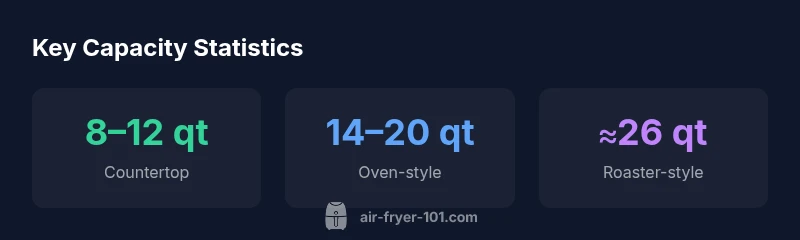
In the countertop category, the largest single-basket air fryers typically top out around 8–12 quarts. If you expand to air fryer ovens or multi-basket designs, capacities commonly reach 14–20 quarts, with some roaster-oven style units marketed for roughly 26 quarts. So, the 'largest capacity' depends on whether you want a single-basket unit or a multi-cook oven.
Understanding Capacity in Air Fryers: What the numbers mean
Capacity is the primary lens people use when they say 'the largest air fryer.' But size alone doesn't tell the whole story. According to Air Fryer 101, capacity is a combination of volume, cooking surface, and airflow, and it's measured differently across unit types. For countertop enthusiasts, you typically see two families: single-basket countertop units and oven-style models that use multiple racks or baskets. When you see a quart figure, treat it as a rough guide to how much food can physically fit, not a guarantee of even browning or consistent cooking. In practice, the largest capacity depends on whether you want a compact, single-basket unit with a big interior, or a bigger appliance that behaves more like a compact oven.
To put it simply: "quart size" tells you how much space there is, but the arrangement of food and the device's airflow determine how evenly it cooks. If you're feeding a family or hosting, you may care more about "batches per meal" rather than the exact quart rating. We'll walk through typical ranges so you can map your needs to the right category, and we'll flag common missteps that new buyers make when chasing the largest possible number.
Countertop single-basket vs oven-style: Pros and Cons
Single-basket countertop units are straightforward and often the most affordable way to get into high-capacity cooking. They excel when you cook simple, uniform items like fries, chicken tenders, or vegetables in a single layer. However, their interior cross-section limits how much food you can physically cook at once, and you’ll likely need to prefill in batches for large gatherings. Oven-style or multi-basket designs flip the idea: you can stack racks or use separate baskets to expand total cooking surface, which translates to more items per cycle and more even distribution of heat. The trade-offs are footprint, price, and learning curve: more features often mean a larger footprint and a steeper learning curve to optimize airflow and browning.
How to choose based on family size and cooking style
For a small apartment or a couple, a high-capacity single-basket unit in the 8–12 quart range can be ideal, balancing space, cost, and capacity. Families of four to six people might benefit from an oven-style model in the 14–20 quart zone, which supports multiple proteins or sides in one go. If you regularly host gatherings or meal-prep for large groups, a roaster-style appliance around 26 quarts can dramatically reduce batch cooking. The decision should align with your typical meals, kitchen footprint, and how often you’ll use the extra capacity. Consider also what you’ll cook most often and whether you value flexibility over sheer size.
Practical guides: estimating load and even cooking
The best practice is to avoid overloading regardless of the quart rating. A good rule of thumb is to fill each tray or rack to about 75% capacity to allow air to circulate. For multi-basket models, avoid stacking items directly on top of each other; leave space between items for air movement. Preheating can help ensure even browning, but not all models require it—follow the manufacturer’s guidance. Use the appropriate temperature and time scaling: for larger batches, start with the same temperature but extend cook time in increments until the center reaches the desired doneness.
Real-world scenarios: when to choose 8-12 qt vs 14-20 qt vs 26 qt
If you cook for two or three, 8–12 quarts is usually sufficient and minimizes waste. For a family of four to six, an oven-style 14–20 quart model shines, handling roasts, multiple sides, and crispy items in fewer cycles. For frequent entertaining or weekly batch cooking, 26 quarts or larger roaster-style units reduce prep time significantly, though they demand more counter space and higher upfront cost. Always balance capacity with your kitchen layout, power availability, and the types of foods you cook most often.
Design considerations beyond size
Capacity is important, but it’s not the only design factor that impacts performance. Look for even heating features, such as a back- or bottom-heating element tuned to reduce cold spots. Basket design matters: deep versus shallow baskets affect air flow and browning. Cleaning matters too: large-capacity models can have more complex interiors, so check whether baskets and racks are dishwasher-safe. Also consider noise level, cord length, and whether the controls are intuitive for your daily use. These factors often determine whether a large unit feels like a burden or a boon in your kitchen.
Maintenance tips for large-capacity models
Large-capacity devices require systematic care to maintain performance. Regularly remove and clean baskets, racks, and seals to prevent sticking, residue, and odor buildup. If your model has a non-stick coating, avoid abrasive cleaners. Periodically check gaskets and door seals for wear and replace as needed to maintain efficiency. Keep the exterior clean to avoid heat buildup that could affect performance. Finally, rotate items in multi-basket units to ensure even cooking across all baskets. A simple monthly cleaning routine goes a long way toward preserving capacity and consistency.
Capacity ranges by air fryer type
| Category | Typical Capacity | Notes |
|---|---|---|
| Single-basket countertop | 8-12 quarts | Compact footprint, simple operation |
| Air fryer oven / multi-basket | 14-20 quarts | Greater versatility and capacity |
| Roaster-style large-capacity | 26 quarts | Extreme capacity for gatherings |
Got Questions?
What is the largest capacity available in consumer air fryers?
For countertop units, the largest commonly available are in the 8–12 quart range for single baskets. Air fryer ovens and multi-basket designs extend capacity to roughly 14–20 quarts. Some roaster-style machines advertise up to about 26 quarts, but availability varies. Consider your kitchen space and how you plan to use the unit.
countertop units go up to 12 quarts; ovens go higher; roaster models around 26 quarts.
Does bigger capacity mean faster cooking?
Not necessarily. Larger capacity can mean longer preheat and total cook times if you load more food. Use batches for very large items or opt for higher heat and shorter times when appropriate to maintain crispness.
Big size doesn't always mean faster; more food may require longer cook times.
Is a large-capacity air fryer easier to use for a family?
Yes, larger capacity reduces batch cooking for families, but verify controls, heat distribution, and cleaning. Look for even-heating features and a basket size that matches your typical meals to maximize convenience.
Yes, bigger can be easier for families, but check features.
What should I consider beyond capacity when choosing?
Footprint, energy use, preheat time, basket design, dishwasher-safe parts, and maintenance cadence all matter. A larger unit is only worth it if it fits your kitchen and your cooking routine.
Think about footprint, preheat, and cleaning.
Are large-capacity air fryers more expensive?
Larger units typically cost more, with price varying by features and build quality. Evaluate whether you’ll use the extra capacity regularly, and compare feature sets to avoid paying for unused capabilities.
Larger usually costs more, but it may be worth it if you cook large batches.
“Capacity is only part of the story; performance, footprint, and ease of use matter as much as the quart size.”
Quick Summary
- Define largest capacity by design, not just quart size
- Single-basket units top out at 8-12 quarts
- Oven-style models reach 14-20 quarts
- Roaster-style units can approach 26 quarts
- Choose based on servings, footprint, and budget