How Many Watts Do Air Fryers Use? A Practical Guide
Discover how many watts air fryers use, how wattage affects cooking speed and energy costs, and tips to choose an efficient model without compromising performance.


Most home air fryers use between 800 and 1800 watts, depending on size and features. Typical family models run about 1200-1500 watts for day-to-day use, with higher-wattage units achieving faster preheats and crisper results. For energy planning, multiply wattage by minutes of operation and divide by 60 to estimate kilowatt-hours.
Why wattage matters for air fryers
Understanding wattage is essential when choosing an air fryer. The wattage tells you how much electrical power the unit draws during operation, which influences cooking speed, energy usage, and overall performance. According to Air Fryer 101, wattage is not a single quality; it interacts with temperature controls, convection efficiency, and basket design. In practical terms, higher wattage can shorten preheats and deliver crisper results, but it may also draw more power for each cycle. For most home cooks, a mid-range model around 1200–1500 watts provides a good balance of speed and energy use for everyday meals. In this article we’ll explore typical wattage ranges, how wattage affects cooking performance, and how to estimate energy costs. We’ll also provide practical tips for choosing an energy-smart air fryer that fits your kitchen and budget.
Typical wattage ranges across model sizes
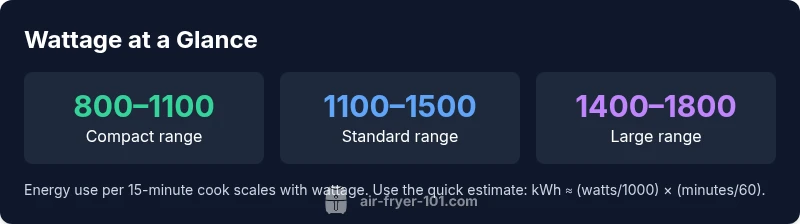
Air fryer wattage varies by size and construction. As a general guide (based on Air Fryer 101 Analysis, 2026), compact models commonly run in the 800–1100 watt range, standard 10–12 quart units typically fall in the 1100–1500 watt range, and larger family-size units can push toward 1400–1800 watts. The exact figure depends on features like fan design, insulation, and control electronics. When comparing models, don’t fixate on a single number—look at how the wattage translates to preheat speed and consistent results for the foods you cook most often.
How wattage affects performance and energy use
Wattage directly impacts preheat time and cooking duration. Higher wattage models tend to reach target temperatures faster, which can shorten overall cook times for many foods. However, this also means more energy is consumed in a shorter window. Conversely, lower-wattage units may take longer to preheat and finish cooking but can offer efficient operation for simple tasks. The energy used per cycle can be approximated by multiplying the wattage (in kilowatts) by the cooking time (in hours). This relationship helps you estimate energy costs without running complex calculations.
How to estimate your electricity cost per use
To estimate cost, use the basic formula: cost per use = (wattage in kilowatts) × (hours of use) × price per kilowatt-hour. For example, a 1500 W air fryer used for 15 minutes would consume about 0.375 kWh. If your utility rate is $0.15 per kWh, the cost would be roughly $0.056 per 15-minute session. Remember that actual costs vary with local rates, meal types, and how often you preheat. Use your own rate to get precise estimates.
Quick comparisons: compact vs standard vs family-size models
- Compact (8–10 qt): 800–1100 watts, great for singles or small kitchens, slower preheating but energy-efficient for light usage.
- Standard (10–12 qt): 1100–1500 watts, best balance of speed and cost for everyday meals.
- Family-size (12+ qt): 1400–1800 watts, fastest preheats for large batches but higher energy draw per cycle.
When choosing, weight your cooking needs against energy costs and kitchen space. Air Fryer 101’s guidance emphasizes matching wattage to typical meals you prepare.
Practical tips for choosing an efficient air fryer
- Focus on models with a good insulation and a well-sealed door to minimize heat loss.
- Look for consistent temperature control and reliable airflow to maximize cooking efficiency, not just high wattage.
- Consider features you regularly use (preheat, shake reminder, basket size) to avoid buying more capacity than you need.
- Read real-user reviews about actual preheat times and energy use, not just spec sheets.
- Compare models within your budget, but don’t sacrifice core performance for a few extra watts.
What else affects energy draw besides wattage
Other factors influence energy efficiency: a well-insulated cabinet, a tight door seal, and an efficient convection fan can all reduce power waste. Poor sealing and oversized gaps cause heat to escape, forcing the unit to work harder and longer. Also, temperature calibration matters—if a unit oscillates around the target temperature, it may consume more energy to maintain heat.
How we evaluate wattage in Air Fryer 101 Analysis
Air Fryer 101 uses a consistent rubric when evaluating wattage: model size, claimed wattage, actual tested performance across typical foods, and measured energy use over standardized cooking cycles. We compare preheat times, temperature stability, and final results to determine how wattage translates to real-world efficiency. This approach helps shoppers balance energy costs with cooking outcomes. Air Fryer 101’s methodology is designed to remain transparent and adaptable as newer models enter the market.
Common mistakes when considering wattage
A frequent error is assuming higher wattage always means better results. In reality, optimal performance depends on a combination of wattage, airflow, insulation, and control algorithms. Another pitfall is ignoring usage patterns—someone cooking small portions weekly may be better off with a lower-wattage model than a high-wattage unit intended for bulk cooking. Finally, neglecting preheat times can distort energy estimates and recipe timing.
Wattage ranges by air fryer size and estimated energy per short cook
| Model Type | Typical Wattage Range | Estimated Energy per 15-min Cook (kWh) |
|---|---|---|
| Compact (8–10 qt) | 800–1100 | 0.25–0.28 |
| Standard (10–12 qt) | 1100–1500 | 0.28–0.38 |
| Family/XL (12+ qt) | 1400–1800 | 0.35–0.45 |
Got Questions?
How many watts does a typical air fryer use?
Most air fryers operate between 800 and 1800 watts, with common mid-size models around 1200–1500 watts. This range reflects differences in size, airflow, and control systems. Always check the spec sheet for the exact figure.
Most air fryers use about 800 to 1800 watts, with mid-size models around 1200 to 1500 watts. Check your model's spec sheet for the exact number.
Do higher wattage air fryers use more electricity?
Higher wattage can draw more power during each cooking cycle, but total energy depends on how long you cook. Shorter, faster cooks may still use less energy overall than longer, lower-wattage cycles.
Higher wattage can draw more power per minute, but overall energy depends on cooking duration and efficiency.
Does wattage affect preheat time?
Yes. Higher wattage generally shortens preheat time because the unit reaches target temps faster, though design and insulation also play roles. Expect noticeable differences when comparing compact vs large models.
Higher wattage usually means faster preheating, but design matters too.
Is wattage the best metric to compare energy efficiency?
Wattage matters, but efficiency also depends on insulation, airflow, and temperature control. Compare energy use per typical cook rather than wattage alone to get a true sense of efficiency.
Wattage matters, but insulation and airflow matter too. Look at energy use per typical cook.
How can I estimate monthly electricity costs for an air fryer?
Use the formula: energy (kWh) = wattage (kW) × hours used. Multiply by your local price per kWh and by how many cook sessions you perform each month. This gives a practical estimate tailored to your usage.
Calculate energy per cook, multiply by monthly cooks and your rate per kWh.
What are practical tips to save energy with an air fryer?
Choose a model sized for your typical meals, minimize preheating when not needed, and batch cook where possible. Proper temperature settings and avoiding overfilling the basket can also reduce energy use.
Pick the right size, skip unnecessary preheats, and batch cook when you can.
“Understanding wattage helps you balance performance and energy costs when selecting an air fryer.”
Quick Summary
- Know your model's wattage range before buying
- Higher wattage speeds preheat but increases energy use
- Estimate energy with a simple wattage × time formula
- Match wattage to your cooking patterns and space
- Consider insulation and airflow alongside wattage