Cooking Times for Air Fryer: A 2026 Guide
Learn cooking times for air fryers by food type, size, and crispness. This Air Fryer 101 guide covers typical ranges, timing tips, and how to calibrate for different models.


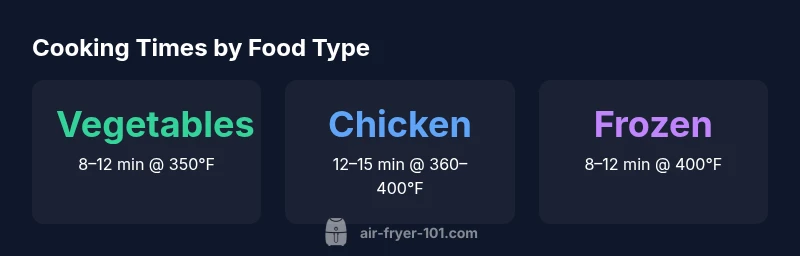
According to Air Fryer 101, cooking times for air fryers depend on food type, thickness, and desired crispness. As a rule of thumb, most vegetables take 8–12 minutes at 350°F, chicken bites 12–15 minutes at 360–400°F, and frozen foods 8–12 minutes at 400°F. Shake halfway for even browning and check for doneness.
Understanding the Basis of Cooking Times
Cooking times for air fryers are governed by a combination of physics and food science. The primary drivers are heat transfer efficiency, moisture content, fat content, and surface area. The convection fan cycles hot air to create a crisp exterior while preserving moisture inside. Different models (basket vs. tray) and the presence or absence of preheating can shift times by a few minutes. For home cooks, it helps to view cooking times for air fryer as starting points rather than fixed rules. By tracking outcomes and adjusting, you can converge on a reliable, repeatable process that yields consistent texture and doneness. In practice, the goal is a balanced outcome: a crisp outer layer with a juicy interior, achieved without overcooking.
How Food Type and Size Change Timing
The type and size of the food dramatically influence cook times. High-water-content vegetables (e.g., broccoli, zucchini) cook quickly, while dense proteins (e.g., chicken breast) take longer. Uniform piece size matters too: uniformly cut items cook more evenly, reducing the need for guesswork. If you’re cooking multiple items together, grouping by similar cook times helps maintain consistency. When assessing cooking times for air fryer results, consider the texture you want (crisp vs. tender) and adjust the time in small increments. Remember, time is a guide, not a guarantee, especially when you change brands or batch sizes.
Building a Personal Time Chart
A practical approach is to build a personal time chart for your specific air fryer model. Start with a baseline time at a chosen temperature for each category (vegetables, proteins, starches). Then adjust for thickness, volume, and basket capacity. Use batch notes to capture what worked: exact temperature, total time, flips, and whether preheating was used. After three trials per item, you’ll begin to see patterns that let you reproduce results with confidence. A well-kept chart also reduces the guesswork during busy weeknights.
Common Food Categories: Vegetables, Proteins, and Carbs
Vegetables usually finish quickly: many fall into the 8–12 minute range at moderate temperatures (around 350°F). Proteins require a careful balance of time and temperature to avoid dryness, with chicken commonly ranging 12–15 minutes in the 360–400°F band. Potatoes and other starches typically land in the 12–15 minute range, depending on cut size. Frozen foods vary but often respond well to 8–12 minutes at higher settings (around 400°F). Having a flexible framework helps you tailor times to your preferences and the exact oil or seasoning used.
Food-Specific Time Framework: Vegetables
For vegetables, start with even cuts and a moderate temperature, then rotate halfway through. Common targets include broccoli florets and cauliflower florets in the 8–10 minute range, bell pepper slices in the 8–12 minute range, and asparagus spears at 6–9 minutes. Leafy greens and delicate vegetables may require shorter times to prevent wilting. Use a single layer whenever possible, as crowding slows heat transfer and can lead to uneven browning. Adjust times by texture preference and moisture content of the produce.
Proteins: Chicken, Beef, and Fish
Proteins demand closer attention to safety and texture. Chicken generally aims for 165°F (74°C) internal temperature, reached in about 12–15 minutes for bite-sized pieces at 360–400°F. Fish cooks quickly, often in the 8–12 minute window at 350–400°F, depending on thickness. Beef and pork can vary by cut and desired doneness, but a 125–145°F range for medium-rare to medium is common for thin slices, with thinner pieces cooking faster. Always verify doneness with a reliable thermometer and adjust based on your appliance’s performance.
Frozen Foods and Reheating Times
Frozen items such as mozzarella sticks, chicken nuggets, and french fries typically require 8–12 minutes at 400°F. Reheating leftovers reuses the same logic: start with shorter times, then extend in 1–2 minute increments until you regain the original texture. Package directions are a good starting point, but your unit and batch size will determine the final timing. Keeping items in a single layer prevents overcrowding and improves uniform browning.
Practical Tips for Consistency
- Preheat when your model recommends it and you’re aiming for fast, even browning.
- Shake or flip items halfway to promote even texture.
- Use a light spray of oil for foods that benefit from browning without excess fat.
- Start with lower end times and add minutes in small increments, especially for dense items.
- Keep a cooking-time journal to track outcomes across foods and batch sizes.
Typical air fryer cooking times by food type
| Food Type | Common Time Range | Temp (°F) | Notes |
|---|---|---|---|
| Vegetables (mixed) | 8–12 | 350 | Stir halfway for even browning |
| Chicken bites | 12–15 | 360–400 | Check internal temp 165°F |
| Potatoes/fries | 12–15 | 375 | Shake tray halfway |
| Frozen snacks | 8–12 | 400 | Follow package guidance |
Got Questions?
What are typical cooking times for common foods in an air fryer?
Times vary by food, but common ranges include vegetables 8–12 minutes, chicken 12–15, potatoes 12–15, and frozen snacks 8–12 at standard temps. Use these as starting points and adjust.
Times depend on the food; start with the ranges above and tweak based on texture.
Should I preheat my air fryer for cooking times?
Preheating helps achieve consistent browning and shorter overall cook times. If your model requires it, preheat for 2–3 minutes before adding food.
Yes, preheat for best results when your unit supports it.
Do air fryer times vary by brand or model?
Yes, different models have different heat distribution. Start with the manufacturer’s guidance and calibrate using your own trials for your unit.
Expect small adjustments per model.
Can I cook multiple items at once in an air fryer?
Crowding slows heat transfer. When possible, arrange items in a single layer and expect a slight time increase; flip or shake more often.
Yes, but avoid overcrowding.
What is the safe internal temperature for chicken cooked in an air fryer?
Chicken should reach 165°F (74°C) internal temperature to be considered safe to eat.
Cook to 165°F.
Is there a universal time for all foods?
No universal cook time exists. Use food-type guidelines and adjust for size, fat, and desired crispness.
There isn’t a universal time.
“Cooking times are guidelines that you tune to your air fryer and the size of your ingredients. With careful calibration, you can consistently achieve crisp textures without overcooking.”
Quick Summary
- Start with baseline times by food type.
- Shake or flip halfway for even browning.
- Calibrate times for basket vs tray models and your texture preference.
- Always verify doneness with a thermometer for safety.
- Build a personal time chart to improve consistency over time.