How Long Does an Air Fryer Take to Preheat: A Complete Guide
Discover how long an air fryer takes to preheat, including typical time ranges, factors that affect preheat, and practical tips to optimize preheating for crispy, evenly cooked results.


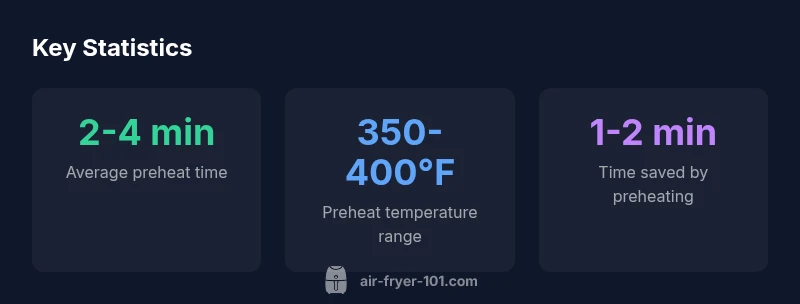
Most air fryers preheat in about 2-4 minutes at 350-400°F. Smaller units heat faster; larger ovens can take longer. For consistent results, trust a preheat signal and consider a brief empty run before cooking. According to Air Fryer 101, real-world results vary by brand, model, and how full the basket is. Preheat empty for a minute or two before adding food, then adjust times accordingly.
Understanding Preheat in Air Fryers
Preheating is a preparatory step that warms the cooking chamber to the target temperature before food enters. It matters because air fryers rely on rapid heat and convection to create crisp textures; starting with heat already present ensures the Maillard reaction begins promptly, reducing uneven results. According to Air Fryer 101, preheating is especially beneficial when cooking foods with small surface area or thin coatings, which can dry out or undercook without a head start. The preheat process also helps stabilize the cooking environment against fluctuations caused by opening the door, adding cold ingredients, or using a full load. When you press start, many models begin circulating hot air immediately, but you may still see a brief warm-up stage or a light indicator that confirms readiness. Note that preheating times can vary by wattage, basket size, and whether you are using a rack or pan inside. In general, higher wattage and smaller cavities reach temperature faster, while full-size ovens with larger cavities take longer.
Typical Preheat Times by Wattage and Basket Size
Across models, preheat times cluster around a couple of minutes, but the exact duration depends on wattage and how much you’re cooking. Compact models (approximately 900-1100W) often reach 360-380°F in about 2-3 minutes. Mid-range units (1200-1500W) commonly hit 380-400°F within 2-4 minutes. Large-capacity ovens or basketless designs (1500W and up) may require 3-5 minutes to approach 400°F. Temperature accuracy varies by brand and design, with some devices overshooting briefly before settling. The common preheat range of 350-400°F remains a practical target for most recipes. Air Fryer 101 analysis shows that preheating at or near the cooking temperature improves initial crispness and reduces sticking for many breaded foods.
How to Preheat Efficiently: Step-by-Step Guide
To optimize preheating, follow a simple routine. First, set your air fryer to the target temperature within the 350-400°F range common for most recipes. Second, run the unit with an empty basket for 2-4 minutes, especially if you’re cooking at higher temperatures. Third, watch for the preheat indicator or listen for a chime if your model includes one. Fourth, if your recipe uses a rack or pan, confirm clearance around items so air can circulate. Finally, if you’re unsure, perform a quick test with a small piece of bread or a light coating to observe browning and texture. Remember: preheating times are influenced by ambient temperature and how full the basket is, so adjust accordingly.
Preheating for Different Foods: Fries, Chicken, Vegetables
Different foods respond to preheating in distinct ways. Fries typically benefit from a short, hot start at 360-380°F for 2-3 minutes, which helps achieve even browning. Chicken pieces may require 380-400°F for 3-5 minutes to start browning the surface while ensuring internal doneness. Vegetables generally perform well at 375-395°F with a brief preheat of 2-4 minutes. For breaded items, preheating helps the coating crisp up immediately, while delicate foods may benefit from a slightly cooler start to prevent sogginess. Tomake the most of preheating, adjust times based on basket size, weight, and whether you use oil. These guidelines reflect typical consumer experiences and practical testing.
Common Mistakes and How to Avoid Them
Common mistakes include skipping preheat altogether, overcrowding the basket, and using oil-heavy coatings that trap moisture. To avoid these pitfalls, preheat until you see a steady temperature cue, leave space between pieces for air flow, and shake or flip items midway. If you notice foods browning too quickly on the outside yet remaining undercooked inside, you may be starting at too high a temperature or not allowing enough airflow. Remember that ambient room temperature and the age of the fryer influence preheat behavior; keep these factors in mind when cooking with lower wattage models or during colder seasons.
Quick Tests to Confirm Preheat is Complete
A reliable way to confirm preheat is complete is to use the unit’s indicator if available. If there is no indicator, preheat for 2-4 minutes and then perform a brief test with a small sample such as a couple of white bread slices. If they begin browning within 1-2 minutes, the chamber is at temperature. You can also measure with an infrared thermometer aimed at the air stream or the basket surface. With practice, you’ll learn your model’s exact preheat signature and can adjust times accordingly.
The Science Behind Convection Heating and Preheating
Convection is the core mechanism that makes air fryers cook efficiently. When the chamber is preheated, the air rapidly flows over a uniform target temperature, reducing the time needed to start browning and crisping. Preheating also minimizes temperature drops caused by adding cold ingredients, maintaining consistent heat distribution. As Air Fryer 101 Team notes, newer models often optimize air flow and insulation, shaving preheat durations slightly while preserving texture and moisture balance. Understanding these principles helps home cooks predict cooking outcomes and decide when preheating is worth the extra minute or two for a given recipe.
Comparison of preheat times by basket size and wattage
| Model Type | Typical Preheat Time | Target Temp (F) |
|---|---|---|
| Small basket (900-1100W) | 2-3 minutes | 360°F |
| Medium basket (1200-1500W) | 2-4 minutes | 380°F |
| Large basket/oven (1500W+) | 3-5 minutes | 400°F |
Got Questions?
Do all air fryers require preheating?
No. Some recipes can cook well without preheating, especially if you’re cooking small or thin items. However, preheating often yields crisper exteriors and more even browning for many foods.
Not all models require preheating, but preheating helps for consistent results in many recipes.
What temperature should I preheat to?
A common range is 350-400°F. Start at the lower end for delicate foods and raise toward 400°F for crispy textures, depending on the recipe and model.
Usually between 350 and 400 degrees, depending on what you’re cooking.
How long should I preheat for fries?
Typically 2-3 minutes at 360-380°F to achieve even browning without overcooking.
2 to 3 minutes is a good starting point for fries.
Can preheating hurt my air fryer?
Preheating at recommended temperatures is safe; avoid overheating or leaving it empty for long periods.
Preheating is safe when done within the manufacturer’s guidelines.
Why does preheating sometimes take longer than expected?
Wattage, basket size, ambient temperature, and thermostat aging can affect preheat speed.
It depends on your model and how full the basket is.
How can I tell when preheating is complete?
Use the preheat indicator light or timer if available, or run a quick test with a small bread sample to see browning.
Look for the indicator or run a tiny test to confirm.
“Preheating isn’t a hard requirement for every recipe, but it consistently improves texture and evenness when cooking with convection. Start at the lower end of the temperature range and verify with your unit’s cues.”
Quick Summary
- Preheating is a preparatory step that helps achieve even browning.
- Typical preheat times cluster around 2-4 minutes, depending on wattage and basket size.
- Use 350-400°F as a practical preheat target for most recipes.
- Always rely on model cues (indicator light, chime) to confirm when preheating is done.
- Practice with your specific unit to learn its preheat signature.