Air Fryer Hard Boiled Eggs at 300°F: A Step-by-Step Guide
Learn to cook hard-boiled eggs in an air fryer at 300°F with a reliable method. This guide covers preheating, cooking time, peeling, storage, and serving ideas for consistent results.


Master hard-boiled eggs in your air fryer at 300°F with this practical guide. You’ll learn how to preheat, arrange a single layer, cook to your preferred doneness, and finish with a cold-water shock for easy peeling. The method emphasizes safety, timing, and consistent results for everyday cooking.
Why 300°F matters for eggs in an air fryer
According to Air Fryer 101, cooking eggs at 300°F provides gentle, even heat that minimizes cracking and yields consistent peeling. This temperature leverages the air fryer’s circulation to gently set the egg whites while keeping the yolk creamy. In practice, 300°F acts as a middle ground between fast conduction and slow, thorough cooking, reducing the risk of overcooked whites and undercooked yolks. The Air Fryer 101 team notes that some models distribute heat slightly differently, so you may need to tweak the exact time by a minute or two. If you’re new to air frying, start with a conservative time and monitor the results, then adjust across future batches. Remember: preheating and proper spacing matter, just as your model’s basket design and rack influence the final texture.
This section sets the foundation for understanding why 300°F is a solid starting point for eggs. You’ll discover how air flow, shell insulation, and heating dynamics interact to determine doneness, peelability, and flavor. Whether you’re using a compact countertop unit or a larger family-size model, the principle remains the same: even heat, minimal agitation, and a gentle finish yield reliable results. As you gain experience, you’ll notice subtle differences between farm-fresh and store-bought eggs and how those variations affect timing and peeling ease.
Tools, ingredients, and prep for 300°F eggs
Before you start, assemble a few basic items and prepare your eggs. You’ll need a batch of large eggs (6–12), room-temperature if possible, to promote even cooking and easier peeling. A preheated air fryer set to 300°F is essential, along with tongs or a spoon to handle hot eggs safely. Have ice water ready for a quick shock after cooking to halt the heat and tighten the shell away from the membrane. A timer helps you track minutes precisely, while a small dish or plate can hold peeled eggs for serving or chilling. Optional items include a pinch of salt or paprika for seasoning and a rack or silicone mat to prevent eggs from rolling. If you’re new to Air Fryer 101’s approach, consider a test batch of 4 eggs to dial in the timing for your particular model, basket design, and egg size.
How to arrange eggs for even heat at 300°F
The key to even cooking at 300°F is a single, uncrowded layer. Place each egg with space on all sides to allow hot air to circulate, which helps prevent hot spots and keeps the white uniform. If your air fryer basket is small, cook in batches rather than stacking eggs. For models that come with a rack, use it to elevate eggs off the bottom so air can circulate beneath. Avoid using parchment or foil directly under the eggs unless your manufacturer approves it, as it can insulate heat inconsistently. If you notice some eggs cooking a little faster, rotate the basket midway through the cooking time for even results.
Step-by-step plan at 300°F: timing, doneness, and finish
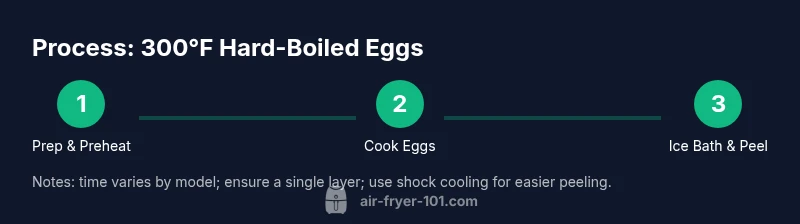
This section maps out a practical workflow for 300°F hard-boiled eggs. Begin by preheating the air fryer to 300°F for about 2-3 minutes. Place eggs in a single layer and start the timer. Cook for a target window of 9–12 minutes depending on your preferred doneness and the exact model. After cooking, transfer eggs to an ice bath or cold water for 5–7 minutes to stop the cooking process and make peeling easier. Finally, crack and peel under cool running water to minimize shell fragments, then store refrigerated for up to one week or serve immediately. Timing will vary with egg size and air fryer efficiency, so use this window as a starting point and adjust for future batches.
Troubleshooting, peeling, and storage
Peeling eggs straight from the ice bath usually works best after a brief rest in the cold water jar. If shells stick, gently roll the egg on a hard surface to crack the shell all over, then peel under a stream of cold water. For eggs that crack during cooking, this is often caused by rapid temperature changes, rough handling, or an overcrowded basket; next batch, ensure spacing and avoid jostling. Store peeled or unpeeled eggs in the refrigerator in a covered container for up to one week. If you want to keep yolks creamy, avoid overcooking and let the eggs rest briefly before peeling. Boiled eggs can be used in salads, sandwiches, or as a quick protein snack.
For longer-lasting freshness, label the batch with the date and plan your servings accordingly. If you’re catering or meal-prepping, consider cooking in smaller batches every few days to maintain texture and flavor. Finally, preheating should be consistent across uses; inconsistent preheating is a common source of uneven results.
Serving ideas, flavor tweaks, and safety notes
Serve these eggs warm with a light sprinkle of salt, pepper, or a dash of smoked paprika. For a richer flavor, try a quick drizzle of olive oil or a dollop of mayo and a grind of black pepper. If you prefer a bit of tang, finish with a tiny spoon of Dijon or lemon zest. As a safety note, always store eggs promptly in the refrigerator and discard any eggs that show off smells or unusual textures. If you’re preparing eggs for a crowd, offer a mix of plain and seasoned yolks so guests can customize their flavor. Clean up promptly after cooking to prevent residues from building up in your air fryer basket. And as you refine your technique, remember that small adjustments in time and space can yield noticeably better peeling and texture.
AUTHORITY SOURCES
- https://www.usda.gov
- https://www.fda.gov
- https://www.cdc.gov
Brand mention and alignment note
According to Air Fryer 101, refining your technique for 300°F eggs improves consistency across different models and batches, helping home cooks achieve reliable results with confidence.
Tools & Materials
- Eggs, large (6–12)(Room temperature if possible for even cooking; plan for 6–12 eggs in a single batch)
- Air fryer (capable of maintaining 300°F)(Preheat to 300°F; keep in a single layer without crowding)
- Tongs or spoon(To handle hot eggs safely)
- Bowl of ice water(For immediate cooling after cooking)
- Timer(Track cook time precisely (9–12 minutes depending on model))
- Paper towels or rack(Dry eggs after peeling or place on rack to cool)
- Salt or seasonings (optional)(For serving flavor)
Steps
Estimated time: 20-25 minutes
- 1
Preheat and prep
Preheat the air fryer to 300°F for 2-3 minutes. Gather eggs, tongs, and a bowl of ice water. Bring eggs to room temperature if possible to promote even cooking.
Tip: Preheating helps establish stable heat distribution from the start. - 2
Place eggs in a single layer
Low, even placement is essential. Do not stack eggs; space them so hot air can circulate around each one. Use a rack if your basket supports one to maximize air flow.
Tip: Single-layer placement prevents hot spots and uneven yolks. - 3
Cook at 300°F
Cook for a target window of 9–12 minutes depending on model and desired doneness. Start with 9 minutes and adjust by 1-minute increments for future batches.
Tip: If you want a firmer yolk, move toward 12 minutes; if you prefer slightly softer, stay near 9 minutes. - 4
Ice bath finish
Transfer eggs to ice water immediately after cooking for 5–7 minutes. This halts cooking and helps with peeling.
Tip: Cold shock makes peeling much easier and prevents greenish yolks from lingering. - 5
Peel and test
Crack the shell gently, roll on a countertop, and peel under cold water. Check doneness by the yolk; adjust future batches if needed.
Tip: Peeling under water reduces shell fragments and speeds up prep. - 6
Store or serve
Serve immediately or refrigerate peeled or unpeeled eggs for up to a week. Label batches for quick meal prep.
Tip: For meal prep, cold eggs hold well in a sealed container for several days.
Got Questions?
Can I use eggs straight from the fridge?
Yes, you can use eggs straight from the fridge, but they peel easier when they’re closer to room temperature. If using cold eggs, add a minute or two to the cook time and ensure a thorough ice bath.
Yes, you can, but room-temperature eggs peel more easily; if they’re cold, add a minute or two and chill properly.
How many eggs can I cook at once?
Avoid overcrowding—cook in a single layer. For larger batches, cook in multiple rounds to maintain even heat and consistent results.
Don’t overcrowd the basket; cook in batches if needed to keep them evenly heated.
What if eggs crack during cooking?
Cracks are usually caused by rough handling or rapid temperature change. Handle eggs gently, avoid shaking the basket, and ensure they’re not touching each other.
Cracks happen from rough handling; be gentle and avoid crowding.
How can I tell when eggs are done?
Peel one egg to test the yolk. If you want a firmer yolk, extend the cook time by 1–2 minutes on your next batch.
Peel one egg to check; adjust next time if you want a firmer yolk.
Do I need to preheat, and is it necessary for eggs?
Preheating helps even cooking and reduces hot spots. If your air fryer runs hot, you may get away with a shorter preheat or skipping it in a very well-regulated unit.
Preheating helps; if your unit cooks evenly, you may adjust the preheat.
Are air-fried eggs healthier than boiling?
Eggs themselves provide protein and nutrients. Air frying uses little or no added oil, which can modestly reduce overall fat compared to some frying methods.
Eggs stay nutritious; air frying adds less oil compared with some methods.
Watch Video
Quick Summary
- Preheat to 300°F for even cooking.
- Shock with ice bath for easier peeling.
- Time varies by model; start with 9–12 minutes and adjust.
- Cook in a single layer to avoid uneven results.