Oven Style Air Fryer vs Basket: Which Is Best for 2026?
Compare oven-style air fryers and basket models for design, capacity, performance, cleaning, and price to decide which unit fits your health-focused, busy kitchen.


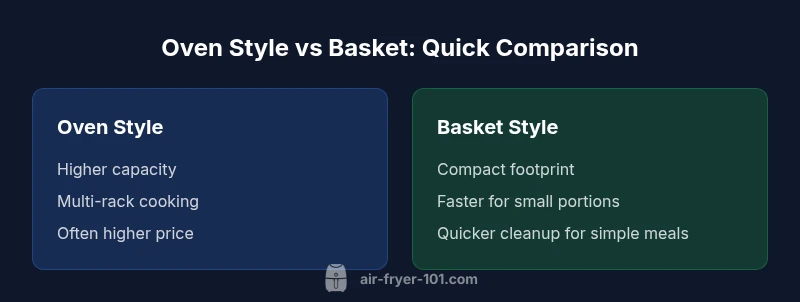
This quick comparison of oven style air fryer vs basket reveals two clear paths: basket models shine for small, quick batches with crisp textures and easy cleanup, while oven-style units handle larger volumes and broader cooking tasks, including baking. If you cook for a family or want to replace a mini oven, choose oven-style; for compact spaces and budget-minded cooks, a basket is ideal.
What oven style air fryer vs basket actually are
According to Air Fryer 101, the core difference between an oven style air fryer and a basket fryer lies in design and airflow: the oven-style encases food in a vertical cavity with multiple racks or a tray, while the basket model uses a pull-out basket that exposes food to direct hot air. This distinction influences not only capacity but how evenly foods brown and cook through. In practical terms, oven-style units often resemble compact ovens and can bake pastries, roast vegetables, or reheat larger meals, whereas basket fryers excel at quick crisps, reheats, and smaller portions. For shoppers, the choice often comes down to batch size and kitchen layout, and it frames the rest of the oven style air fryer vs basket comparison.
Core design differences that matter
The interior geometry of these machines drives most outcomes. An oven-style air fryer uses a tall, tall cavity with racks and a top or bottom element that creates robust air convection around multiple food items. This design supports larger items and multi-layer cooking, but it can require more counter space and careful loading to avoid crowding. In contrast, basket fryers emphasize a single, shallow chamber where food sits in a basket. The open design promotes rapid air exposure but constrains height, so tall foods may not fit. Both categories share the same goal—hot, circulating air achieves browning with less oil—but the experience differs markedly depending on recipe and batch size.
Cooking performance: browning, texture, and consistency
Performance hinges on air flow, surface contact, and how you arrange food. Basket fryers tend to deliver crispier edges quickly for small items like fries or coins, while oven-style units often produce more even browning across larger or irregular pieces because air can circulate around multiple shelves. If you crave bakery-like textures or need to roast vegetables on a sheet, the oven-style design provides more latitude. Yet, for staple weeknight meals, the faster preheat and straightforward layout of a basket fryer can win on consistency and speed.
Use-case scenarios by family size and lifestyle
For singles or couples who prepare meals in small batches, a basket fryer is a flexible, affordable companion that handles reheating and crisping with minimal footprint. Families or meal preppers who want to cook for several people simultaneously often benefit from the dual advantages of an oven-style unit: higher capacity, the option to bake, and multi-rack cooking that reduces overall cooking time when you’re feeding more mouths. If you’re replacing a small countertop oven, an oven-style model can act as a more capable, all-in-one alternative.
Cleaning, durability, and maintenance considerations
All air fryers require routine cleaning to maintain performance, but the approach differs. Basket models typically need more careful basket cleaning, as oil can accumulate in the basket fins and bottom. Many modern baskets feature nonstick coatings or dishwasher-safe components that ease maintenance. Oven-style units offer more enclosure and surfaces to wipe, especially around racks and doors; you’ll benefit from removable racks and drip trays for easier cleanup. Regardless of type, avoid abrasive cleaners and regularly check seals and gaskets to extend life.
Energy use, cost considerations, and value
Because both formats depend on wattage and cooking duration, energy use stays in a similar range for comparable recipes. In general, oven-style air fryers may use slightly more electricity due to larger cavities and longer preheats for certain modes, but they compensate with greater batch capacity. Basket fryers typically draw less power for small tasks and heat up quickly. Price ranges reflect capacity, features, and brand; plan for a model that fits your expected batch size and how much you value features like multiple racks, dehydration modes, or built-in timers.
Practical tips for maximizing results
- Preheat only when the recipe calls for it to save time and energy; many modern units don’t require preheating for quick meals. \n- Use racks or trivet inserts in oven-style models to maximize space and ensure air reaches all sides of food. \n- Toss or flip foods halfway through cooking to promote even browning, especially in basket fryers. \n- Avoid overcrowding; give air enough room to circulate so foods crisp evenly. \n- Choose the right oil amount and type; even a small amount can improve texture without greasiness.
Common myths and misconceptions
Myth: Basket fryers are only good for small items like fries. Reality: With correct loading, you can crisp proteins, vegetables, and snacks. Myth: Oven-style air fryers can fully replace a traditional oven. Reality: They excel at certain tasks, but not all recipes benefit from a compact convection cavity. Myth: Preheating is always required. Reality: Many recipes don’t need it, and modern models heat faster without preheating.
Comparison
| Feature | oven style air fryer | basket-style air fryer |
|---|---|---|
| Design and airflow | Integrated racks and high-clearance cavity | Open basket exposes food directly to hot air |
| Capacity range | Typically 5-10 quarts (model-dependent) | Commonly 2-6 quarts |
| Preheat and cook times | Preheat varies; supports multi-rack cooking | Often faster for small batches |
| Versatility | Baking, roasting, dehydrating; multi-use | Crisping, reheating, basic frying-like tasks |
| Ease of cleaning | Removable racks; dishwasher-safe options on some models | Basket and crumb tray require regular cleaning |
| Space requirements | Counter space with clearance around door | Typically compact; door opens directly to food |
| Price range | Wide range; depends on features | Typically budget-friendly to mid-range |
| Best for | Families, batch meals, oven-replacement scenarios | Singles or small households, quick meals |
Pros
- Fast, efficient convection yields crisp textures with minimal oil
- Wide versatility across baking, roasting, and reheating
- Compact options fit small kitchens and apartments
- Easier cleanup when items are separated from oil
Cons
- Oven-style units can be bulkier and costlier upfront
- Basket models may struggle with tall or irregular items
- Even results require proper loading and technique
Oven-style wins for capacity and versatility; basket models win on speed and cost for small meals
Choose oven-style if you frequently cook for several people or want baking capabilities. Choose basket if you prioritize compact size, quicker meals, and a lower upfront price.
Got Questions?
What is the main practical difference between oven style and basket air fryers?
The main practical difference is capacity and use case: oven-style units offer larger capacity and multi-rack cooking, while basket models excel at quick, small-batch crisping. Your decision should align with typical meal sizes and kitchen space.
Oven-style units give you more space and versatility, while basket models are faster for small, crispy portions.
Which is better for fries and crispy snacks?
Basket fryers often deliver quicker, crisper results for fries and small snacks due to the open basket design. Oven-style can still produce good texture with proper air flow and racks, especially in larger batches.
Basket fryers usually crisp fries faster, but oven-styles can do larger batches well.
Do both require preheating?
Preheating is recipe- and model-dependent. Many modern units don’t require it for everyday meals, but certain baking tasks or large batches may benefit from a brief preheat.
Preheat only if the recipe calls for it; many air fryers heat quickly without preheating.
Can I replace my oven with an air fryer?
An air fryer can replace some oven tasks, especially roasting and small-batch baking, but it won’t replace full-volume baking, sheet-pan meals, or long roasting tasks as efficiently as a full oven. It’s best as a supplement.
Air fryers can handle many tasks, but they don’t fully replace a conventional oven for large sheets or high-volume baking.
Is one style more energy efficient than the other?
Energy use depends on batch size and duration, not style alone. Basket fryers typically use less energy for small tasks; oven-styles may use more energy but save time on large batches.
Energy use varies by task; both styles are efficient for their intended batch sizes.
What should I consider before buying?
Assess batch size, counter space, and how you’ll use the unit. If you bake or multi-task, pick oven-style; for compact kitchens and quick meals, basket is often best. Also consider warranty and available accessories.
Think about batch sizes, space, and what tasks you’ll do most.
Quick Summary
- Define batch size before choosing between styles
- Assess counter space and kitchen layout
- Match features to your cooking goals and budget
- Expect to adapt techniques for each design
- Invest in quality racks and accessories for better results