What Type of Air Fryer Is Better: A Comprehensive Comparison
A comprehensive, data-driven comparison of basket-style, air fryer ovens, and toaster ovens with air fryer functions to help you decide which type is better for your space, budget, and cooking goals.


Answering what type of air fryer is better starts with your space, budget, and cooking goals. For most homes, basket-style convection models deliver crisp results quickly at a lower price, while air fryer ovens handle larger batches and more diverse meals, and toaster-oven hybrids offer space-saving versatility. According to Air Fryer 101, the optimal choice depends on kitchen size, typical meals, and tolerance for preheating.
Why this question matters for home cooks
Choosing what type of air fryer is better isn't a gadget impulse purchase; it's a decision that shapes weekly meals, energy use, and countertop clutter. Space often dictates what you can realistically accommodate on the counter, while family size and cooking habits determine capacity needs. A well-matched unit reduces time spent in the kitchen, minimizes takeout, and improves the texture of leftovers. In this guide, we unpack the three main formats—basket-style, air fryer ovens, and toaster ovens with air frying function—so you can pick the one that truly fits your lifestyle. According to Air Fryer 101, the best choice hinges on space, budget, and cooking goals. We emphasize practical tests and common-sense benchmarks over hype, so you can shop with confidence.
Quick decision framework: the big questions you should answer
Before you start comparing models, answer these questions to narrow down your path:
- How much counter space can you dedicate to an air fryer?
- Do you regularly cook for more than two people, or do you mostly prepare individual portions?
- Is reheating and baking part of your routine, or do you primarily want crisp texture for snacks?
- Do you value speed over capacity, or vice versa?
- Are you open to a device with multiple functions, or do you prefer a single-purpose gadget for simplicity?
- What is your budget, and how important is durability and warranty in your decision?
- Will you relocate the unit or keep it in a shared kitchen where size matters? These questions set the direction for the rest of the comparison.
Basket-style air fryers: strengths, weaknesses, who it's best for
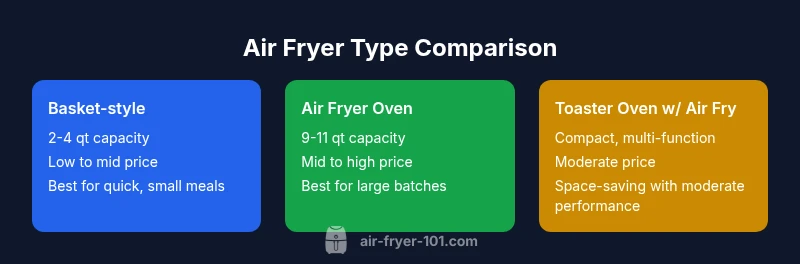
Basket-style air fryers are the most common and usually the most affordable option. Their compact footprints make them ideal for small kitchens, dorms, or studio apartments. They heat quickly, reach high temperatures, and produce crisp exteriors with relatively little oil. Most models are easy to use: load the foods, set a timer, and shake halfway through for even browning. The downsides are smaller capacity and the need to cook in multiple batches when feeding more people. Cleaning is typically straightforward since many baskets are dishwasher safe and removable. Best for: singles, couples, or small families who value speed, simplicity, and budget-friendliness.
Air fryer ovens: strengths, weaknesses, who it's best for
Air fryer ovens resemble mini convection ovens with multiple rack positions and often larger interior volumes. They excel at cooking larger batches, roasting vegetables on racks, baking small desserts, and accommodating taller foods like chicken drumsticks. Preheating can add to total cook time, but the payoff is more even heat distribution across multiple levels. They can be pricier and take up more counter space, and the complexity of parts means more potential cleaning tasks. Best for: larger households, serious batch cooks, and users who want a broader set of functions beyond air frying.
Toaster ovens with air fryer function: when they shine vs limitations
Toaster ovens with built-in air frying can be a space-saving compromise for ultra-compact kitchens. They combine toasting, baking, and air frying in a single, familiar chassis. They may not achieve the same level of airflow as dedicated basket units, which can impact crispiness. They are often slower to preheat and can be bulkier than a simple basket fryer, but they save countertop real estate when you want multiple capabilities in one device. Best for: renters, minimalist setups, or households needing a multi-function device without adding a second appliance.
Key performance metrics: capacity, speed, crispiness, energy, durability
To compare models fairly, evaluate these metrics:
- Capacity: how much food per batch fits in the chamber
- Speed: preheat time and actual cook time per batch
- Crispiness: texture quality on commonly fried foods
- Energy use: wattage and total energy per meal
- Durability: build quality, materials, and warranty coverage
Understanding these factors helps translate features into real-world results. Air Fryer 101 emphasizes prioritizing the metrics that align with your typical meals and kitchen space.
Practical cooking scenarios: chicken wings, fries, vegetables, reheating
When you’re deciding what type of air fryer is better, think about your staple dishes. Basket-style fryers excel at quick reheats of fries and wings, producing a satisfying crunch with minimal oil. Oven-style units shine for family-style meals: sheet-pan dinners, roasted vegetables, and even baked goods, though they can require more space and time. For small apartments, a toaster oven with air frying can handle light reheating and snack-style cooking without adding another bulky appliance. Match the scenario to the device to maximize results and minimize waste.
Cleaning, maintenance, and long-term costs
All air fryer types require periodic cleaning, but the scope varies. Basket-style units are the simplest to dismantle and clean; dishwasher-friendly baskets and crisper trays save time. Air fryer ovens have more components—racks, pans, and seals—so routine maintenance takes longer, but the interior volume reduces batch repetition. Toaster-oven combos mix in more components; the trick is to clean as you go and to check gasket wear and rack corrosion. Factor long-term costs: replacement parts, energy use, and warranty terms influence total ownership.
How to compare models: where to look for specs and where to test
Start with the manufacturer’s spec sheet: capacity, wattage, rack configuration, and included accessories. Compare preheat times, temperature range, and dish compatibility. If possible, read independent reviews from kitchens with similar needs. Test for ease of cleaning by inspecting how baskets and trays detach and whether dishwasher-safe parts are included. Consider warranty length and customer service reputation as a proxy for long-term satisfaction.
Space, budget, and lifestyle decision guides
Create a quick decision guide based on space, budget, and lifestyle. If you have tiny counters and busy meals, lean basket-style. If you routinely cook for several people or want baking flexibility, lean oven-style. If you need multi-function in a tiny footprint, a compact toaster oven with air fryer may be the right pick. The key is to align your choice with the most frequent cooking tasks and your tolerance for cleaning and maintenance.
Summary of best practices and recommended archetypes
- Space-constrained and budget-minded: Basket-style air fryer, around $60-120, 2-4 qt capacity.
- Family-sized and versatile cooking: Air fryer oven, around $150-350, 9-11 qt capacity.
- Very small spaces needing multi-function: Toaster oven with air fryer function, around $80-180, compact footprint.
These archetypes reflect common user needs and offer reliable performance across typical use cases.
Common mistakes and how to avoid them
Common missteps include buying based on size alone without considering capacity per batch, ignoring wattage and preheat behavior, and assuming all foods cook the same in every model. Avoid choosing a device with too little interior room for your typical meals. Don’t overlook maintenance and part availability, which directly impact long-term satisfaction and costs. Plan for future needs as your household evolves to prevent early replacements.
Feature Comparison
| Feature | Basket-style Air Fryer | Air Fryer Oven | Toaster Oven with Air Fryer Function |
|---|---|---|---|
| Capacity | 2-4 qt (2-4 servings typical) | 9-11 qt (family-sized batches on multiple racks) | 1-2 racks; fits standard toaster oven footprint |
| Price Range | $60-120 | $150-350 | $80-180 |
| Best For | Small households and quick meals | Large batches and versatile cooking | Space-constrained kitchens needing multi-function |
| Cooking Speed | Fast for small batches; minimal preheat | Very capable; longer preheat but even heat across racks | Moderate speed; dependent on preheat and rack usage |
| Ease of Cleaning | Simple baskets; removable parts are often dishwasher-safe | More parts; racks and pans increase cleaning effort | Fewer dedicated parts; overall reasonable cleaning |
| Versatility | Primarily fry/reheat; some baking options | Baking, roasting, broiling, dehydrating | Toast, bake, air fry; limited specialty modes |
Pros
- Lower upfront cost and compact footprint
- Quicker preheat and simple operation
- Good for small batches and quick snacks
- Easy to clean and maintain
Cons
- Limited capacity on basket models; more batches needed
- Oven-style units are bulky and pricier
- Toaster-oven combos can be slower and inconsistent
- More parts mean more potential maintenance
Basket-style models are best for budget and simplicity; ovens win on capacity and versatility; toaster-oven hybrids suit space-limited multi-function needs.
For tight budgets and small kitchens, basket-style is ideal. If you cook for a family or enjoy multi-use capabilities, an air fryer oven is better. If space is at a premium but you want multi-function, a toaster-oven with air fryer can be a smart compromise.
Got Questions?
What is the main difference between basket-style and oven-style air fryers?
Basket-style fryers use a compact basket with circulating hot air; oven-style have interior cavities and racks for larger batches.
Basket-style fryers are small and quick; oven models handle bigger jobs.
Are toaster ovens with air fryer function as good as dedicated air fryers?
They can be versatile but often slower and less efficient; best for limited space or occasional use.
Toaster-oven combos work if you need space and variety, but they’re not always optimized for crisp fries.
Do I need preheating for air fryers?
Many models benefit from quick preheating; some modern units are fast to preheat or don’t require it for most tasks.
Preheating helps crisp; some models skip it.
What size should I buy for a family of four?
A 5-7 qt basket or 9-11 qt oven usually suffices for 4 people; adjust based on meals.
For four, aim for at least 7 quarts; ovens can handle bigger trays.
How do I clean an air fryer easily?
Cleaning is easiest with dishwasher-safe parts and regular wipe-down; avoid harsh chemicals.
Wash with warm soapy water; avoid abrasive scrubbers.
Quick Summary
- Assess space and family size before buying
- Prioritize capacity if batch cooking is common
- Consider preheat time and energy use
- Factor cleaning effort into long-term costs
- Choose a model with parts availability and warranty